Brining Time Calculator
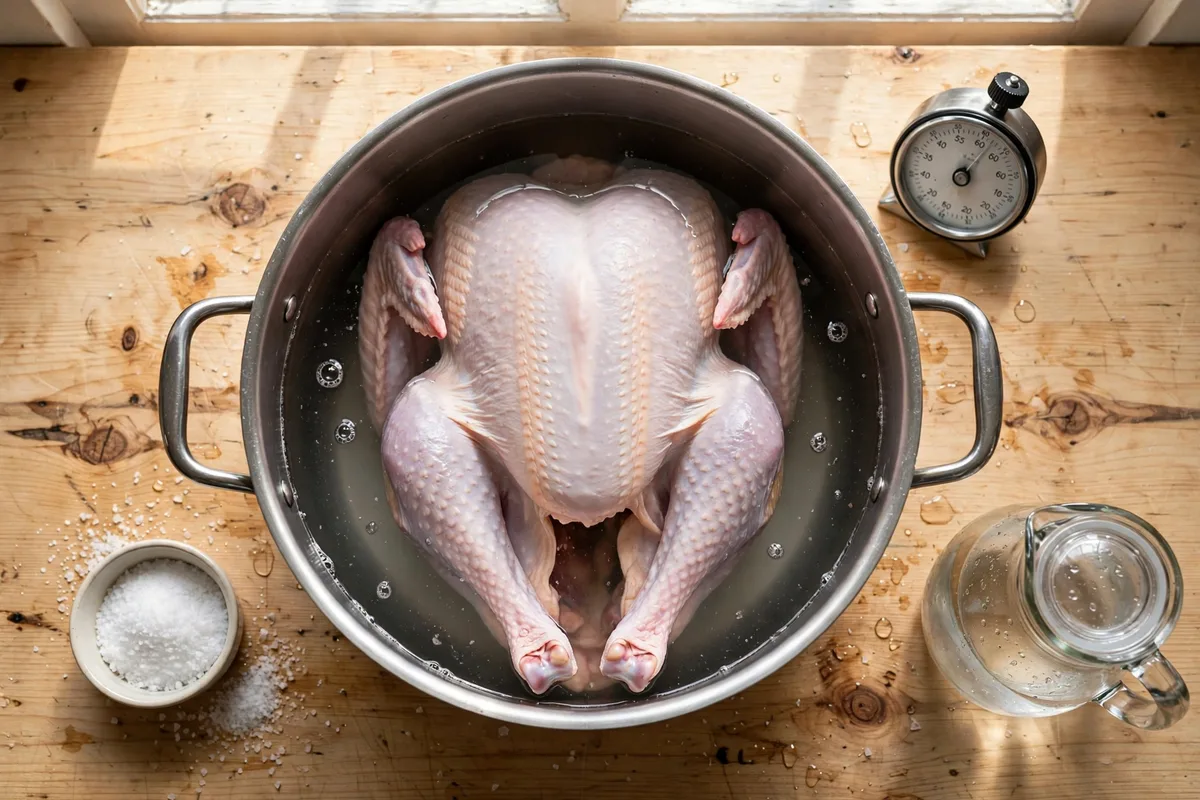
You know the meat should be brined, but you do not know how long to leave it in. This brining time calculator gives you the brining time for chicken, turkey, pork, and beef by cut and weight — so the meat comes out juicy instead of salty.
Free calculator
Use the calculator
Enter your values below, then press Calculate. Your inputs stay in your browser — nothing is sent anywhere.
Result appears in the highlighted box above. The formula used is shown in “How the math works” below, so you can check every answer.
How to use it
- Choose the Meat — chicken pieces, whole chicken, turkey, pork chops, pork loin or roast, or beef roast.
- Enter the Meat weight and choose the Weight unit (kilograms or pounds).
- Press Calculate.
- Read the brining time range in the result box, plus the water needed to cover the meat.
- Put the meat in the chilled brine, keep it refrigerated, and take it out inside the time shown — do not leave it in longer.
Worked example
With the values already filled in on the page — chicken pieces, 1 kg — press Calculate and the calculator returns a brining time of 1–2 hours. That is the exact result the page produces for the default inputs.
To check it by hand: look up chicken pieces in the table below — 1–2 hours — and the water to cover is about 1 liter per kg, so 1 kg needs about 1,000 ml. A 5 kg whole turkey needs 12–24 hours and about 5,000 ml of water to cover it, so start it the day before you cook. If your result differs, re-check that chicken pieces and 1 kg are entered.
How the brining time calculator works
Brining time depends on the cut and its thickness, not on the weight alone: thin pieces brine in 1–2 hours, while a whole turkey needs 12–24 hours. The weight sets the water needed to cover the meat — about 1 liter per kilogram — so measure by covering the meat in the pot, because pot shape changes the exact amount. Do not extend both a strong brine and a long time at once, or the meat can turn salty and ham-like.
| Meat | Brining time | Water to cover (per kg) |
|---|---|---|
| Chicken pieces | 1–2 hours | About 1,000 ml |
| Whole chicken | 8–12 hours | About 1,000 ml |
| Turkey (whole) | 12–24 hours | About 1,000 ml |
| Pork chops | 1–2 hours | About 1,000 ml |
| Pork loin or roast | 4–8 hours | About 1,000 ml |
| Beef roast | 4–8 hours | About 1,000 ml |
Common mistakes
- Brining small pieces overnight. Chicken pieces and pork chops need only 1–2 hours. Overnight makes them salty and ham-like, so take them out inside the time shown.
- Brining at room temperature. Meat in brine must stay refrigerated. Room-temperature brining lets bacteria grow while the meat sits in liquid.
- Reusing brine for a second batch. Used brine has been in contact with raw meat and cannot be made safe for reuse by boiling. Discard it after one use.
- Using too little water to cover the meat. Any part above the brine does not brine at all. Use about 1 liter of water per kilogram of meat and weigh the meat down if it floats.
- Starting a turkey too late. A whole turkey needs 12–24 hours in the brine, so start it the day before you cook, not the morning of.
A note before you start
Use a container that fits the meat snugly so it stays submerged with as little extra water as possible, and weigh the meat down if it floats. Chill the brine fully before adding the meat, and keep the container covered in the fridge for the whole brining time. For the salt and sugar amounts for your brine, use the Meat Brine Calculator.
Frequently asked questions
How long should I brine chicken pieces?
1–2 hours. Longer than that makes them salty, so take them out inside the time the calculator shows.
How long does a whole turkey need in brine?
12–24 hours. Start it the day before you cook, keep it refrigerated the whole time, and take it out before cooking.
Does a heavier piece need a longer brine?
The time depends on the cut and its thickness, not on the weight alone — a 2 kg chicken and a 1 kg chicken both need 8–12 hours. The weight sets the water needed to cover the meat, about 1 liter per kilogram.
Can I brine meat overnight?
A whole chicken (8–12 hours) or a turkey (12–24 hours) can brine overnight in the fridge. Chicken pieces, pork chops, and other thin cuts need only 1–2 hours, so overnight is too long for them.
Why must brining meat stay refrigerated?
Brine is not a preservative at these strengths and times. Refrigeration keeps the meat at a safe temperature while the salt works, which room temperature does not.
Related: Kitchen Tools & Gadgets · Meat Brine Calculator · Roast Turkey Time Calculator · All calculators
Results are estimates for home cooking. Always check food with a thermometer and follow the manufacturer's instructions for your equipment.