Egg Boiling Timer Calculator
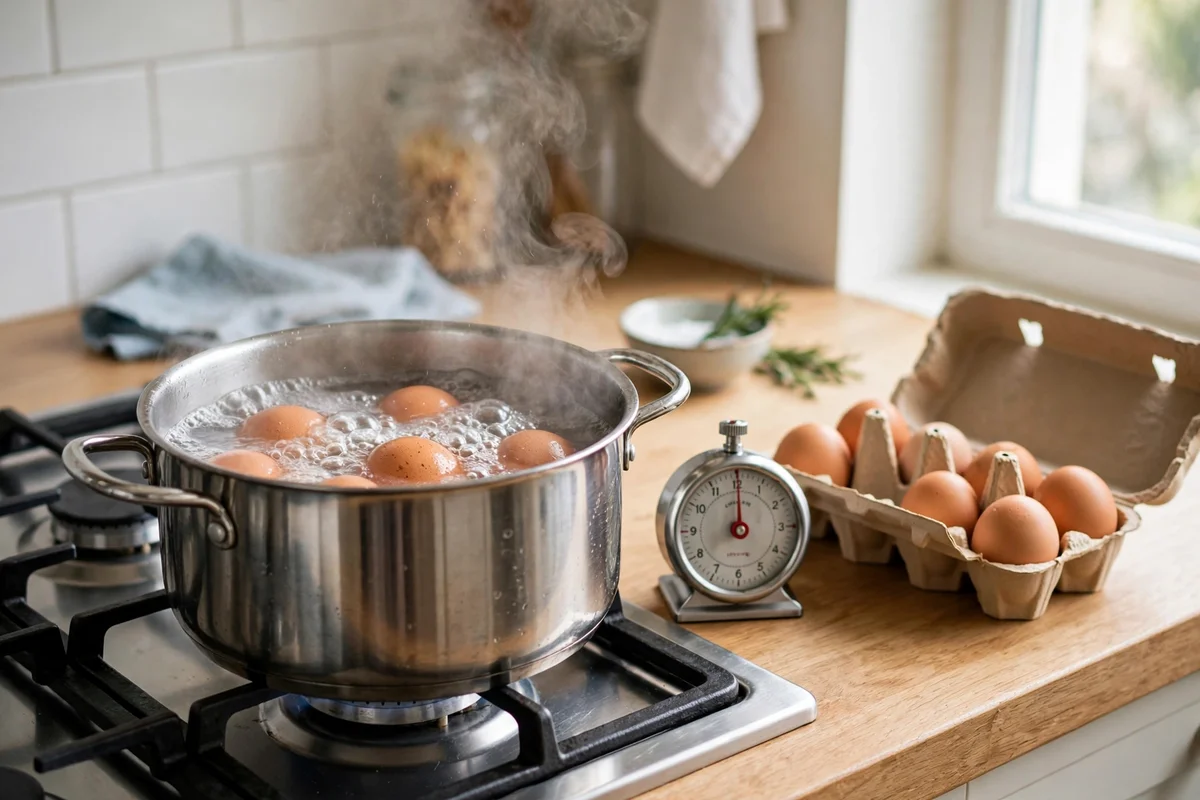
You want a soft, medium, or hard egg, but you do not know how long to boil it, given its size and starting temperature. This Egg Boiling Timer Calculator gives you the minutes for your egg.
Free calculator
Use the calculator
Enter your values below, then press Calculate. Your inputs stay in your browser — nothing is sent anywhere.
Result appears in the highlighted box above. The formula used is shown in “How the math works” below, so you can check every answer.
How to use it
- Choose the egg size from the list — large is already selected as the starting example.
- Choose the starting temperature — from the fridge is already selected.
- Choose the desired doneness — soft is already selected. Then enter the Number of eggs, the Altitude in feet, and choose the Method: from a rolling boil, or a cold start (eggs in cold water, timed from the boil).
- Press Calculate.
- Read the boiling time in minutes shown in the result box, then start timing once the water is at a rolling boil.
Worked example
With the values already filled in on the page — large egg, from the fridge, soft — press Calculate and the calculator returns a boiling time of 6 minutes. That is the exact result the page produces for the default inputs.
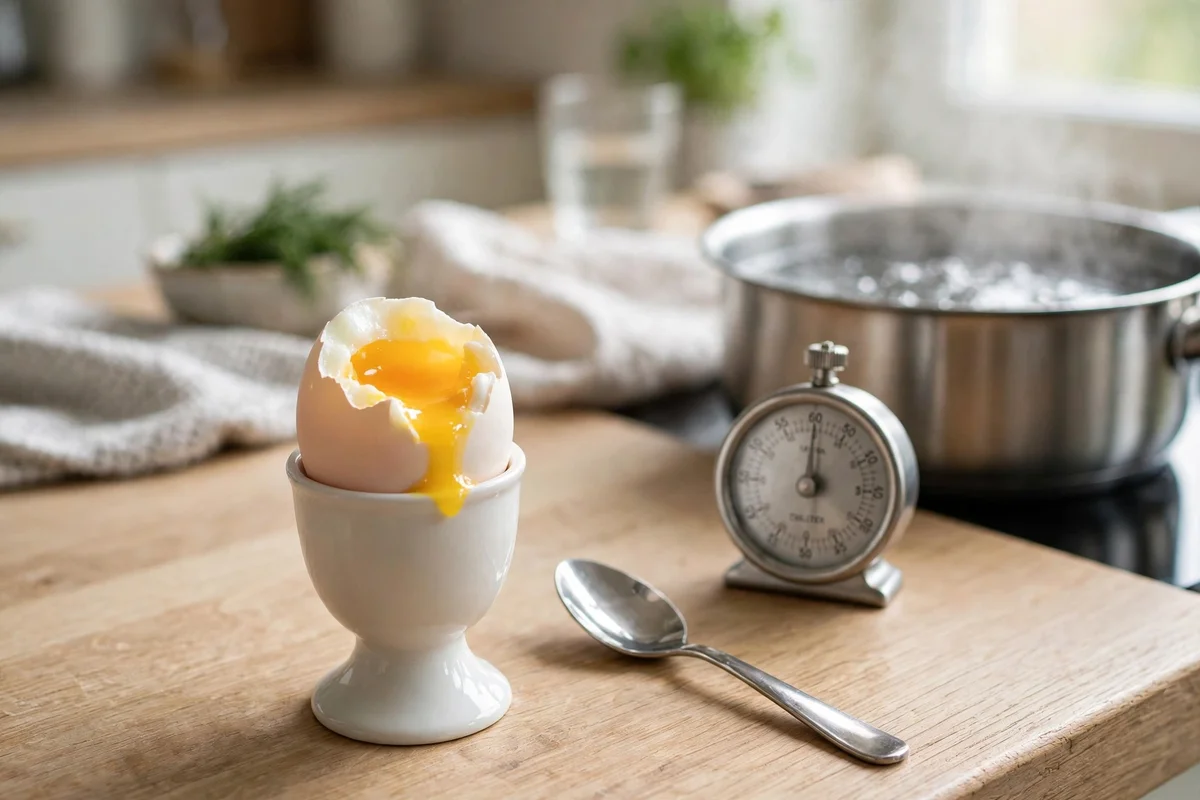
To check it by hand: the base time for a large egg from the fridge at soft doneness is 6 minutes, the size adjustment for large is 0 minutes, and the starting-temperature adjustment for the fridge is 0 minutes, so 6 + 0 + 0 = 6 minutes. If your result differs, re-check that large, fridge, and soft are all selected. With 8 eggs at 5,000 feet, the same soft egg takes 6 + 1 (batch) + 2 (altitude) = 9 minutes.
How the egg boiling timer calculator works
Start with the base time for a large egg from the fridge: soft 6 minutes, medium 8 minutes, hard 10 minutes. Then apply the adjustments: small −1 minute, medium 0 minutes, large 0 minutes, extra-large +1 minute; room temperature −1 minute, fridge 0 minutes. Boiling time = base + size adjustment + starting-temperature adjustment. All times are approximate, because pot size, water volume, and altitude change how fast water returns to the boil. A cold start adds 2 minutes for the water to heat up; timing still starts at the rolling boil.
| Doneness (large, fridge) | Base time |
|---|---|
| Soft | 6 minutes |
| Medium | 8 minutes |
| Hard | 10 minutes |
| Adjustment | Change |
|---|---|
| Small egg | −1 minute |
| Medium or large egg | 0 minutes |
| Extra-large egg | +1 minute |
| Room temperature start | −1 minute |
| Fridge start | 0 minutes |
| 7–12 eggs in one batch | +1 minute |
| Altitude above 3,000 feet | +1 minute per 1,000 feet |
| Cold start (eggs in cold water) | +2 minutes |
Common mistakes
- Starting the timer before the water boils. The times assume a rolling boil, unless you choose the cold-start method, which adds 2 minutes for the heat-up. Timing from cold water without choosing cold start adds unknown minutes and gives a different result every time.
- Using the same time for every egg size. A small egg cooks faster than an extra-large egg. Ignoring size is the fastest way to get a hard egg when you wanted soft.
- Forgetting the starting temperature. A fridge-cold egg needs longer than a room-temperature egg. Using a fridge time for a warm egg overcooks it.
- Leaving eggs in hot water after the timer ends. Eggs keep cooking in hot water. Move them to cold water if you want cooking to stop at the time shown.
- Boiling at a violent rolling boil for the whole time. A very hard boil can crack shells and jostle eggs. A steady, gentle boil is enough once the water is boiling.
A note before you start
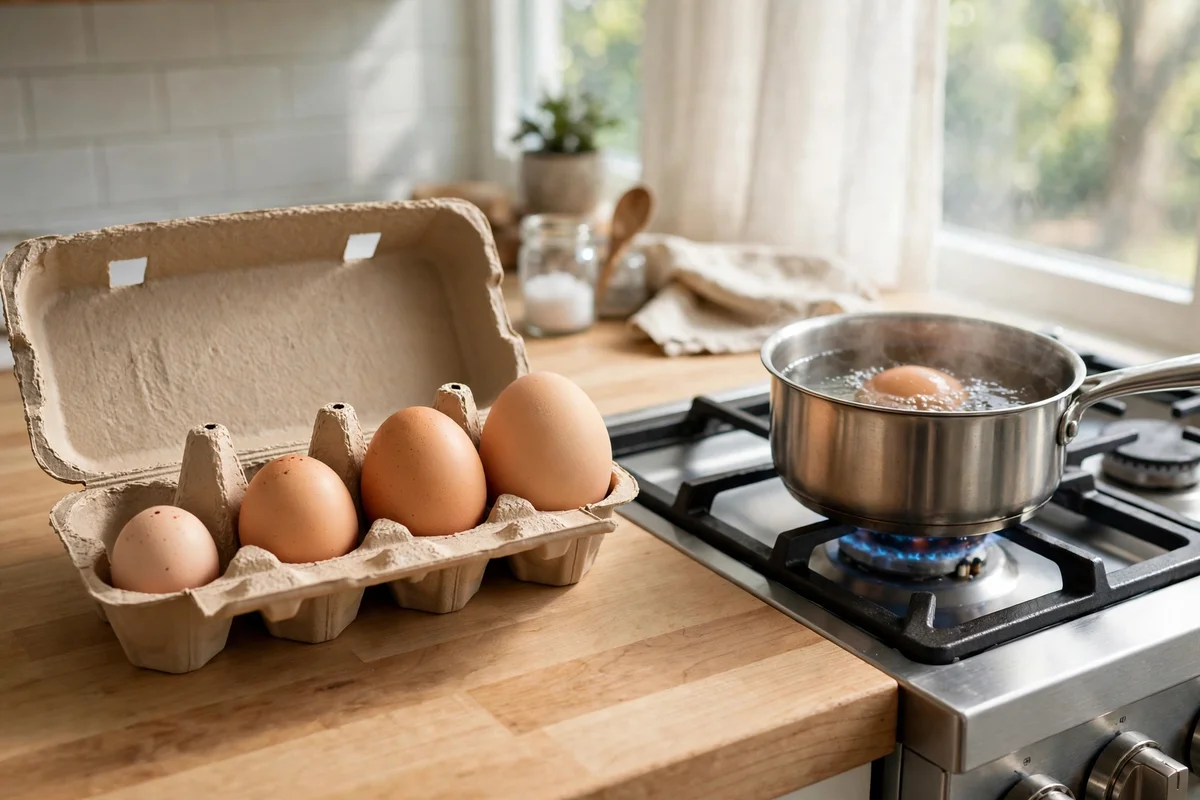
Put eggs in with a spoon so they do not crack on the bottom of the pot, and keep the water deep enough to cover them. If you are cooking several eggs at once, give them room so the water returns to the boil quickly after they go in.
Frequently asked questions
Does the timer start when the eggs go in or when the water boils?
When the water is at a rolling boil. Put the eggs in, wait for the boil to return, then start timing for the minutes shown.
Why does a room-temperature egg need less time?
It starts warmer, so the center reaches the target doneness sooner. The calculator subtracts 1 minute for a room-temperature start for that reason.
What is the difference between soft, medium, and hard here?
Soft means a runny yolk with a set white, medium means a partly set yolk, and hard means a fully set yolk. The base times of 6, 8, and 10 minutes for a large fridge egg mark those three stages.
Should I cool the eggs after boiling?
Yes, briefly, if you want them to stop cooking at the time shown. Cold water stops the cooking and makes peeling easier, especially for hard eggs.
Can I use this timer for very fresh eggs?
Yes, but very fresh eggs can be harder to peel whatever the time. The cooking time does not change, so peel under running water if the shell sticks.
Related: Kitchen Tools & Gadgets · Roast Turkey Time Calculator · Recipe Serving Scaler · All calculators
Results are estimates for home cooking. Always check food with a thermometer and follow the manufacturer's instructions for your equipment.