How to Choose a Kitchen Scale for Beginners

How to choose a kitchen scale for beginners starts with a simple digital scale. It holds up to 5 kilograms, reads in 1 gram steps, and switches between grams and ounces. It has a tare button and a display you can still read when a large bowl sits on top. The tare button is the key skill: place the bowl on the scale, press tare to reset the display to zero, then add flour until the display shows the weight you need, with no mental subtraction and no extra bowls to wash. A scale with those features, and no extra apps or modes you will not use, will make your baking more consistent from the first week.
Short answer: if you want our pick, start with the Etekcity 11lb in our best food scale for beginners guide — it reads in 1 gram steps, holds 11 lb (5 kg), and keeps the tare-first method simple. The rest of this guide shows you how to test any scale the same way before you buy.
How to choose a kitchen scale for beginners — why does weighing beat measuring with cups for a beginner?
Cups measure volume, which changes with how you scoop, how packed the ingredient is, and how humid the day is, while a scale measures weight, which stays the same however you add the ingredient. One cup of flour can weigh noticeably more or less depending on whether you scoop it straight from the bag or spoon it lightly into the cup and level it off. That difference can make a dough too dry or too wet. A scale removes that variation: 250 grams of flour is 250 grams however you pour it, and you can add several ingredients to one bowl, pressing tare between each one, without washing extra measuring cups. That is why many baking recipes now list weights alongside cups, and why a scale is often the first tool that makes a beginner's baking repeatable, rather than a matter of luck on the day.
Step by step: choose a scale with a tare-first flour test
Use this worked example: you want to weigh 250 grams of flour in one large mixing bowl, then add 150 grams of sugar to the same bowl without washing anything in between. Follow the steps with that example in mind, and you will test the scale the way you will actually use it.
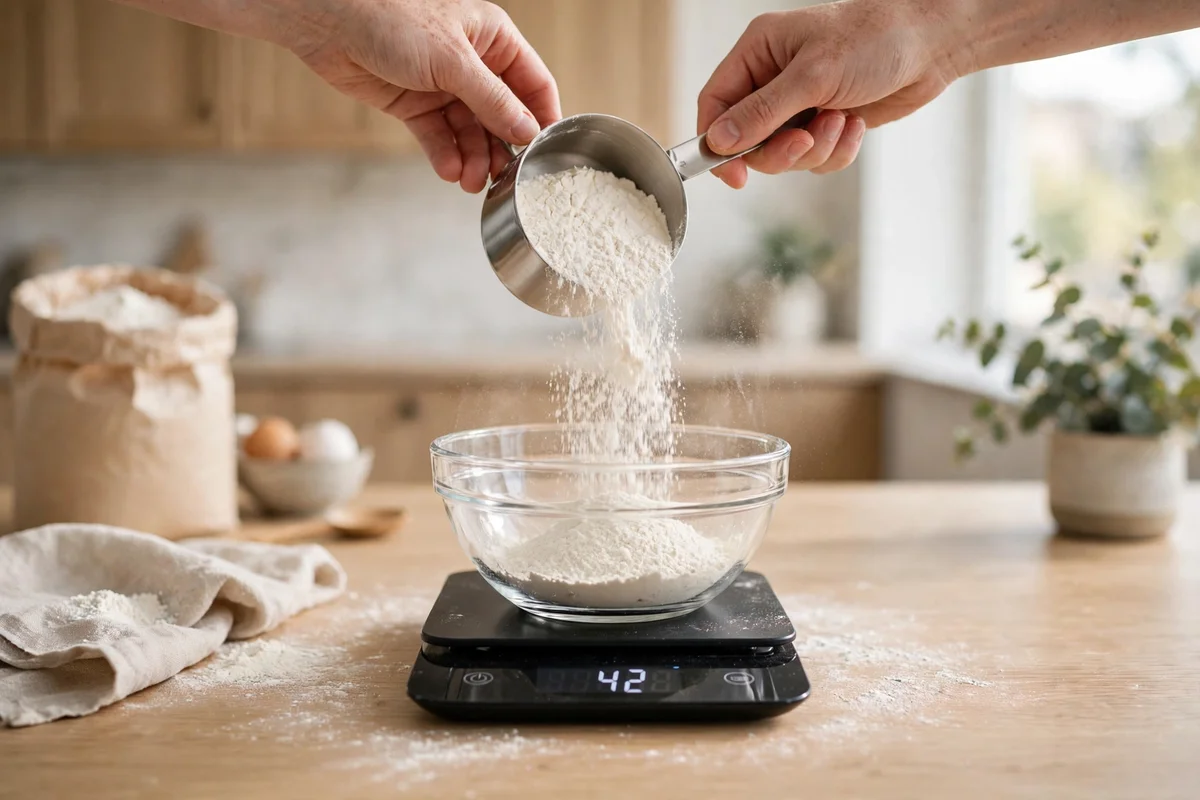
- Start with the starter spec: 5 kilograms capacity and 1 gram steps. Look for a scale that holds up to 5 kilograms, which is about 11 pounds, and that reads in 1 gram steps, because that combination handles a large bowl of bread dough and still measures small amounts such as yeast or salt usefully. A scale with a much smaller capacity, such as 2 kilograms, may overload when a heavy bowl plus dough goes on top, and a scale that only reads in 5 gram steps is too coarse for small baking amounts. Check the label for both numbers: capacity is the total load including the bowl, not just the ingredient, and the step size is the smallest change the display shows. A 5 kilogram and 1 gram scale is the standard beginner recommendation, and it is enough for most home baking and cooking without paying for laboratory precision you will not use.
- Test the tare button with a bowl, then with flour, then with sugar. Place your largest mixing bowl on the scale, press the tare or zero button, and check that the display reads zero with the bowl still on top. Add flour slowly until the display shows 250 grams, then press tare again, and check that the display returns to zero with the flour still in the bowl. Add sugar until the display shows 150 grams, which means you have added 150 grams of sugar to the 250 grams of flour, in one bowl, with no subtraction and no second bowl to wash. If the tare button is hard to find, slow to respond, or hidden under the bowl, the scale will frustrate you every time you bake, because tare is the button you will press more than any other.
- Check that the display stays visible under your largest bowl. Place your largest bowl on the scale, filled with flour to stand in for a real bake, and stand where you normally stand to cook, looking down at the display as you would while pouring. The numbers should be large, clear, and not hidden behind the bowl's edge, because a display that disappears under a wide bowl forces you to lift the bowl to check the weight, which spills flour and breaks your flow. Some scales solve this with a pull-out display that slides out from under the bowl, or with a display set at an angle, while others place the display too close to the platform. If you cannot read the display with your largest bowl on the scale, choose a different scale, even if the rest of its features look good, because an unreadable display defeats the purpose of weighing.
- Check grams and ounces, and ignore modes you will not use. Press the unit button and check that the scale switches between grams and ounces easily, because many recipes list one or the other, and a scale that only shows grams will force you to convert every ounce recipe by hand. Check that the unit button is easy to find and does not change the unit accidentally when you press tare, because an accidental switch from grams to ounces mid-recipe can ruin a bake. Ignore extra modes you will not use as a beginner, such as milk volume modes, calorie counting, or phone apps, because they add buttons and confusion without improving your baking. A scale with three clear buttons, for power, tare, and units, is easier to learn and harder to use wrong than a scale with a dozen small, unlabeled buttons.
- Check the platform size, the buttons, and the power source together. Place your largest bowl on the platform and check that the bowl sits stable without wobbling over the edges, because a platform that is too small for a wide bowl makes the bowl tip when you pour. Press each button with floury or damp hands, as you will in real baking, and check that the buttons respond clearly and do not stick. Check the power source: replaceable batteries are easy to swap at once, while rechargeable scales need charging and can run out mid-bake if you forget to charge them. Check the auto-off time as well: a scale that turns off after 30 seconds can lose your place during a slow recipe, while one that stays on for several minutes is more forgiving for a beginner.
- Check cleaning and storage, before you buy. Look at the top surface: a flat, smooth top wipes clean easily, while a top with grooves, seams, or a raised lip traps flour and sugar in corners that are hard to clean. Check whether the maker says the scale can be wiped with a damp cloth, and never submerge a scale in water or run it under a faucet unless the maker explicitly says it is waterproof, because water damages the electronics inside. Measure the spot where you will store the scale, and check that it fits in a drawer or on a shelf without the platform being crushed by other items. A scale that is easy to clean and easy to store will be used often, while one that is awkward to clean will be left in a cabinet after the first messy bake.
- Weigh three real recipes in the first week, and keep notes. In the first week, weigh flour for pancakes, sugar for cookies, and dough for bread, using the tare method each time, and note after each recipe whether the display stayed visible, whether tare worked smoothly, whether the scale stayed stable under the bowl, and whether cleanup was easy. If the display hid under the bowl, if tare was slow, or if the scale turned off mid-recipe, those are real problems, not minor annoyances, and they will affect every bake. A scale that passes three real recipes, with your bowls and your recipes, is the right scale for you, and it is worth keeping, even if a different scale looks better on a shelf.
Kitchen scale choices for a beginner
| Feature | Starter choice | Why it matters | Watch out for |
|---|---|---|---|
| Capacity | 5 kilograms (11 pounds) | Handles a heavy bowl plus dough | Overloading a small scale damages it |
| Step size | 1 gram | Measures yeast and salt usefully | 5 gram steps are too coarse for small amounts |
| Display | Large, visible under a large bowl | You can read it while pouring | A display hidden behind a wide bowl |
| Tare button | Large, easy to find, fast | Lets you add ingredients to one bowl | A slow or hidden tare button |
| Units | Grams and ounces | Covers most recipes | Accidental unit switches mid-recipe |
| Extra modes | None needed to start | Fewer buttons, fewer mistakes | Apps and modes you will not use |
What you need — and what to skip
You need a digital scale with 5 kilogram capacity, 1 gram steps, grams and ounces, a clear tare button, and a display you can read under your largest bowl. A flat, wipe-clean top, spare batteries or a charging cable, and a storage spot where the platform will not be crushed complete the setup. You do not need a pocket scale for spices, a phone app, or a scale with dozens of modes to start: one simple, readable scale covers most beginner baking and cooking.
Skip an analog scale if you want precise gram readings, because analog dials are harder to read to 1 gram, and skip a scale with no tare button, because tare is essential for weighing in one bowl. Skip a scale whose display hides under your largest bowl, skip a scale that turns off after a very short time, and skip paying extra for apps, calorie modes, or milk volume modes you will not use as a beginner. Skip submerging any scale in water, unless the maker explicitly says it is waterproof.
6 mistakes beginners make — and how to fix them
- Weighing without tare, then doing mental subtraction for every ingredient. Fix: place the bowl on the scale, press tare to zero, add the ingredient, press tare again, and add the next ingredient. One bowl, no subtraction, no extra washing.
- Forgetting that capacity includes the bowl, then overloading the scale. Fix: remember that 5 kilograms is the total load, bowl plus food. A heavy bowl plus a large dough can overload a small scale, so check the total, not just the ingredient weight.
- Choosing a scale whose display hides under a large bowl. Fix: test the scale with your largest bowl before you buy, standing where you normally cook. If you cannot read the numbers while pouring, choose a scale with a pull-out or angled display.
- Accidentally switching units mid-recipe, from grams to ounces. Fix: check the unit before you start, and choose a scale where the unit button is separate from tare and hard to press by accident. If the display suddenly looks wrong, check the unit first.
- Using cups for flour because the scale feels slower at first. Fix: practice the tare method with flour for one week. Weighing becomes faster than cup measuring once the habit forms, and it gives more consistent results every time.
- Washing a scale under running water. Fix: wipe the top with a damp cloth and dry it, and never submerge a scale unless the maker explicitly says it is waterproof. Water damages the electronics and can ruin an otherwise good scale.
When to stop — safety note
Stop using a scale at once if it gives wildly different readings for the same bowl, if the display flickers or goes blank under a normal load, or if it has been dropped or soaked in water. An unreliable scale can ruin a recipe, and a water-damaged scale can be unsafe. Never exceed the maximum capacity, because overloading can permanently damage the scale's sensors, and never place a very hot bowl or pan directly on the scale, which can damage the platform and affect readings. Keep the scale dry, store it where it will not be crushed, and remove batteries if you will not use it for a long time, to prevent leakage. If the scale turns off mid-recipe and loses your place, check the auto-off setting and the batteries before assuming the recipe is wrong.
Related on Kitchenlify
- Kitchen Tools & Gadgets
- Cups to Grams Converter
- Cooking Measurement Converter
- How to Choose Mixing Bowl Sizes for Beginners
- All guides
Frequently asked questions
What kitchen scale should a beginner buy?
A simple digital scale with 5 kilograms capacity, 1 gram steps, grams and ounces, a clear tare button, and a display you can read under a large bowl. That combination handles most home baking and cooking, from flour for pancakes to dough for bread, without extra modes or apps you will not use.
What does the tare button do on a kitchen scale?
The tare button resets the display to zero with a bowl or container already on the scale, so the weight shown is only the ingredient you add next. Place the bowl on the scale, press tare, add flour to the weight you need, press tare again, and add the next ingredient to the same bowl, with no subtraction and no extra bowls to wash.
Is a 5 kg kitchen scale enough for a beginner?
Yes, for most home baking and cooking. Five kilograms, about 11 pounds, covers a large bowl plus bread dough, a batch of cookies, or a family meal's ingredients. Remember that capacity includes the bowl, so a heavy bowl plus a very large dough can approach the limit, but for everyday baking, 5 kilograms is plenty.
Do I need 1 gram accuracy on a kitchen scale?
A 1 gram step size is a good starter spec, because it lets you measure small amounts such as yeast, salt, and baking powder usefully, while still handling large amounts such as flour and dough. A scale that only reads in 5 gram steps is too coarse for small baking amounts, while a scale that reads to 0.1 grams is more precision than most beginners need.
Why can I not read the display when a large bowl is on the scale?
Many scales place the display too close to the platform, so a wide bowl covers it. Test the scale with your largest bowl before you buy, standing where you normally cook. If the display hides, choose a scale with a pull-out display, an angled display, or a larger platform that leaves the numbers visible.
Should I buy a digital or an analog kitchen scale?
Digital is better for most beginners, because it reads in grams and ounces clearly, has a tare button, and shows 1 gram steps easily. Analog scales use a dial and a spring, which are harder to read precisely, and they usually have no tare button. If you already own an analog scale, it can still work for rough cooking, but digital is better for baking.
Can I weigh liquids on a kitchen scale?
Yes, for most cooking, because 1 milliliter of water weighs 1 gram, so grams work well for water and similar liquids. For other liquids, such as oil or milk, weight and volume differ, so follow the recipe's weight if it gives one, or use a measuring jug for volume if the recipe lists milliliters. Do not assume every liquid weighs the same as water.
How do I clean a kitchen scale?
Wipe the top with a damp cloth after use, and dry it fully. Never submerge a scale in water or run it under a faucet, unless the maker explicitly says it is waterproof, because water damages the electronics. Keep flour and sugar out of the buttons and joints, and store the scale where the platform will not be crushed.
Why does my scale turn off in the middle of a recipe?
Most scales have an auto-off feature to save batteries, and some turn off after a very short time, such as 30 seconds, which can lose your place during a slow recipe. Check the auto-off time before you buy, and choose a scale that stays on for several minutes. If your scale already turns off quickly, work faster, or press a button gently to wake it, then re-tare if needed.
How do I check if my scale is accurate?
Weigh something with a known weight, such as an unopened bag of sugar or flour, or a nickel, which weighs 5 grams. If the reading is off by more than a gram or two, change the batteries and try again on a flat, hard surface, and replace the scale if it still reads wrong.
What about auto-off and maximum capacity?
Most kitchen scales switch off after a minute or two with no change, which can interrupt a slow recipe, so tare and work steadily, and tap the scale to wake it if it sleeps. Check the maximum capacity before you buy — a 5-kilogram scale covers most home baking, but a heavy bowl plus ingredients can reach the limit on a smaller scale.