How to Choose Baking Dish Size for Beginners
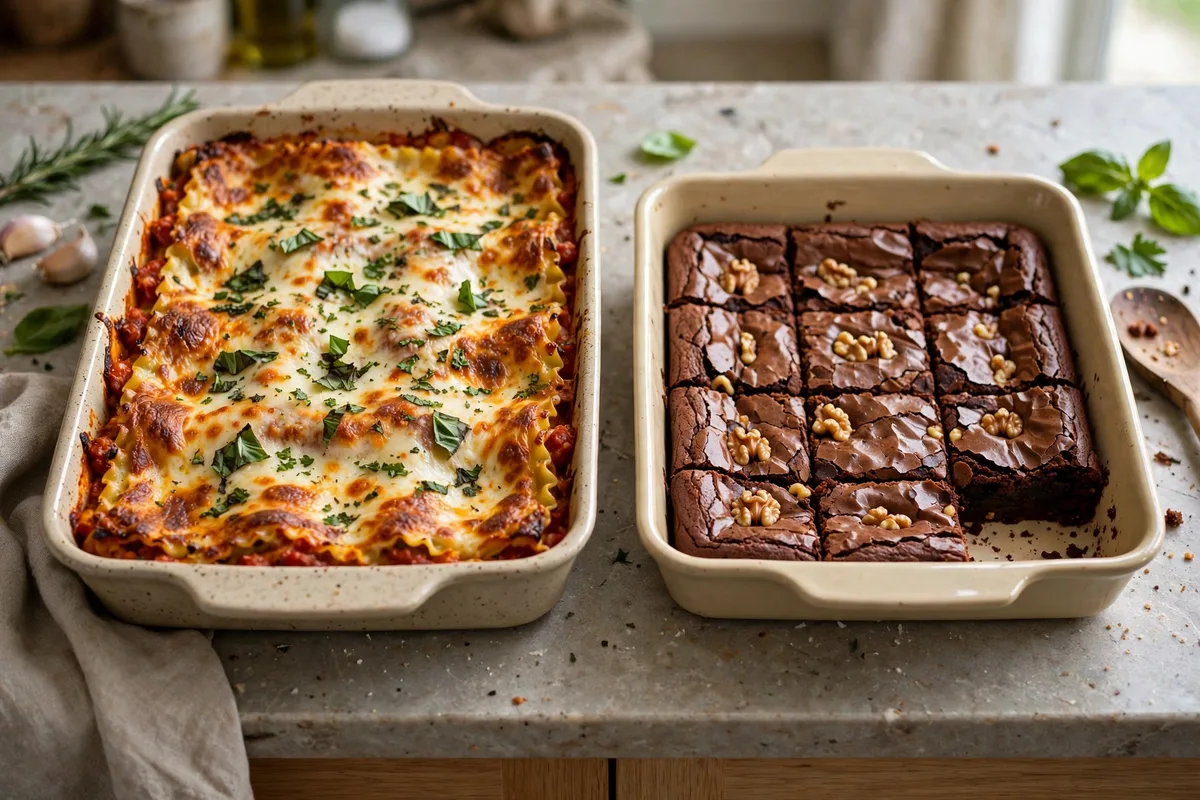
How to choose baking dish size for beginners? Match the dish to the recipe's volume, not just its shape. A 9x13-inch dish holds about 14 cups and feeds 8 to 12 people as a main dish, while an 8x8-inch dish holds about 8 cups and feeds 4 to 6. Start with the recipe's pan size, check the capacity in cups, and make sure the dish fits your oven. The wrong size is why cakes sink in the middle or spill over the sides: too big and the batter spreads thin and dries out, too small and the center stays raw while the edges burn.
how to choose baking dish size for beginners — what is the short answer?
Most home cooks think in dimensions like 8x8 or 9x13, but baking authorities stress that capacity matters just as much as size — a dish's volume in cups is what decides whether a recipe fits. A larger dish spreads batter thin, so it cooks faster and often drier; a smaller dish piles it deep, so the center stays raw while the edges race ahead. That is how to choose baking dish size for beginners step by step in one paragraph. Read the recipe's pan size, check the capacity, and match the volume. It is also the answer to what size baking dish do I need: a 9x13-inch dish is the single most useful size for family cooking.
How do I do it step by step?

- Read the recipe's pan size first. Recipes usually tell you what size pan to use for a reason: recipe developers test their creations multiple times with specific pans, so following their lead is your safest bet. If the recipe calls for a 9x13 dish and you only have an 8x8, you can use the smaller dish, but you risk spillage and undercooked food — so start with the recipe, not with the dish you happen to own.
- Check the capacity in cups. Capacity is the number that decides whether a recipe fits. At a standard depth of about 2 inches, an 8x8-inch square holds 8 cups, a 9x9-inch square holds 10 cups, a 9x13-inch rectangle holds 14 cups, and a 9-inch round holds 8 cups. Casserole dishes are sold by volume instead: a small dish is 1 to 1.5 quarts (4 to 6 cups), a medium dish is 2 quarts (8 cups), and a large dish is 3 quarts (12 cups).
- Match the volume when you swap. The golden rule of swapping pans is to match the volume — and, ideally, the surface area — as closely as you can. An 8x8-inch square is about the same as a 9-inch round (both about 8 cups), a 9x13-inch dish is about the same as two 8-inch or 9-inch round pans, and a 2-quart dish is about the same as an 8x8-inch pan. If you cannot match the area exactly, keep the batter depth similar to the original and adjust the bake time: thinner bakes finish faster, deeper ones take longer.
- Count the servings you need. A 9x13-inch casserole usually feeds 8 to 12 people as a main dish or 12 to 20 as a side. An 8x8-inch dish feeds 4 to 6 as a main or 8 to 12 as a side, while a 9x9-inch dish feeds about 6 to 8 as a main. Those are planning ranges, not promises printed into the pan — but they are the fastest way to pick a size for the people you are actually feeding.
- Check the depth and the oven. A cake meant for a 2-inch deep pan will spill over in a 1-inch pan, and bread may not rise properly in a pan that is too deep. Measure across the inside edges, not the outside, so the rim thickness does not throw off your reading — and to find the true capacity, fill the dish to the brim with water using a measuring cup. Then check that the dish fits your oven, remembering that the handles take up space too.
- Remember the material. Material changes the outcome as much as size does. Metal heats fast and gives crisp, even edges, dark metal browns most aggressively, and ceramic and glass heat slowly but hold that heat long after the oven is off. When a recipe calls for a metal pan and you are using glass, lower the oven temperature by 25 degrees Fahrenheit — glass keeps conducting heat well past the timer, so without that drop your edges can overbake before the center is set.
- Fill it no more than two-thirds full. Fill baking dishes no more than two-thirds full for batters that rise a lot, or up to three-quarters full for steadier dishes, so there is room to grow without spilling. A dish more than three-quarters full may take longer to cook, come out raw in the middle, or bubble over — and an oversized dish for a small casserole will dry the food out or burn the edges.
What mistakes should I avoid?

- Using a dish too big for the recipe. A larger dish spreads the batter thin, so it cooks faster and often dries out, and a casserole in an oversized dish dries on the edges before the center cooks through. Fix: match the dish to the recipe's volume in cups, not just its shape.
- Using a dish too small for the recipe. A smaller dish piles the batter deep, so the center stays raw while the edges race ahead — and a dish that is too small can overflow, spilling batter into the oven. Fix: if the recipe calls for a 9x13 and you only have an 8x8, halve the recipe or split it across two dishes.
- Measuring the outside edges. The outside measurement includes the rim thickness, so it overstates the space the food actually gets. Fix: measure across the inside edges, and find the true capacity by filling the dish to the brim with water from a measuring cup.
- Ignoring the material. Glass and ceramic hold heat long after the oven is off, so a recipe written for metal overbakes at the edges in glass. Fix: lower the oven temperature by 25 degrees Fahrenheit when you use glass for a recipe written for metal.
- Filling the dish to the brim. A batter that rises has nowhere to go in a full dish, so it spills over the rim and burns on the oven floor. Fix: fill no more than two-thirds full for batters that rise a lot, or up to three-quarters for steadier dishes.
- Forgetting the oven fit. A giant dish looks great in the store and is useless if it will not fit in your oven — and the handles take up space too. Fix: measure your oven space before you buy, and remember that a dish that fits only by shuffling racks is a dish you will dread using.
What do I need, and what should I skip?
You need the recipe's pan size, written down; a measuring cup for checking capacity; a tape measure for inside edges and oven space; one 9x13-inch dish and one 8-inch square dish as the starter pair; a toothpick for checking doneness, not just the clock.
Skip using a dish too big, so the bake dries out. Skip using a dish too small, so it overflows. Skip measuring the outside edges instead of the inside. Skip ignoring the material — glass needs a 25 degree drop. Skip filling the dish to the brim. Skip forgetting to check the oven fit.
Baking dish sizes explained 9x13 vs 8x8 — which dish wins?
| Dish | Holds | Serves (main) |
|---|---|---|
| 8x8 inch square | 8 cups | 4 to 6 people |
| 9x9 inch square | 10 cups | 6 to 8 people |
| 9x13 inch rectangle | 14 cups | 8 to 12 people |
| 9-inch round | 8 cups | 4 to 6 people |
| 2-quart casserole | 8 cups | 4 to 6 people |
What does the worked example look like?
Worked example: halving a 9x13 recipe, and splitting a lasagna. Say a lasagna recipe fills a 9x13-inch dish, which holds 14 cups. Halve the recipe and you have 7 cups of filling — 14 divided by 2 is 7 — and an 8x8-inch dish holds 8 cups, so the halved recipe fits with 1 cup to spare: 8 minus 7 is 1. Or keep the full recipe and split it across two 8x8 dishes: two 8x8 dishes give 128 square inches of surface (64 plus 64), against 117 square inches for the 9x13, so the two smaller dishes hold the same lasagna — one to eat tonight, one to freeze. And for servings: a 9x13 feeds 8 to 12 as a main, while one 8x8 feeds 4 to 6 — so for 10 people, one 9x13 covers it, or two 8x8 dishes cover 8 to 12 between them. Our best ceramic baking dish set guide lists the exact sizes each top set includes, so you can match a set to the recipes you cook most.
When should I stop?
Stop baking a recipe in a dish that is clearly too small the moment batter rises over the rim — a spill in the oven burns, smokes, and can set off the smoke alarm, so move the batter to a bigger dish before it goes in. Stop using a glass dish at the same temperature as a metal recipe without the 25 degree drop: glass keeps conducting heat after the timer, and the edges overbake before the center sets. And stop filling a dish to the brim with a batter that rises — two-thirds full is the limit, or it will spill.
What is the quick checklist?
- Recipe's pan size read and written down.
- Capacity checked in cups — 8x8 is 8, 9x9 is 10, 9x13 is 14.
- Swap matched by volume — 8x8 is about a 9-inch round.
- Servings counted — 9x13 feeds 8 to 12 as a main.
- Inside edges measured, oven fit checked with handles.
- Filled no more than two-thirds full for rising batters.
What else helps on Kitchenlify?
- Ceramic vs Stainless Steel Baking Dish for Beginners
- How to Organize Baking Supplies in a Small Kitchen
- Why Did My Cake Sink in the Middle
- How to Choose a Cookware Set for Beginner's Guide
- All guides
If the recipe names a pan size you do not own, the Baking Pan Size Converter works out the swap for the pan you have.
Frequently asked questions
How to choose baking dish size for beginners step by step?
Read the recipe's pan size first, check the capacity in cups, match the volume when you swap, count the servings you need, check the depth and the oven fit, remember the material, and fill no more than two-thirds full. That is how to choose baking dish size for beginners step by step — and the short version is match the dish to the recipe's volume, not just its shape.
What size baking dish do I need?
For most family cooking, a 9x13-inch dish: it holds about 14 cups, feeds 8 to 12 people as a main dish, and is the size most recipes call for. What size baking dish do I need for smaller bakes is a different answer — an 8x8-inch dish holds 8 cups and feeds 4 to 6 — so the starter pair is one 9x13 and one 8-inch square.
Baking dish sizes explained 9x13 vs 8x8 — which is bigger?
The 9x13 is much bigger: it has 117 square inches of surface against 64 for the 8x8, and holds about 14 cups against 8 cups — almost double. Baking dish sizes explained 9x13 vs 8x8 comes down to this: the 9x13 feeds 8 to 12 as a main, the 8x8 feeds 4 to 6, and a 9x13 recipe halves neatly into an 8x8 with 1 cup to spare.
How many people does a 9x13 casserole feed?
A 9x13-inch casserole usually feeds 8 to 12 people as a main dish, or 12 to 20 people as a side dish. Cut into a 3-by-4 grid it gives 12 pieces, which is why it is the standard for family meals and potlucks — and if you need more, a second 9x13 is the answer, not a deeper dish.
Can I use an 8x8 pan instead of a 9x13?
Yes, if you halve the recipe: a 9x13 holds about 14 cups and an 8x8 holds about 8 cups, so half a 9x13 recipe is 7 cups, which fits the 8x8 with 1 cup to spare. Or split the full recipe across two 8x8 dishes — two 8x8s give 128 square inches against 117 for the 9x13 — one to eat tonight and one to freeze. Do not pour a full 9x13 recipe into one 8x8: it will overflow.
How do I measure a baking dish?
Measure across the inside edges, not the outside, so the rim thickness does not throw off your reading. To find the true capacity, fill the dish to the brim with water using a measuring cup and count the cups — that number is what really matters when you are swapping pans, because brands label the same dimensions with different capacities.
Should I lower the temperature for a glass baking dish?
Yes, by 25 degrees Fahrenheit, when the recipe calls for a metal pan. Glass and ceramic heat slowly but hold that heat long after the oven is off, so without the drop your edges can overbake before the center is set. Metal heats fast and gives crisp, even edges, while dark metal browns most aggressively of all.
How full should I fill a baking dish?
No more than two-thirds full for batters that rise a lot, or up to three-quarters full for steadier dishes like casseroles. A dish more than three-quarters full may take longer to cook, come out raw in the middle, or bubble over — and for cakes, never fill more than two-thirds, or the rise has nowhere to go.
What is the most versatile baking dish size?
The 9x13-inch rectangle: it is the workhorse of family cooking, the single most-used size for casseroles, lasagna, baked pasta, and sheet cakes, and the size most recipes call for. Pair it with an 8-inch square dish for brownies, small casseroles, and half recipes, and those two dishes cover about 90 percent of the recipes you will come across.