How to Choose a Food Storage Container Size for Your Shelf
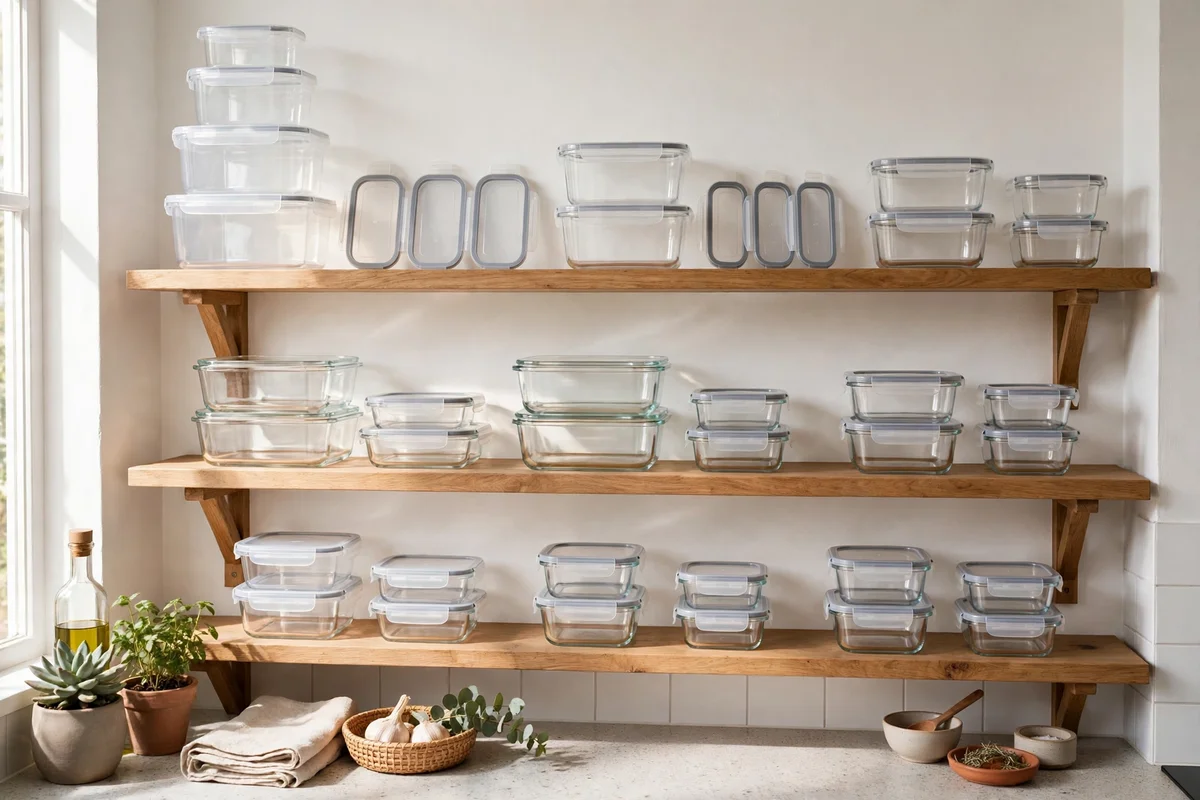
How to choose a food storage container size for your shelf starts with the shelf, not the food: a container that looks right in your hand can still be wrong for your shelf — too deep, and the door will not close; too tall, and it will not slide under the shelf above; too wide, and you lose the whole row to one box. Choosing by shelf measurements first, rather than by how much food a container claims to hold, saves you from a cupboard full of boxes that never quite fit. This guide walks you through measuring your shelf, reading container sizes honestly, and picking shapes that actually stack and slide in a real kitchen.
The short answer: how to choose a food storage container size for your shelf
Measure your shelf before you buy anything. Write down the usable depth, the clear height between shelves, and the width you can spare, then subtract a small clearance gap for lids and for your fingers. A container only fits if its footprint, including its lid, sits inside those three numbers with room to slide in and out. Capacity on the label matters less than these measurements, because a tall, narrow container and a short, wide one can hold the same amount of food while fitting completely different shelves.
Worked example: pass or fail on the same shelf
Use the shelf from the worked example in this guide: 11.5 inches deep, 10 inches of clear height, and 18 inches of width. After the clearances, the limits are 11 inches of usable depth and 9 inches for the container plus its lid. Now test three containers against those two numbers, lid on, at their widest point, including any latch or clip that sticks out at the sides.
Container A, 10 inches deep and 8.5 inches tall with its lid, passes. It leaves 1 inch of depth spare and 1.5 inches of lift room above the lid, so the lid can come straight off without hitting the shelf above. Container B, 11 inches deep and 9.5 inches tall with its lid, fails on height. It fits the depth, but only 0.5 inch of lift room remains, so the lid cannot be lifted off in place. Container C, 12 inches deep and 8 inches tall with its lid, fails on depth. It is short enough, but it sticks out past the front edge or presses against the back wall, and the door may not close. A container must pass both numbers to pass at all.
Then run the fit-through-opening check, which is a different test from fitting on the shelf. Measure the cabinet opening itself, including the door frame and any lip, and compare the container against it. A wide container can fit a deep shelf and still be too wide to pass through the opening, and a tall container can fit the height once inside and still catch on the frame on the way in. If it cannot pass through the opening, it does not fit, no matter what the shelf numbers say. Measure the widest point with the lid clipped on, because latch and lid projection are part of the container, not an extra.
| Shelf band | Buy a container no larger than | Best shape for this band |
|---|---|---|
| Shallow and low: usable depth under 10 inches, clear height under 8 inches | Under 10 inches deep, under 7 inches tall with the lid, keeping 1 inch of lift room | Short and wide, so food can be spooned out without lifting the container out |
| Medium: usable depth 10 to 12 inches, clear height 8 to 10 inches | Within the measured depth and at least 1 inch below the clear height, lid included | Rectangular, for neat rows and stable stacking |
| Deep and tall: usable depth over 12 inches, clear height over 10 inches | Within the measured depth and at least 1 inch below the clear height, lid included | Tall and narrow for liquids, or stacked medium containers for leftovers |
Buying by capacity alone fails this test, because two containers with the same capacity can have completely different footprints. Always leave grasp room at the sides as well: a row packed edge to edge may look neat, but you cannot grip one container without dragging its neighbors out with it.
Step by step
- Measure the usable shelf depth. Measure from the front edge of the shelf to the back wall, then subtract about half an inch so the container does not press against the back or stick out past the front. Do this on every shelf you plan to use, because shelves in the same cabinet are not always the same depth. Write the smallest depth down, not the largest, since the smallest shelf decides what fits everywhere. If a shelf has a lip or a raised front edge, measure from the inside of that lip, because that is the space you can actually use.
- Measure the clear height between shelves. Measure from the top of one shelf to the underside of the shelf above it, at the spot where the container will sit. Shelves can sag slightly in the middle, so measure near the front and near the back and use the smaller number. This clear height is your hard limit. A container that is exactly the same height as the gap will jam, so you need clearance on top of it, which the next step covers.
- Add lid-lift and finger clearance. A container needs more than its own height. If the lid lifts off, you need room above it to lift the lid straight up without hitting the shelf above. If the lid snaps on from the side, you need room at the sides for your fingers. As a practical rule, leave at least one inch of clear space above a lidded container and about half an inch on each side. Without that gap, you will have to pull the whole container out just to open it, which defeats the purpose of neat shelf storage.
- Work through a worked example before you shop. Take a real shelf as an example. Suppose your shelf measures 11.5 inches deep, 10 inches of clear height, and 18 inches of width that you are willing to give to containers. Subtract half an inch from the depth, leaving 11 inches of usable depth. Subtract one inch of lid clearance from the height, leaving 9 inches for the container and lid together. That means any container deeper than 11 inches or taller than 9 inches, lid included, will not work on this shelf, no matter how good its capacity looks on the label. Within those limits, two containers 8 inches wide each would fill 16 inches of the 18-inch width and leave a finger gap at each side, while three containers 5.5 inches wide would fill 16.5 inches and give you a separate box for each kind of leftover. Running these numbers first turns a vague shopping trip into a short list of sizes that will actually fit.
- Match the shape to what you store. Tall, narrow containers suit soups, sauces, and liquids that you pour. Short, wide containers suit leftovers, cut fruit, and salads that you spoon out. Square containers waste less shelf space than round ones when they sit side by side, because round containers leave curved gaps between them. Rectangular containers are often the best compromise, since they stack neatly and their lids are easy to line up. Choose the shape for the food, not just for the shelf, because a container that fits but is awkward to fill and empty will end up unused at the back.
- Check the lid size, not just the base size. Many containers are wider at the lid than at the base, and lids that clip on the outside add width on every side. Measure the container with its lid on, at its widest point, and use that number against your shelf measurements. Also check whether lids stack flat on top of each other when stored separately. If lids are bulky or oddly shaped, they can take up as much shelf space as the containers themselves, so a set with flat, stackable lids is usually easier to live with.
- Plan for stacking, with a safe limit. Stacking doubles your shelf space, but only if the containers are made to nest or stack without sliding. Stack two or three of the same size together rather than mixing sizes, because mixed stacks lean and topple. Keep the heaviest container at the bottom and the lightest at the top, and do not stack so high that you cannot lift the top container down safely with one hand while the shelf above limits your grip. If a stack feels wobbly when you test it empty, it will feel worse when it is full of food.
Common mistakes to avoid
- Buying by capacity alone. A large capacity number tells you how much the container holds, not whether it fits your shelf. A tall container and a flat container can share the same capacity and fit completely different spaces, so always check length, width, and height with the lid on.
- Forgetting the lid in the height measurement. Measuring only the base and discovering the lid adds an inch is one of the most common sizing errors. The lid is part of the container when it sits on the shelf, so every measurement must include it.
- Measuring only one shelf. Shelves vary in depth and height, especially in older cabinets and corner units. A size that fits the top shelf may not fit the middle one, so measure each shelf you plan to use.
- Leaving no finger room. Containers packed edge to edge look tidy in a photograph but are hard to use. Without a small gap at the sides, you cannot grip a container to pull it out, and you will drag its neighbors out with it.
- Mixing too many sizes. A cupboard full of different sizes looks flexible but stacks poorly and wastes space. Two or three sizes that match your shelves will serve most kitchens better than ten sizes that do not stack together.
- Ignoring the door or the shelf lip. A container that fits the shelf but blocks the cabinet door, or catches on a raised shelf lip every time you slide it, will annoy you daily. Check the door swing and any lip before you settle on a size.
What you need — and what to skip
You need a tape measure, a notepad or your phone for notes, and one existing container to test the fit if you have one. A pencil mark on masking tape on the shelf edge can help you remember the usable depth while you shop. That is genuinely all the equipment this decision requires, and it costs nothing if you already own a tape measure.
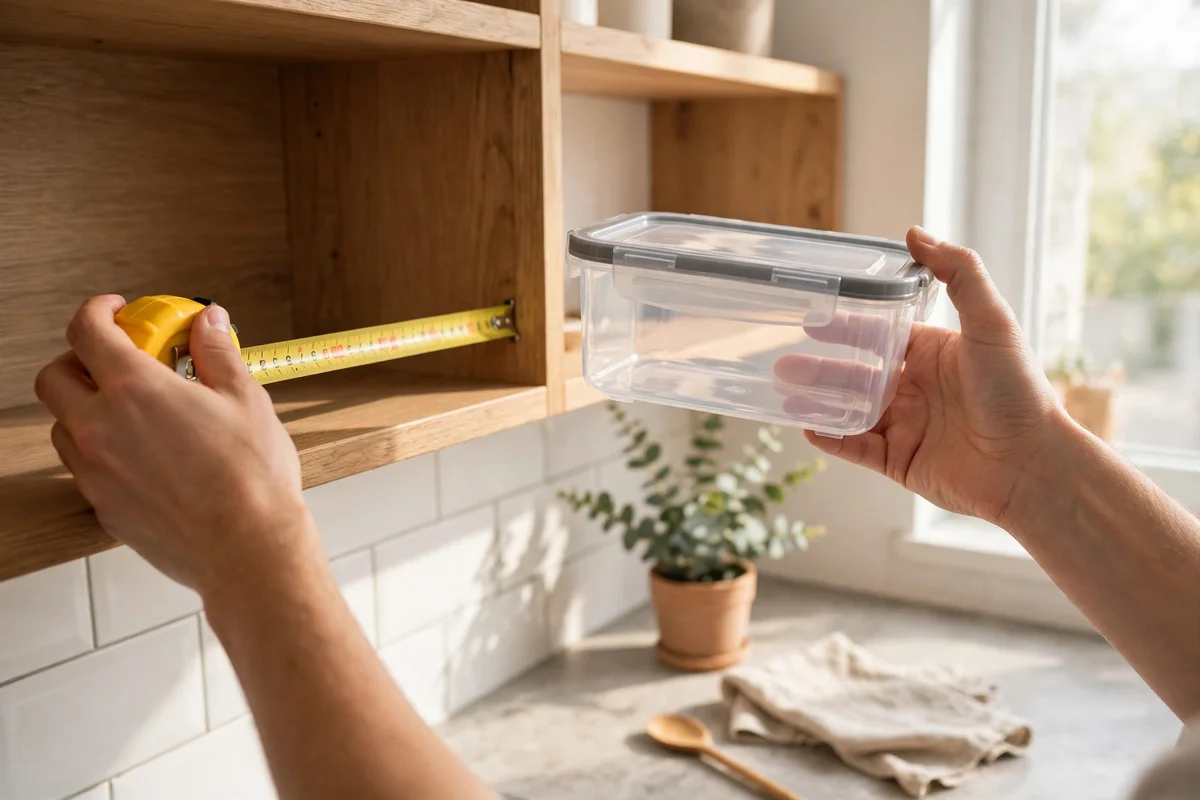
Skip buying a large mixed set before measuring, skip containers with lids that are much wider than their bases unless you have measured for them, and skip specialty shapes for everyday storage. Fancy compartment containers and unusually tall bottles have their place, but they should be bought for a specific job after the everyday sizes are sorted, not as a first purchase.
Container shapes compared for shelf use
| Shape | Best for | Shelf fit | Watch out for |
|---|---|---|---|
| Rectangular | Leftovers, meal prep, general use | Stacks neatly, wastes little space | Lids can vary in size between sets |
| Square | Small shelves, side-by-side rows | Very efficient in a row | Harder to pour liquids from corners |
| Round | Soups, sauces, liquids | Leaves gaps between containers | Wastes space when lined up in rows |
| Tall and narrow | Stocks, sauces, drinks | Good on deep, tall shelves | Tips easily and needs height clearance |
When to stop
Stop when every container you own has a shelf spot where it slides in and out without forcing, its lid lifts or clips off without hitting the shelf above, and you can reach it without moving three other boxes. If you have to remove containers to reach containers, the system is too crowded, and the fix is usually fewer containers or a second shelf, not a new set in a different size.
Related on Kitchenlify
Frequently asked questions
What size food storage container fits a standard kitchen shelf?
There is no single standard size, because shelf depths and heights vary between cabinets. Measure your own shelf depth, clear height, and width, subtract clearance for the lid and your fingers, and choose a container that fits inside all three numbers. That measured fit matters more than any general size recommendation.
Should I measure the container with the lid on or off?
Always measure with the lid on, at the widest point. The lid is part of the container when it sits on the shelf, and lids that clip on the outside can add width and height that the base measurement hides.
Are square or round containers better for shelves?
Square and rectangular containers usually use shelf space better, because they sit side by side without curved gaps. Round containers are better for pouring soups and sauces, so the best choice depends on what you store most often.
How much clearance should I leave above a container?
Leave at least one inch above a lidded container so you can lift the lid off without hitting the shelf above. For clip-on lids, also leave about half an inch on each side for your fingers.
How many sizes of container do I really need?
Most kitchens do well with two or three sizes that fit their shelves and stack together: a small size for sauces and snacks, a medium size for everyday leftovers, and a larger size for family meals. More sizes usually mean worse stacking, not better storage.
Do I need to measure every shelf I plan to use?
Yes. Shelves in the same cabinet are not always the same depth, and shelves can sag slightly in the middle. Measure depth and clear height on each shelf, and use the smallest numbers, since the smallest shelf decides what fits everywhere.
Will a container fit if it fits the shelf but not the cabinet opening?
No. Measure the cabinet opening itself, including the door frame and any lip, and compare the container against it. A container that cannot pass through the opening does not fit, even if it would fit once inside.
What shape is best for soups and for leftovers?
Tall, narrow containers suit soups, sauces, and liquids that you pour. Short, wide containers suit leftovers, cut fruit, and salads that you spoon out. Choose the shape for the food as well as for the shelf.
How high can I safely stack containers?
Stack two or three containers of the same size together, with the heaviest at the bottom and the lightest at the top. Do not stack so high that you cannot lift the top container down safely with one hand, and avoid mixed stacks, because they lean and topple.