How to Choose Muffin Pan vs Loaf Pan Size for Beginners

How to choose muffin pan vs loaf pan size for beginners starts with one batch. One banana-bread batch that makes 12 standard muffins also makes one 9 by 5 inch loaf, as long as you fill each muffin cup two-thirds full and fill the loaf pan no more than two-thirds full. Give the loaf roughly twice the bake time of the muffins. Muffins bake fast because each small portion has a lot of surface area, while a loaf bakes slowly because heat must reach the center through a deep mass of batter. Choose muffins when you want fast baking, easy sharing, and individual portions, and choose a loaf when you want slices, a longer shelf life in the freezer, and a single pan to wash.
How to choose muffin pan vs loaf pan size for beginners — why does the same batter bake so differently as muffins and as a loaf?
The difference is shape, not recipe: a muffin is a small, shallow portion with a large surface area relative to its volume, so heat reaches the center quickly, moisture escapes fast, and the muffin sets in 18 to 25 minutes at a typical muffin temperature. A loaf is a deep, narrow mass with a small surface area relative to its volume, so heat takes much longer to reach the center, moisture escapes slowly, and the loaf needs 50 to 65 minutes at a slightly lower temperature to bake through without burning the outside. That is why converting a batch is not just a matter of pouring batter into a different pan. The fill level, the oven temperature, and the bake time must all change. The test for doneness changes too, from a light spring-back for muffins to a skewer test for a loaf. A standard muffin cup holds about one-third cup of batter when full, but you should only fill it two-thirds full, which is about one-quarter cup per muffin. A 9 by 5 inch loaf pan holds about 8 cups when full, but you should only fill it to about 5 cups of batter. That is why 12 muffins and one loaf hold a similar total amount.
Step by step: convert one banana-bread batch between 12 muffins and a 9x5 loaf
Use this worked example: you have one batch of banana-bread batter made from 3 ripe bananas, 2 cups of flour, 1 cup of sugar, 2 eggs, and butter and leavening, which comes to about 5 to 5.5 cups of batter. Follow the steps to bake it as 12 muffins first, then as one loaf, and you will see exactly how fill level and bake time change.
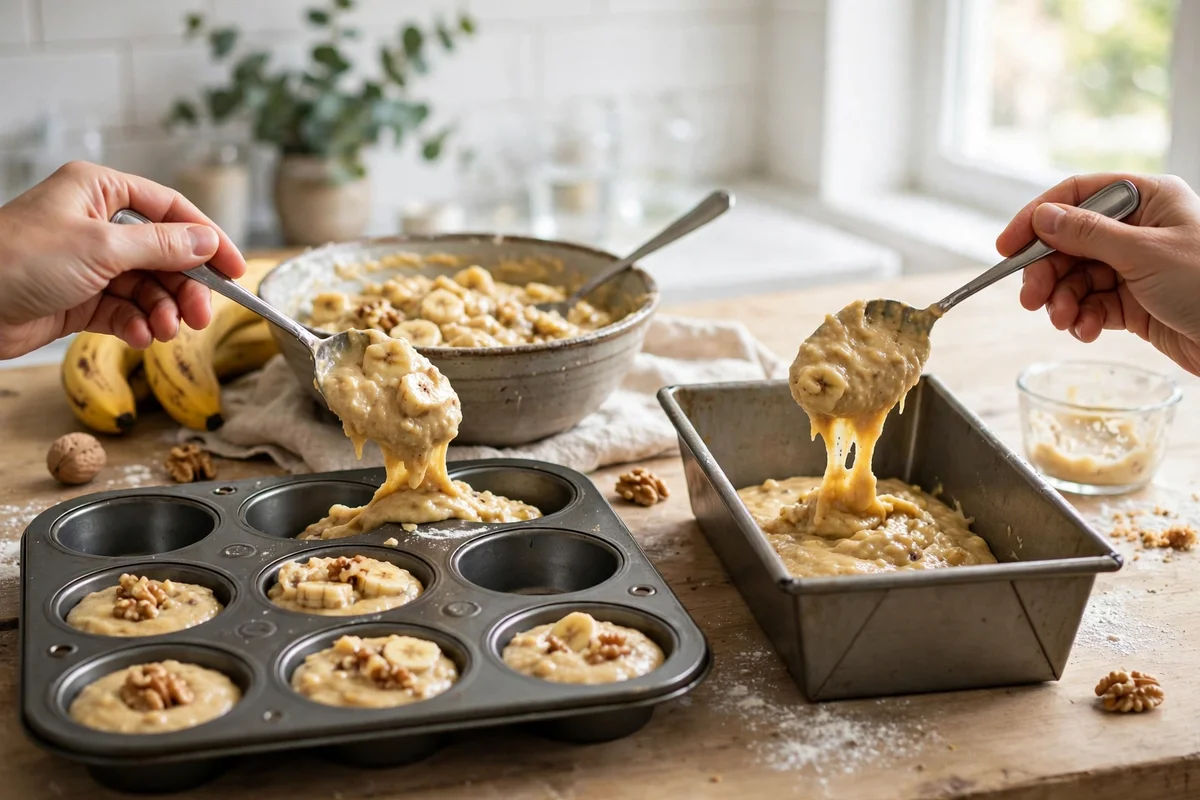
- Measure your batter volume before you choose a pan. Pour the finished batter into a large measuring jug, or measure it in cups as you mix, and write down the total: for the example batch, it should be about 5 to 5.5 cups. This number decides the pan, because a pan must hold the batter with room for rising, not just hold it when full. Twelve standard muffin cups, filled two-thirds full at about one-quarter cup each, hold about 3 cups of batter, which seems less than 5 cups, but in practice a standard banana-bread batch written for 12 muffins often makes 12 full muffins plus a little extra, or 12 muffins when the cups are filled a little fuller, so check your own batch volume rather than trusting a recipe's yield alone. For the loaf, a 9 by 5 inch pan holds 8 cups when full, and its working capacity at two-thirds full is about 5.25 cups, which matches the example batch well, and that is why this batch converts cleanly to one loaf.
- Fill the muffin cups two-thirds full, and no fuller. Line a 12-cup standard muffin pan with paper liners or grease it well, then fill each cup two-thirds full, which is about one-quarter cup of batter per cup, using a measuring cup or an ice-cream scoop for even portions. Do not fill the cups to the top, because banana-bread batter rises a lot, and overfilled cups will spread over the pan, join together, and bake into flat, messy muffins with burnt edges. Even filling matters more than perfect filling: if one cup has much more batter than the others, that muffin will take longer to bake and may still be wet in the center when the others are done. Tap the pan gently on the counter once to settle the batter and remove large air bubbles, then place it in the oven without delay.
- Bake the muffins at the recipe temperature, and check early. Bake the muffins at the temperature your banana-bread recipe gives for muffins, often around 375 degrees Fahrenheit, or at the loaf temperature plus a little, because muffins need higher heat for a shorter time to rise well. Check the muffins 5 minutes before the recipe's time, which is often 18 to 25 minutes total: the tops should be golden, spring back lightly when pressed, and a toothpick inserted in the center of a middle muffin should come out with only a few moist crumbs, not wet batter. Remove the muffins from the pan after 5 minutes of cooling, and cool them on a rack, because muffins left in a hot pan continue to bake and can become dry. Note the exact time your muffins took, because your oven and your pan will affect the next batch.
- Fill the 9 by 5 inch loaf pan no more than two-thirds full. Grease the 9 by 5 inch loaf pan well, or line it with parchment paper with overhanging edges for easy lifting, then pour in the same batch of batter, up to about two-thirds of the pan's height, which is about 5 to 5.25 cups. Do not fill the loaf pan to the top, because banana bread rises significantly, and an overfilled loaf will overflow in the oven, spill batter onto the oven floor, and bake with a sunken, gummy center. Smooth the top with a spatula, tap the pan gently to remove air bubbles, and check that the batter sits at least 1 inch below the rim, leaving room for the loaf to rise and dome without spilling over the sides.
- Lower the temperature slightly for the loaf, and roughly double the bake time. Bake the loaf at a slightly lower temperature than the muffins, often around 350 degrees Fahrenheit, because the deep loaf needs gentler heat to bake through without burning the outside before the center sets. Plan for roughly double the muffin time: if your muffins took 20 minutes, plan for about 50 to 65 minutes for the loaf, checking from 45 minutes onward. The exact time depends on your oven, your pan material, and your batter, so do not trust the clock alone: use the skewer test in the next step to decide when the loaf is done. A loaf that looks done on top can still be wet in the center, which is why time alone is not a safe test for a deep bake.
- Test the loaf with a skewer, and cool it before slicing. Insert a wooden skewer or a thin knife into the center of the loaf, at its highest point, and pull it out: it should come out clean or with only a few moist crumbs, not with wet batter clinging to it. If the skewer shows wet batter, return the loaf to the oven for 5 to 10 minutes, then test again, and cover the top loosely with foil if it is browning too fast while the center catches up. When the loaf passes the skewer test, let it cool in the pan for 10 to 15 minutes, then lift it out using the parchment overhang or turn it out carefully, and cool it fully on a rack before slicing. Slicing a hot loaf crushes the crumb and makes it gummy, while a fully cooled loaf slices cleanly and holds its shape.
- Decide muffins or loaf by occasion, not by habit, for the next batch. For the next batch, decide by the occasion: choose muffins when you need fast baking, individual portions for lunchboxes or sharing, or a bake that cools quickly and freezes well in portions. Choose a loaf when you want slices for toast or breakfast, a bake that keeps well wrapped for several days, or a single pan to wash instead of a muffin pan with 12 cups to clean. Keep notes on both bakes: the muffin time, the loaf time, the oven temperature for each, and how the crumb looked, because those notes turn a one-time conversion into a reliable recipe you can repeat. One batch, baked both ways on different days, teaches you more about pan size than any general chart, which is why this guide focuses on this one conversion, not on every possible pan.
One banana-bread batch: 12 muffins vs one 9x5 loaf
| Feature | 12 standard muffins | One 9 by 5 inch loaf |
|---|---|---|
| Batter per portion | About one-quarter cup per cup | About 5 to 5.25 cups in one pan |
| Fill level | Two-thirds full per cup | Two-thirds full for the pan |
| Oven temperature | Often about 375 degrees Fahrenheit | Often about 350 degrees Fahrenheit |
| Bake time about | 18 to 25 minutes | 50 to 65 minutes, roughly double |
| Doneness test | Spring-back and toothpick | Skewer in the center, clean |
| Best for | Sharing, lunchboxes, fast baking | Slices, toast, longer storage |
What you need — and what to skip
You need a standard 12-cup muffin pan, a 9 by 5 inch loaf pan, paper liners or parchment paper, a measuring cup or scoop for even muffin filling, and a wooden skewer or thin knife for testing the loaf. A cooling rack for both bakes, and foil for covering a loaf top that browns too fast, complete the setup. You do not need a general pan-conversion chart to start: one batch, converted between these two pans with the steps above, covers the most common beginner question.
Skip filling muffin cups or the loaf pan to the top, skip baking a loaf at muffin temperature for muffin time, and skip slicing a hot loaf, which crushes the crumb. Skip using a general conversion chart for this batch, because charts give volumes for many pans but do not tell you how fill level, temperature, and time change for this specific batter. Skip leaving muffins in a hot pan for a long time after baking, because they continue to bake and dry out, and skip testing a loaf only by its top color, because a brown top can hide a wet center.
6 mistakes beginners make — and how to fix them
- Filling muffin cups to the top, so muffins spread and join together. Fix: fill each cup two-thirds full, about one-quarter cup per cup, and use a scoop for even portions. Overfilled muffins rise over the pan and bake into flat, messy shapes.
- Filling a loaf pan to the top, so it overflows in the oven. Fix: fill the 9 by 5 inch loaf pan no more than two-thirds full, about 5 to 5.25 cups, leaving at least 1 inch below the rim for rising. An overfilled loaf spills and bakes with a gummy center.
- Baking a loaf for muffin time, and finding a wet center. Fix: plan for roughly double the muffin time for a loaf, about 50 to 65 minutes, and test with a skewer in the center. Time alone is not safe for a deep bake.
- Baking a loaf at muffin temperature without lowering it. Fix: lower the temperature slightly for the loaf, often to about 350 degrees Fahrenheit, so the outside does not burn before the center sets. Muffins need higher heat for a shorter time.
- Testing a loaf only by its top color. Fix: use a skewer in the center, at the highest point, and look for a clean skewer or only a few moist crumbs. A brown top can hide wet batter in the center.
- Slicing a loaf while it is still hot. Fix: cool the loaf in the pan for 10 to 15 minutes, then cool it fully on a rack before slicing. A hot loaf crushes and turns gummy when cut, while a cooled loaf slices cleanly.
When to stop — safety note
Stop baking if batter overflows in the oven, if smoke comes from spilled batter on the oven floor, or if a pan is so full that it cannot be lifted safely into the oven without spilling. Always use oven mitts for a full loaf pan, because it is heavy and hot, and lift it with both hands, keeping it level so batter does not slosh to one side. Never open the oven door repeatedly during the first half of a loaf bake, because the sudden temperature drop can cause the loaf to sink, and never leave a baking loaf unattended for a long time if your oven has a history of hot spots or spills. If a loaf top browns too fast while the center is still wet, cover it loosely with foil and continue baking, rather than raising the temperature or removing the loaf early.

Related on Kitchenlify
- Bakeware
- Cake Servings Calculator
- Baking Pan Size Converter
- How to Choose Baking Sheet Material for Beginners
- All guides
Frequently asked questions
Can I bake banana bread as muffins instead of a loaf?
Yes. One batch that makes one 9 by 5 inch loaf also makes about 12 standard muffins, as long as you fill each muffin cup two-thirds full. Bake the muffins at a slightly higher temperature for a shorter time, often 18 to 25 minutes, and test with a toothpick in a middle muffin, rather than using the loaf time.
How long does banana bread take as a loaf vs as muffins?
Muffins usually take 18 to 25 minutes, while a 9 by 5 inch loaf usually takes 50 to 65 minutes, roughly double the muffin time, at a slightly lower temperature. The exact time depends on your oven, your pan, and your batter, so start checking the loaf from 45 minutes onward, and use a skewer test in the center to decide when it is done.
How full should I fill a muffin pan for banana bread?
Fill each standard muffin cup two-thirds full, which is about one-quarter cup of batter per cup. Do not fill cups to the top, because banana-bread batter rises a lot, and overfilled cups spread over the pan, join together, and bake into flat muffins with burnt edges. Use a scoop for even filling, so all muffins bake in the same time.
How full should I fill a 9 by 5 inch loaf pan?
Fill it no more than two-thirds full, which is about 5 to 5.25 cups of batter, leaving at least 1 inch below the rim for rising. A loaf pan holds about 8 cups when full, but filling it to the top will cause it to overflow in the oven and bake with a sunken, gummy center. Smooth the top and tap the pan gently before baking.
Should I lower the oven temperature for a loaf vs muffins?
Yes, slightly. Muffins often bake at about 375 degrees Fahrenheit, while a loaf often bakes at about 350 degrees Fahrenheit, because the deep loaf needs gentler heat to bake through without burning the outside before the center sets. Follow your recipe's temperatures if it gives both, and adjust by checking early on your first conversion.
How do I know when banana bread loaf is done in the center?
Insert a wooden skewer or a thin knife into the center of the loaf, at its highest point, and pull it out. It should come out clean or with only a few moist crumbs, not with wet batter clinging to it. If the skewer shows wet batter, bake for 5 to 10 minutes more, covering the top loosely with foil if it is browning too fast.
Can I use an 8 by 4 inch loaf pan instead of a 9 by 5 inch pan?
You can, but the smaller pan holds less batter, so you must not pour the full batch into it, or it will overflow. Use only about two-thirds of the batch in an 8 by 4 inch pan, and bake the rest as muffins, or use a larger pan for the full batch. Always match the batter volume to the pan's working capacity, not its full capacity.
Why did my banana bread sink in the middle?
A loaf sinks most often because it was underbaked in the center, because the pan was overfilled, or because the oven door was opened too early and the temperature dropped suddenly. Check doneness with a skewer, fill the pan only two-thirds full, and avoid opening the oven during the first half of the bake. A loaf that looks done on top can still be wet inside.
Should I choose muffins or a loaf for banana bread?
Choose muffins for fast baking, individual portions, lunchboxes, and easy sharing, because they bake in 18 to 25 minutes and cool quickly. Choose a loaf for slices, toast, and longer storage, because one loaf keeps well wrapped for several days and gives even slices. The same batter works for both, so choose by the occasion, not by habit.
How do I convert the batch to mini muffins or cupcakes?
One banana-bread batch fills about 24 mini muffins or 12 standard cupcakes. Fill each cup about two-thirds full and bake at the same temperature, but start checking mini muffins after about 10 minutes and cupcakes after about 15 minutes, because they bake much faster than a loaf. A toothpick should come out with a few moist crumbs.