How to Choose Pot Size for Cooking for Two

How to choose pot size for cooking for two starts with two pots: a 1.5 to 2 quart saucepan for sauces, rice, oatmeal, and reheating soup, and a 3 to 4 quart pot for pasta, soup, and vegetables. Fill each pot only to two-thirds full, because food bubbles, pasta expands, and rice triples in volume, and a pot filled to the brim will boil over. A pot that is too large spreads a small amount of food thin, so it scorches, while a pot that is too small boils over and makes a mess. This guide covers saucepans and everyday pots for two, with Dutch ovens covered separately, because their size, weight, and shape need their own guide.
How to choose pot size for cooking for two — why does a pot for two need a different size from a family pot?
A pot's listed capacity is measured to the brim, but you should never cook with a pot filled to the brim, because boiling liquids foam, pasta moves, and sauces bubble up. The working capacity, the amount you can actually cook, is about two-thirds of the listed capacity for boiling, and about half for simmering thick foods that bubble vigorously. For two people, a main-course soup serving is about 1 to 1.5 cups per person, or 2 to 3 cups total, which is about 0.5 to 0.75 quart. The pot also needs room for stirring, for pasta water to move, and for rice to expand. That is why a 1.5 to 2 quart saucepan works for sauces and rice for two, while a 3 to 4 quart pot works for pasta and soup for two. Each pot gives the food room to move, without spreading it so thin that it scorches on a large burner.
Step by step: choose two pot sizes for cooking for two
Use this worked example: tonight you cook rice and a tomato sauce for two, and tomorrow you cook pasta and a vegetable soup for two. Follow the steps with those two dinners in mind, and you will choose pot sizes by real volumes, not by a guess.
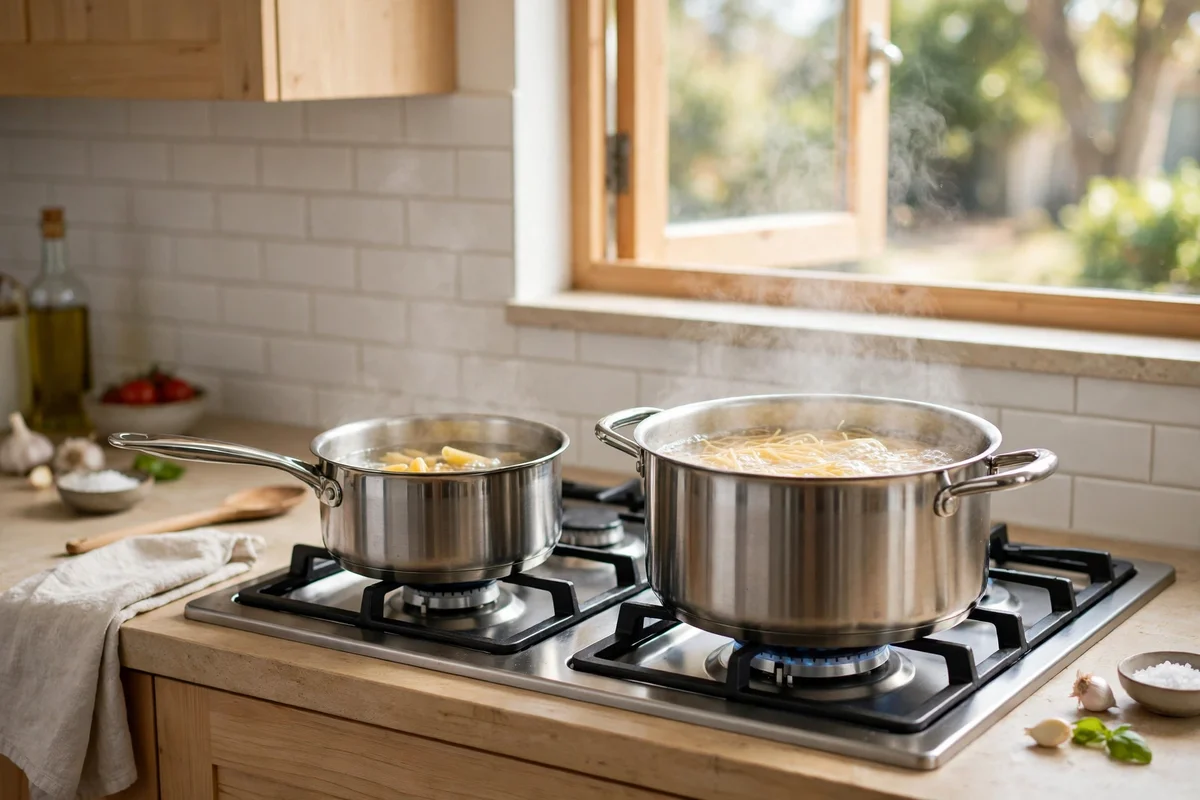
- Add up the food volume for your two example dinners. For rice for two, 1 cup of dry rice plus 2 cups of water comes to 3 cups before cooking, and the cooked rice will expand to about 3 cups of rice, which is about 0.75 quart. For tomato sauce for two, about 2 cups of sauce is typical, which is 0.5 quart. For pasta for two, about 8 ounces of dry pasta needs about 3 to 4 quarts of water to move freely, even though the pasta itself is small, because pasta needs water volume to avoid sticking. For vegetable soup for two, about 4 to 5 cups of soup is typical, which is about 1 to 1.25 quarts. Write these numbers down, because they show why one pot cannot cover both dinners: rice and sauce need a small saucepan, while pasta and soup need a larger pot.
- Apply the fill-to-two-thirds rule to each dinner. Take each food volume and divide by two-thirds to find the pot size you need: rice at 0.75 quart cooked needs a pot of at least 1.1 quarts, but a 1.5 to 2 quart saucepan gives comfortable headroom for bubbling and stirring. Soup at 1.25 quarts needs a pot of at least 1.9 quarts, but a 3 to 4 quart pot gives room for pasta water, for soup to bubble without boiling over, and for stirring without splashing. Pasta is the exception that proves the rule: even though pasta for two is only about 2 cups cooked, it needs 3 to 4 quarts of water to cook well, so the pot size is decided by the water, not by the pasta. A pot filled to two-thirds is the working limit, not a suggestion to ignore.
- Choose the 1.5 to 2 quart saucepan for sauces, rice, and reheating. Pick a saucepan of 1.5 to 2 quarts, with a lid that fits well, for rice for two, tomato sauce for two, oatmeal, reheating soup, and warming milk. Test it with your rice example: place 1 cup of dry rice and 2 cups of water in the saucepan, and check that the liquid sits at about half the pot's height, leaving room for bubbling and for the rice to expand. Check the base diameter against your burner: the base should sit fully on the burner without hanging far over the edge, because a base that is much larger than the burner heats unevenly, and a base that is much smaller than the burner wastes heat. A saucepan in this size is also light enough to lift with one hand when full, which matters when you are pouring sauce or rice.
- Choose the 3 to 4 quart pot for pasta, soup, and vegetables. Pick a pot of 3 to 4 quarts, with a lid, for pasta for two, soup for two, steaming vegetables, and boiling potatoes. Test it with your pasta example: fill the pot with 3 to 4 quarts of water, and check that the water sits at about two-thirds of the pot's height, leaving room for pasta to move and for water to bubble without boiling over. Check that the pot is wide enough that pasta can move freely, not so tall and narrow that pasta clumps at the bottom. A 3 to 4 quart pot is also the right size for soup for two with leftovers for lunch the next day, because it gives you a little extra without forcing you to cook a family-sized batch.
- Match each pot to a burner, and check the handles and lid. Place each pot on the burner you will use most, and check that the base sits flat and fully on the burner, without rocking and without hanging more than about 1 inch over the edge. Check the handles: they should be long enough to grip safely with a mitt, and the lid handle should stay cool enough to lift. Check the lid fit: a lid that gaps lets steam escape and slows cooking, while a lid that fits well keeps heat in and lets you simmer gently. A pot that fits its burner, with safe handles and a good lid, will cook more evenly and more safely than a pot that is the right size on paper but the wrong shape for your stove.
- Test both pots in one week of cooking for two, and keep notes. Cook rice and sauce in the saucepan, and pasta and soup in the larger pot, noting after each meal whether food scorched, whether water boiled over, whether the pot was easy to lift when full, and whether leftovers fit well. If rice scorches in the saucepan, the pot may be too large for the burner, or the heat may be too high for the amount of food. If pasta sticks in the larger pot, check whether you used enough water, not just whether the pot was large enough. If soup boils over, check whether you filled the pot past two-thirds, because that is the most common cause. One week of notes, with real dinners, tells you whether the pair works, and it is far more useful than a size chart alone.
- Decide whether you need a third pot, or whether two are enough. After a month of cooking for two, decide whether two pots cover your meals, or whether a third pot would help. If you often cook a main dish and a side dish at the same time, a second small saucepan can help, but it is not essential if you can time the dishes one after another. If you batch cook soup for the week, a larger pot may be useful, but that is batch cooking, not cooking for two, and it needs its own size decision. Do not buy a third pot on the first shopping trip: buy the two pots that cover your everyday dinners, learn them well, and add a third only when a regular meal actually needs it.
Pot sizes for cooking for two
| Pot | Size | Best for two | Working amount |
|---|---|---|---|
| Small saucepan | 1.5 to 2 quarts | Rice, sauce, oatmeal, reheating | About 1 to 1.3 quarts of food |
| Everyday pot | 3 to 4 quarts | Pasta, soup, vegetables | About 2 to 2.7 quarts of food |
| Too small | Under 1 quart | Warming milk for one | Boils over with pasta or soup |
| Too large | 6 quarts or more | Batch cooking, family meals | Spreads food thin, scorches |
What you need — and what to skip
You need a 1.5 to 2 quart saucepan with a well-fitting lid, a 3 to 4 quart pot with a lid, and a burner that matches each pot's base diameter. Oven mitts that let you lift a full pot safely, and a wooden spoon for stirring without scratching, complete the setup. You do not need a Dutch oven for cooking for two, because that is a separate size and weight decision, and you do not need a full set of pots in every size to start.
Skip a very large pot for cooking for two, because it spreads small amounts of food thin and causes scorching, and skip a very small pot for pasta or soup, because it boils over. Skip filling any pot past two-thirds for boiling, skip a pot whose base does not fit your burner, and skip buying a Dutch oven as a substitute for an everyday pot, because its weight and shape suit different jobs. Skip buying a full pot set before you know which two sizes you actually use every week.
6 mistakes beginners make — and how to fix them
- Filling a pot to the brim, then watching it boil over. Fix: fill to two-thirds for boiling, and to half for thick, bubbling foods. A pot's listed capacity is to the brim, not the working capacity, and boiling food needs headroom.
- Cooking a small amount of sauce in a very large pot. Fix: use the 1.5 to 2 quart saucepan for sauces and rice for two, so food sits deep enough to stir and heat evenly. In a large pot, a small amount spreads thin and scorches.
- Using too little water for pasta, even in the right pot. Fix: use 3 to 4 quarts of water for pasta for two, so pasta can move freely and not stick. The pot size is decided by the water, not by the pasta alone.
- Choosing a pot whose base does not fit the burner. Fix: match the base diameter to the burner, so the base sits flat and fully on the burner. A base that hangs far over the edge heats unevenly and wastes energy.
- Lifting a full pot with one hand or with wet hands. Fix: use both hands, dry mitts, and a steady grip, especially for a 3 to 4 quart pot full of pasta water. A full pot is heavy, and a slip can cause a serious burn.
- Buying a Dutch oven as an everyday pot for two. Fix: keep Dutch ovens as a separate decision, with their own size and weight guide. An everyday saucepan and pot cover cooking for two better, and at a lighter weight.
When to stop — safety note
Stop cooking if a pot boils over repeatedly, if the base rocks on the burner, or if the handles become too hot to hold safely. Each of those is a warning that the pot, the burner, or the heat level is wrong. Always use oven mitts for a full pot, lift with both hands, and pour hot water away from your body, keeping your hands clear of steam. Never fill a pot past two-thirds for boiling, never leave a pot of boiling water unattended, and never place a cold pot on a very hot burner and then fill it with cold water, which can warp thin metal. If a pot's base is warped, if the lid does not fit, or if the handles are loose, replace or repair the pot before cooking with it again. A damaged pot is harder to control when it is full and hot.
Related on Kitchenlify
- Cookware Sets
- Pasta Per Person Calculator
- Rice Per Person Calculator
- How to Choose Dutch Oven Size for Beginners
- All guides
For two people in a small kitchen, a best nonstick cookware set for a small kitchen keeps the pieces — and the storage — small.
Frequently asked questions
What size pot should I buy for cooking for two?
Start with two pots: a 1.5 to 2 quart saucepan for rice, sauces, oatmeal, and reheating, and a 3 to 4 quart pot for pasta, soup, and vegetables. Those two sizes cover most dinners for two, with room to stir and boil without spilling, as long as you fill each pot only to two-thirds full.
How full should I fill a pot when cooking?
Fill a pot only to two-thirds full for boiling, and to about half full for thick foods that bubble vigorously, such as sauces and oatmeal. A pot's listed capacity is measured to the brim, but boiling food needs headroom for bubbling, expansion, and stirring, and a pot filled to the brim will boil over.
Can I cook pasta for two in a 2 quart saucepan?
It is not ideal, because pasta for two needs about 3 to 4 quarts of water to move freely and not stick, even though the pasta itself is small. A 2 quart saucepan will be too crowded for pasta, and the water will boil over or the pasta will clump. Use a 3 to 4 quart pot for pasta, and save the saucepan for rice and sauces.
What size saucepan is best for rice for two?
A 1.5 to 2 quart saucepan is best for rice for two. One cup of dry rice plus 2 cups of water comes to about 3 cups before cooking, and the cooked rice expands to about 3 cups, which fits comfortably in a 1.5 to 2 quart saucepan with room for bubbling and stirring. A larger pot spreads the rice thin and can cause scorching.
Do I need a Dutch oven for cooking for two?
Not as a first pot. A Dutch oven is heavier, larger, and suited to slow braises, soups, and bread, with its own size guide based on quarts per person. For everyday cooking for two, a saucepan and an everyday pot cover rice, pasta, soup, and sauces better, and at a lighter weight. Add a Dutch oven later, when slow cooking becomes regular.
How do I match a pot to my burner?
Place the pot on the burner and check that the base sits flat and fully on the burner, without rocking and without hanging more than about 1 inch over the edge. A base that is much larger than the burner heats unevenly, while a base that is much smaller wastes heat. Match the pot to the burner you will use most, not just to the largest burner on your stove.
Why does food scorch in a large pot when I cook for two?
Food scorches when a small amount spreads thin across a large base, so it heats too fast and dries out before it cooks through. Use the smaller saucepan for small amounts, keep the heat at medium or lower for sauces, and stir more often. A pot that is too large for the amount of food is a common cause of scorching for two-person cooking.
Can one pot cover all cooking for two?
One pot can manage for a short time, but it will be a compromise: a 3 quart pot is too large for a small sauce and too small for comfortable pasta water. Two pots, a 1.5 to 2 quart saucepan and a 3 to 4 quart pot, cover the range much better, and they nest or stack in most cabinets without taking much extra space.
What is the best pot material for cooking for two?
Stainless steel with an aluminum core is a good all-round choice for saucepans and pots for two, because it heats evenly, handles sauces and soups well, and lasts for years. Nonstick is useful for delicate foods such as eggs, but it is not ideal as an everyday pot for pasta and soup, where high heat and long boiling wear the coating faster.