How to Soften Hardened Brown Sugar
How to soften hardened brown sugar starts with matching the method to how hard it is and how soon you need it: if you need it now, microwave it in short bursts with a damp paper towel, or heat it gently in a low oven. If you can wait overnight, seal it with a slice of bread, apple slices, or a damp terra-cotta disk, and let moisture move back into the sugar slowly. Brown sugar hardens because it loses moisture to the air, so every working method either adds moisture back gently or breaks the lump apart, and the best method depends on whether the sugar is slightly clumpy, firmly packed, or a single rock-hard block.
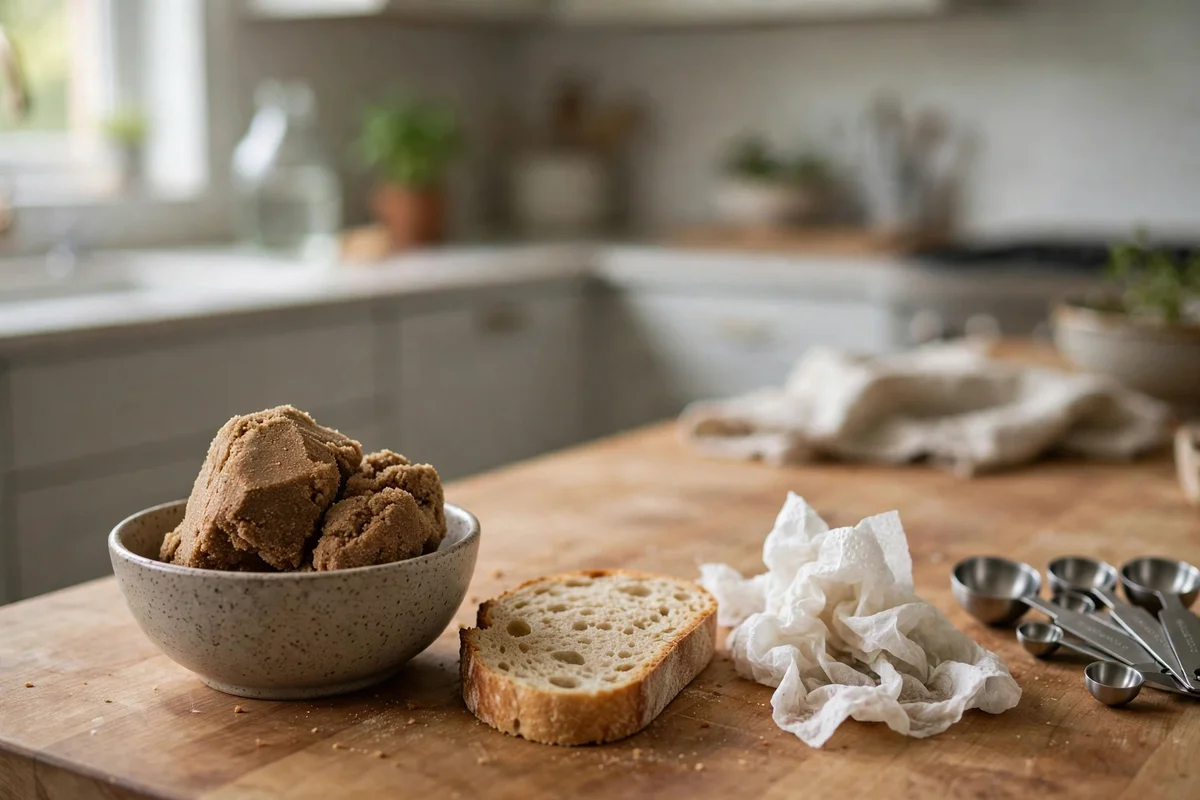
The short answer: how to soften hardened brown sugar
For sugar you need now, place the amount you need in a microwave-safe bowl, cover it with a damp paper towel, and microwave in 20-second bursts, fluffing with a fork between bursts, until it is soft. For a larger amount, spread it on a lined tray and heat in a 250 degree Fahrenheit oven for 5 minutes, checking and fluffing every few minutes. For sugar you can leave overnight, seal it in an airtight container with a slice of bread, a few apple slices, or a soaked terra-cotta disk for 8 to 24 hours, then remove the bread or apple. After softening, measure it right away, because microwaved and oven-softened sugar hardens again as it cools.
Why this happens
Brown sugar is white sugar coated with molasses, and molasses holds moisture. That moisture is what keeps brown sugar soft and packable. When the sugar sits in an unsealed bag or a loose container, air pulls moisture out of the molasses, the crystals lock together, and the sugar sets into clumps or a solid block. Light and dark brown sugar harden the same way, because both lose moisture, though dark brown sugar starts with more molasses. Softening works by reversing that moisture loss: heat loosens the crystals and frees trapped moisture, while bread, apple, or terra-cotta slowly gives moisture back to the sugar over hours. Breaking the lump apart with a rolling pin or food processor does not add moisture, but it makes hard sugar measurable again, which is sometimes all a recipe needs. The storage step matters as much as the rescue, because sugar softened and then left open will harden again within days.
Step by step

- Judge how hard the sugar is before you pick a method. Press the sugar with a fork. If it breaks into clumps that crumble, it is slightly hard. If it holds its shape but can be broken with effort, it is firmly packed. If it is a single solid block that will not dent, it is rock-hard. Slightly hard sugar responds to overnight methods, firmly packed sugar responds to either method, and rock-hard sugar usually needs heat first, followed by an overnight method to finish it.
- For need-it-now sugar, use the microwave in short bursts. Place only the amount you need in a microwave-safe bowl, because microwaved sugar hardens again as it cools. Cover it with a damp, not dripping, paper towel. Microwave in 20-second bursts, removing the bowl each time to fluff the sugar with a fork and break up softened edges. Stop as soon as the sugar is soft enough to measure, usually after 40 to 90 seconds total. Do not microwave for a long stretch, because the sugar can melt, scorch, and then set even harder.
- For a larger amount now, use a low oven. Preheat the oven to 250 degrees Fahrenheit. Spread the sugar in a thin layer on a parchment-lined baking tray. Heat for 5 minutes, then remove the tray, fluff the sugar with a fork, and return it for 1 to 2 minute intervals if needed, until it is soft. The oven method suits a full bag better than the microwave, because heat spreads evenly across a thin layer. Watch it closely, because sugar near the edges softens first and can scorch while the center is still hard.
- For overnight softening, seal it with bread. Place the sugar in an airtight container or sealed bag with 1 slice of plain bread on top. Seal it tightly and leave it for at least 8 hours, up to 24 hours. The sugar draws moisture from the bread, and the bread turns dry and hard while the sugar turns soft. Remove the bread and throw it away when the sugar is soft, and do not leave bread in sugar for days, because it can mold.
- Or seal it with apple slices or a terra-cotta disk. If you have no bread, use 2 to 3 apple slices in a sealed container for 8 to 24 hours, then remove them, because apple left longer can spoil. For a reusable option, soak a terra-cotta sugar disk in water for 15 minutes, pat it dry, place it in the sealed container with the sugar, and leave it overnight. The disk releases moisture slowly and can stay in the container afterward to help keep the sugar soft.
- Measure and use the sugar promptly after heat softening. Heat-softened sugar is at its softest while warm, and it firms up again as it cools. Measure what you need right away, pack it into the measuring cup as the recipe requires, and start baking. If it firms up before you measure, give it one more short microwave burst with a damp paper towel, rather than adding water directly to the sugar.
- Store the softened sugar airtight to keep it soft. Transfer the sugar to an airtight container as soon as it is soft, pressing out extra air before sealing. Keep a terra-cotta disk in the container if you have one, and store the container in a cool, dry pantry, not next to the stove or in a humid spot. Check the seal each time you use it, because a loose lid is how the whole cycle starts again.
Worked example: one bag, three hardness levels, three fixes
Suppose you open a bag and find three problems at once: a few soft clumps at the top, a firmly packed middle, and a rock-hard block at the bottom. Treating all three the same way wastes time or ruins the sugar. Handle each level with the method that fits it, and you save the whole bag.
| Hardness | What it feels like | Best method | Time |
|---|---|---|---|
| Slightly clumpy | Breaks apart with a fork | Seal with bread or apple overnight | 8 to 24 hours |
| Firmly packed | Holds shape, breaks with effort | Microwave bursts or low oven | 5 to 15 minutes |
| Rock-hard block | Will not dent, single solid lump | Low oven first, then overnight with bread | Oven plus overnight |
For the rock-hard block, start with the oven method to break the structure, then seal the broken pieces with bread overnight to restore moisture. Microwaving a rock-hard block alone often softens only the outside while the center stays hard, and the softened outside then re-hardens before you can measure it. The two-stage fix takes longer, but it is the method that actually saves a solid block rather than just warming its surface.
Which softening method should you use? Decide by time and hardness
The fastest method is not the gentlest, and the gentlest method is not fast. Pick by how soon you need the sugar and how hard it is, not by which method you have used before.
| If you need it | And the sugar is | Use | Avoid |
|---|---|---|---|
| Right now | Slightly clumpy or firmly packed | Microwave in 20-second bursts | One long microwave stretch |
| Right now | Large amount, firmly packed | Low oven at 250 degrees Fahrenheit | High oven heat, which scorches edges |
| Tomorrow | Any hardness | Bread, apple, or terra-cotta overnight | Leaving bread or apple in for days |
| For measuring only | Rock-hard, no time to wait | Rolling pin in a sealed bag, or food processor | Adding water directly, which dissolves sugar |
Common mistakes to avoid

- Microwaving in one long stretch. Fix: use 20-second bursts and fluff with a fork between bursts. A long stretch melts and scorches the outside while the center stays hard, and the sugar sets harder as it cools.
- Adding water directly to the sugar. Fix: use a damp paper towel over the bowl, or bread, apple, or terra-cotta in a sealed container. Direct water dissolves sugar into syrup and ruins measuring.
- Leaving bread or apple in the sugar for days. Fix: remove bread or apple after 8 to 24 hours, once the sugar is soft. Left longer, bread dries out and apple can spoil, and neither helps after the sugar is already soft.
- Softening the whole bag when you need 1 cup. Fix: soften only the amount you need by heat, because heat-softened sugar hardens again as it cools. Save the overnight method for the whole bag.
- Storing softened sugar in the original open bag. Fix: transfer it to an airtight container right away, with a terra-cotta disk if you have one. An open bag repeats the hardening cycle within days.
- Hitting a rock-hard block with a hammer on the counter. Fix: seal the sugar in a sturdy bag first, then use a rolling pin on a stable surface. Hitting an unwrapped block scatters sugar and can damage the counter or the bag.
What you need — and what to skip
You need the hardened sugar, a microwave-safe bowl and damp paper towels for the fast method, or a parchment-lined tray and a 250 degree Fahrenheit oven for a larger amount. For overnight methods you need an airtight container, plus a slice of bread, a few apple slices, or a terra-cotta sugar disk. A fork, a rolling pin, and a sealed bag cover the breaking methods.
Skip adding water directly to the sugar, skip high oven heat, skip microwaving the whole bag for a single recipe, and skip storing brown sugar in the fridge, because the fridge can dry it out and cause clumping. Skip buying a new bag before trying an overnight method, because most hardened sugar is fully recoverable.
When to stop — and safety notes
Stop and let the sugar cool before handling it after microwaving or oven heating, because hot sugar can burn skin and sticks to it. Use oven mitts for the tray, and handle the bowl with a towel if it is hot. If sugar has mold, smells off, or has been contaminated with water or other liquids, throw it away rather than trying to rescue it. Keep apple and bread out of sugar once softening is done, so they do not mold in storage. This guide covers food preparation technique only.
Related on Kitchenlify
- All guides
- Food Storage
- Bakeware
- How to Store Flour Long Term in the Pantry
- How to Measure Flour Correctly
Frequently asked questions
How do you soften brown sugar quickly?
Place the amount you need in a microwave-safe bowl, cover it with a damp paper towel, and microwave in 20-second bursts, fluffing with a fork between bursts, until soft. Use the sugar right away, because it hardens again as it cools.
How do you soften brown sugar without a microwave?
Use a low oven at 250 degrees Fahrenheit: spread the sugar thin on a lined tray, heat for 5 minutes, fluff with a fork, and repeat in short intervals until soft. Or seal it overnight with bread, apple slices, or a terra-cotta disk.
How long does it take bread to soften brown sugar?
Usually 8 to 24 hours in a sealed airtight container. Place 1 slice of bread on top of the sugar, seal it, and check after 8 hours. Remove the bread once the sugar is soft, and do not leave it in for days.
Can I use an apple to soften brown sugar?
Yes. Place 2 to 3 apple slices in a sealed container with the sugar for 8 to 24 hours, then remove them. The sugar draws moisture from the apple. Remove the apple once the sugar is soft, because apple left longer can spoil.
What is a terra-cotta brown sugar disk, and how does it work?
It is a small unglazed terra-cotta disk that you soak in water for 15 minutes, pat dry, and place in a sealed container with the sugar. It releases moisture slowly, softening hard sugar overnight, and it can stay in the container afterward to help keep sugar soft.
Why does brown sugar get hard?
Brown sugar hardens when it loses moisture to the air. Brown sugar is white sugar coated with molasses, and molasses holds the moisture that keeps it soft. An unsealed bag or loose container lets that moisture escape, and the crystals lock together.
Can I soften rock-hard brown sugar?
Yes, usually. Start with the low oven method to break the solid structure, then seal the broken pieces with bread or a terra-cotta disk overnight to restore moisture. A single microwave burst alone often softens only the outside of a rock-hard block.
How do I keep brown sugar soft after softening it?
Transfer it to an airtight container right away, press out extra air, and keep a terra-cotta disk in the container if you have one. Store it in a cool, dry pantry, and check the seal each time you open it.
Should I store brown sugar in the fridge?
No. The fridge can dry brown sugar out and cause clumping, and it can pick up smells from other foods. Store brown sugar in an airtight container in the pantry instead.
Can I still use brown sugar that has hardened?
Yes, if it has only hardened from moisture loss and shows no mold or off smell. Soften it by heat or by an overnight method, measure it promptly, and store it airtight. If it has mold or smells off, throw it away.
Can I use white sugar and molasses instead of brown sugar?
Yes. Mix 1 cup of white sugar with 1 tablespoon of molasses for light brown sugar, or 2 tablespoons for dark brown sugar, and stir until the color is even. Use it right away in the recipe, because it measures and bakes the same as brown sugar, and it saves a trip to the store when your brown sugar has turned to a brick.
How do I measure brown sugar when it is hard?
Weigh it instead of packing it into a cup, because hard sugar does not pack evenly and a packed cup can be short. One cup of packed brown sugar weighs about 220 grams, so weigh that amount, or break the sugar into chunks, warm it briefly in the microwave, and pack it while it is soft.