How to Stop Stainless Steel Pan From Warping

How to stop stainless steel pan from warping: heat the pan slowly on medium heat, match the burner to the pan base, and let the pan cool before you wash it — never put a hot pan under cold water. Warping is thermal shock: one part of the metal expands or contracts faster than the rest, and the base bends. A warped pan spins on the burner, pools oil on one side, and cooks unevenly forever after. The fix is not a repair — it is the habits that stop the shock in the first place.
how to stop stainless steel pan from warping — what is the short answer?
Preheat the pan on medium for 2 to 3 minutes instead of blasting it on high, use a burner the same size as the pan base, and let the pan cool to room temperature before washing it in warm water. That is how to keep stainless steel pan from warping in one routine: slow heat, matched burner, cool before washing. Stainless steel pan warping starts when one part of the base heats faster than the rest, so slow, even heat is the whole answer. Thin pans warp fastest, so a thicker, fully clad pan resists warping better — but even a thick pan warps if you shock it with cold water while it is still hot.
How do I do it step by step?
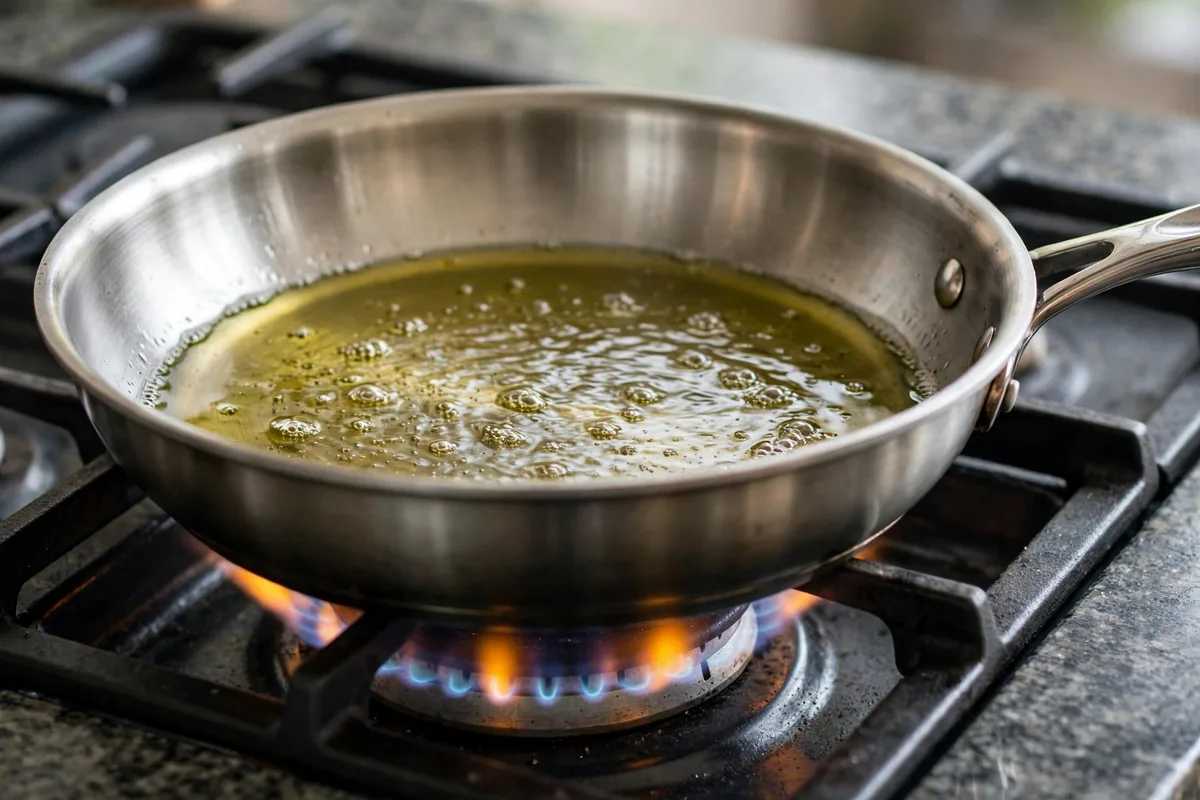
- Preheat slowly on medium heat. Set the empty pan on the burner on medium heat for 2 to 3 minutes before you add oil or food. Slow heat lets the whole base expand evenly; high heat from cold concentrates stress in the center and bends the metal over time. That is the first habit in how to keep stainless steel pan from warping: never start on high.
- Match the burner to the pan base. Use a burner the same size as the pan base, or a little smaller — never a burner much larger than the pan, and never a small burner under a big pan. A burner larger than the pan heats the sides and the handle; a burner smaller than the pan heats only the center, which is how a dome forms. A matched burner heats the whole base at once.
- Add food only when the pan is ready. Add oil when the pan is hot, then food when the oil shimmers. Food dropped into a cold pan sits and steams, and a cook who then cranks the heat to high shocks the pan. A pan that is already hot at the right temperature never needs a blast of high heat to catch up.
- Never put a hot pan under cold water. Let the pan cool on the stove or on a trivet until you can touch the handle comfortably, then wash it in warm water. A hot pan under cold water is the single fastest way to warp stainless steel — the metal contracts unevenly in seconds. This one rule prevents most warping on its own.
- Do not heat an empty pan on high. An empty pan on high heat has nothing to absorb the heat, so the base overheats and bends. If you need a hot pan, heat it on medium with a little oil in it, and watch for the shimmer. An empty pan left on a hot burner is the second most common cause of warping.
- Let the pan cool before the dishwasher. If you use the dishwasher, let the pan cool first and put it on the top rack away from the heating element. A hot pan in a cold dishwasher cycle gets the same shock as a hot pan under a cold tap. Hand-washing in warm water after cooling is the safest routine of all.
- Test the base once a month. Set the cool, empty pan on a flat counter and press the rim: if it rocks or spins, the base has started to warp. A slight dip of 2 to 4 millimeters in the center is normal on many stainless pans — it flattens out when hot — but a pan that spins on the burner will never heat evenly again. Catch it early, change the habit, and the warp stops getting worse.
What mistakes should I avoid?
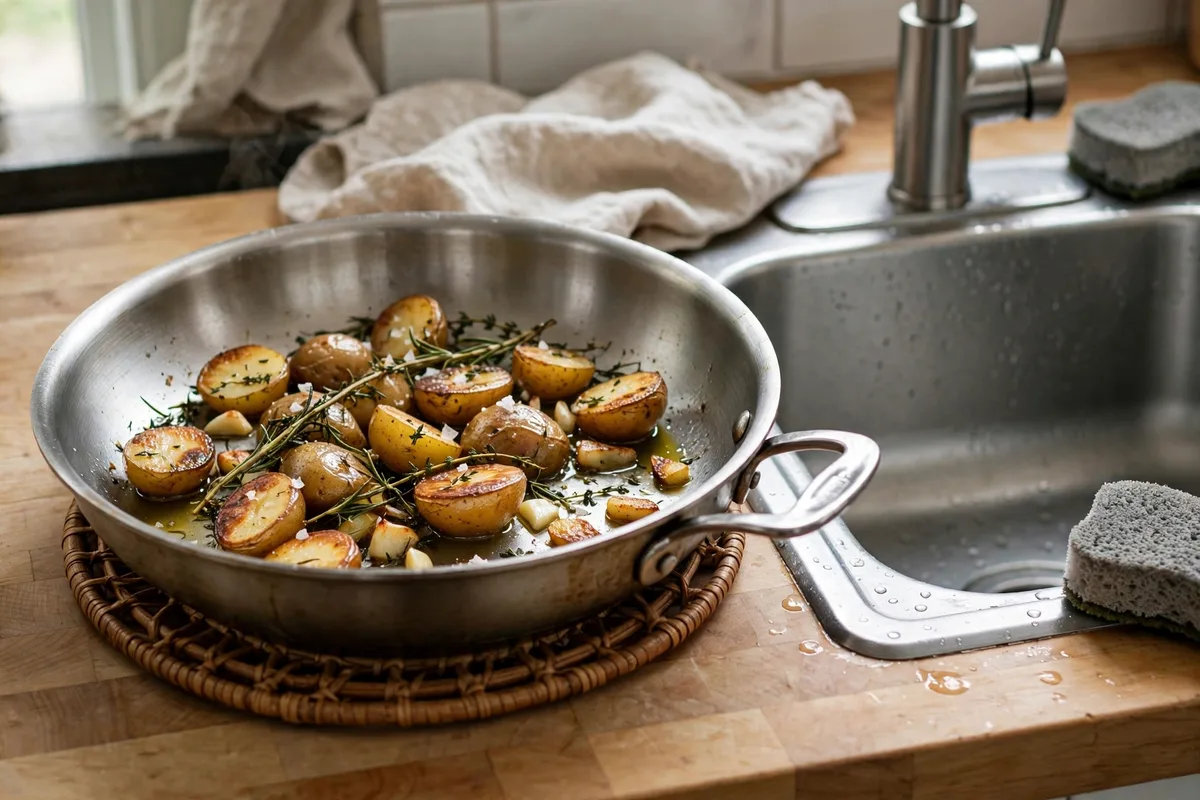
- Putting a hot pan under cold water. The metal contracts unevenly in seconds and the base bends — this is the fastest way to warp a pan. Fix: let the pan cool on the stove, then wash it in warm water.
- Starting on high heat from cold. High heat from cold concentrates stress in the center of the base, and over months the pan domes. Fix: preheat on medium for 2 to 3 minutes, then raise the heat only if the recipe needs it.
- Using a burner smaller than the pan. A small burner heats only the center, so the center expands while the edges stay cool — the base domes. Fix: match the burner to the pan base, or use a smaller pan on that burner.
- Heating an empty pan on high. With no food or oil to absorb the heat, the base overheats and bends. Fix: heat on medium, and add oil before the pan gets very hot.
- Adding salt to cold water in the pan. Salt in cold water can pit the steel, leaving tiny dents that weaken the base over time. Fix: add salt only after the water has come to a boil.
- Ignoring a pan that spins. A pan that spins on the burner has a warped base, and it will heat unevenly and pool oil forever after. Fix: test the base on a flat counter once a month, and replace the pan if the spin gets worse — a badly warped pan is a safety risk, because it tips easily.
What do I need, and what should I skip?
You need a stainless steel pan with a flat base; a burner the same size as the pan base; a trivet or a cool burner for cooling; warm water and mild dish soap for washing.
Skip starting on high heat from cold. Skip a burner much larger or smaller than the pan. Skip putting a hot pan under cold water. Skip heating an empty pan on high. Skip washing a hot pan in cold water.
How to keep stainless steel pan from warping — the 5 habits that work?
| Habit | What it does | Warp risk | Do it |
|---|---|---|---|
| Preheat on medium, 2 to 3 minutes | Base expands evenly | Low | Always |
| Match burner to base | Whole base heats at once | Low | Always |
| Cool before washing | Metal contracts slowly | Low | Always |
| Hot pan under cold water | Uneven contraction | High | Never |
| Empty pan on high heat | Base overheats | High | Never |
| Small burner under a big pan | Center heats alone | High | Never |
What does the worked example look like?
Worked example: a 10-inch pan, 400°F, and 0.05 inch of expansion. You heat a 10-inch stainless steel pan to about 400°F. Metal expands when heated, and a 10-inch pan grows to about 10.05 inches at that temperature — that is 10.05 minus 10, which is 0.05 inch of growth, or about 1/20 of an inch. Heated slowly, the whole base grows that 0.05 inch together and shrinks back together as it cools. Shocked with cold water, one side shrinks fast while the other side is still hot, and that uneven 0.05 inch is what bends the base. That is how to fix warped stainless steel pan thinking in real numbers: the movement is tiny, 0.05 inch, and slow heating is what keeps it even. Our stainless steel vs nonstick cookware set guide compares stainless sets that hold up to this kind of heat.
When should I stop?
Stop using a pan that spins freely on the burner or rocks when you press the rim — it heats unevenly, pools oil on one side, and tips easily when full. You can sometimes press a slightly warped pan flat again with a wooden block and a mallet, but replace a badly warped pan: it will not heat evenly again, and no repair makes it safe. And stop the habit that warped it — a new pan warps the same way if you keep shocking it with cold water.
What is the quick checklist?
- Preheat slowly on medium for 2 to 3 minutes.
- Match the burner to the pan base.
- Let the pan cool before washing.
- Wash in warm water, never cold water on a hot pan.
- Never heat an empty pan on high.
- Test the base on a flat counter once a month.
What else helps on Kitchenlify?
- Cleaning & Care
- How to Prevent Food Sticking in a Stainless Steel Pan
- How to Clean a Burnt Stainless Steel Pan Without Scratching
- Stainless Steel vs Nonstick vs Cast Iron for Beginners
- All guides
Frequently asked questions
How to stop stainless steel pan from warping — what is the one rule?
Never put a hot pan under cold water. That single shock bends the base faster than any other habit. That is how to stop stainless steel pan from warping in one rule — and the second rule is just as simple: preheat slowly on medium heat instead of blasting a cold pan on high.
How to keep stainless steel pan from warping when I preheat?
Preheat on medium heat for 2 to 3 minutes, then add oil and wait for the shimmer. Slow heat lets the whole base expand evenly, so the metal grows together and shrinks back together. That is how to keep stainless steel pan from warping during the heat-up, which is when most warping starts.
How to fix warped stainless steel pan — can I flatten it again?
Sometimes, for a mild warp: warm the pan on low heat for 5 to 10 minutes, set it on a flat heat-resistant surface, put a piece of wood over the bowed side, and tap the wood gently with a mallet until the pan sits flat. Check it with a level and repeat if needed. A badly warped pan that spins freely will not come back — replace it, because it heats unevenly and tips easily.
Why does my stainless steel pan spin on the burner?
Stainless steel pan warping bends the base into a slight dome, so it touches the burner only in the center and spins around that point. The cause is almost always thermal shock — a hot pan under cold water, or high heat from cold. A pan that spins will pool oil on one side and cook unevenly, so it is time to change the habit or replace the pan.
Is a slightly concave pan bottom normal?
Yes — a slight dip of about 2 to 4 millimeters in the center is normal on many stainless steel pans, and it is deliberate: the metal flattens out as it heats. What is not normal is a pan that rocks, spins, or pools all its oil on one side. Test the pan cold on a flat counter: a small dip is fine, a spin is a warp.
Do thick pans warp less than thin pans?
Yes. A thicker, fully clad pan spreads heat through more metal and resists bending, while a thin pan has less material to absorb the stress and warps faster. But even a thick pan warps if you shock it — thickness buys forgiveness, not immunity. Slow heat and cool-before-washing matter for every pan.
Can I put a stainless steel pan in the dishwasher?
You can, but let it cool first and keep it away from the heating element. A hot pan in a cold dishwasher cycle gets the same shock as a hot pan under a cold tap. Hand-washing in warm water after the pan has cooled is the safest routine, and it also keeps the handles tight.
Does adding salt to cold water warp a pan?
It does not warp the pan, but it can pit the steel — salt sitting in cold water leaves tiny dents that weaken the base over time. Add salt only after the water has come to a boil, when it dissolves at once. It is a small habit that keeps the base smooth for years.
What burner size should I use for my pan?
A burner the same size as the pan base, or a little smaller. A burner much larger than the pan heats the sides and the handle; a burner much smaller heats only the center and domes the base. If your biggest burner is smaller than your pan, use a smaller pan on it — the matched pair heats evenly and warps far less.