How to Store Coffee Beans Fresh for the Longest Time
How to store coffee beans fresh for the longest time starts with the bag you just bought: coffee beans go stale because of four enemies — air, light, heat, and moisture. Most guides answer that with a catalogue of containers, which leaves a beginner with the real question unanswered: what do I do with the one small bag I just bought? This guide answers that question first: if you buy a small bag and finish it in two to three weeks of daily brewing, the best storage is usually the bag it came in — not a new container, and not the freezer — and this guide shows you exactly how to handle that bag, when decanting actually helps, and when freezing is worth it.
The short answer: how to store coffee beans fresh for the longest time
For a small bag finished in two to three weeks, keep the beans in their original bag if it has a valve, squeeze the air out, roll the top tight, clip it shut, and store it in a dark, cool cupboard away from the oven. Do not move the beans to a new container on day one, do not top up an old container with new beans, and do not freeze a small bag you will finish soon, because freezing and thawing a bag you open daily does more harm than good. Buy small, buy often, and grind only what you need for each brew.
Step by step
- Check the roast date and plan the finish date. Look for the roast date on the bag, not just a best-by date, and work out roughly when you will finish the bag at your normal daily amount — for most daily brewers, a small bag lasts about two to three weeks, which is the window this guide is built around. Beans are at their best in the first few weeks after roasting, and they fade gradually after that, so a bag you will finish in that window does not need long-term storage at all; it needs protection from air, light and heat for a short time, which the original bag already provides. If you will not finish the bag for two months or more, skip ahead to the decision table below, because that is a different problem with a different answer. Writing the roast date and your expected finish date on the bag takes ten seconds and stops you guessing later whether the beans are fresh or past their best.
- Keep a small bag in its original valved bag. If the bag has a small one-way valve — the little round disc you can feel on the front or back of many coffee bags — keep the beans in that bag, because the valve lets gas from fresh beans escape without letting air back in, and the bag itself blocks light. Fold the top of the bag down tightly to push out as much air as you can, roll it down firmly, and clip it shut with a bag clip or a tight fold held by a rubber band, so the opening stays sealed between brews. Do not decant a small bag into a new container on the first day, because every transfer exposes the beans to air and leaves a thin layer of old beans and oils in the new container, which is exactly the topping-up problem described below. The original bag, rolled tight and clipped, in a dark cupboard, is the simplest and often the best choice for a two-to-three-week bag.
- Store the bag in a dark, cool cupboard, away from heat. Put the clipped bag in a cupboard that stays cool and dark, away from the oven, the stove, a sunny windowsill and the top of the fridge, where heat rises and speeds up staling. Light and heat are quiet enemies: a bag left on the counter in sunlight, or next to the oven, will fade faster than the same bag in a dark cupboard, even if both are sealed. Do not store beans in the fridge for daily use, because a bag taken in and out of a cold fridge collects condensation, and moisture on the beans dulls flavor and can encourage mold in ground coffee. A steady, cool cupboard, opened only to take beans out for brewing, is the right home for a small bag, and it needs no special equipment at all.
- Use the daily routine on one small bag for two to three weeks. Imagine you buy one small bag on a Saturday and brew one pot every morning. On Saturday, you open the bag, brew the first pot, then squeeze the air out, roll the top tight, clip it, and put it in a dark cupboard. Each morning, you open the bag, scoop out only what you need, roll it tight and clip it again, and put it straight back — the whole ritual takes about fifteen seconds, and the beans stay protected between brews. By the second weekend, the bag is about half empty, but because it has been rolled tighter each day as the beans are used, there is very little trapped air inside, and the coffee still tastes fresh. By the third weekend, the bag is nearly finished, you buy the next small bag, and you start again with a fresh bag — no decanting, no freezing, no container to wash, and no old beans mixed in with new ones. That is the whole system, and it works precisely because the bag is small enough to finish before staling becomes the main problem.
- Grind only what you need, just before brewing. Whole beans stay fresh much longer than ground coffee, because grinding exposes a huge surface area to air, so ground coffee goes stale in days, not weeks, even in a sealed container. Grind only the amount you need for each brew, just before you brew it, and keep the rest of the bag whole, sealed and in the cupboard. If you buy pre-ground coffee, the same rule applies in reverse: buy the smallest bag you will finish quickly, keep it sealed and clipped in a dark cupboard, and accept that it will fade faster than whole beans, so finishing it promptly matters even more. Never grind a whole bag at once to save time, because you are trading a few minutes of convenience for a week of stale coffee.
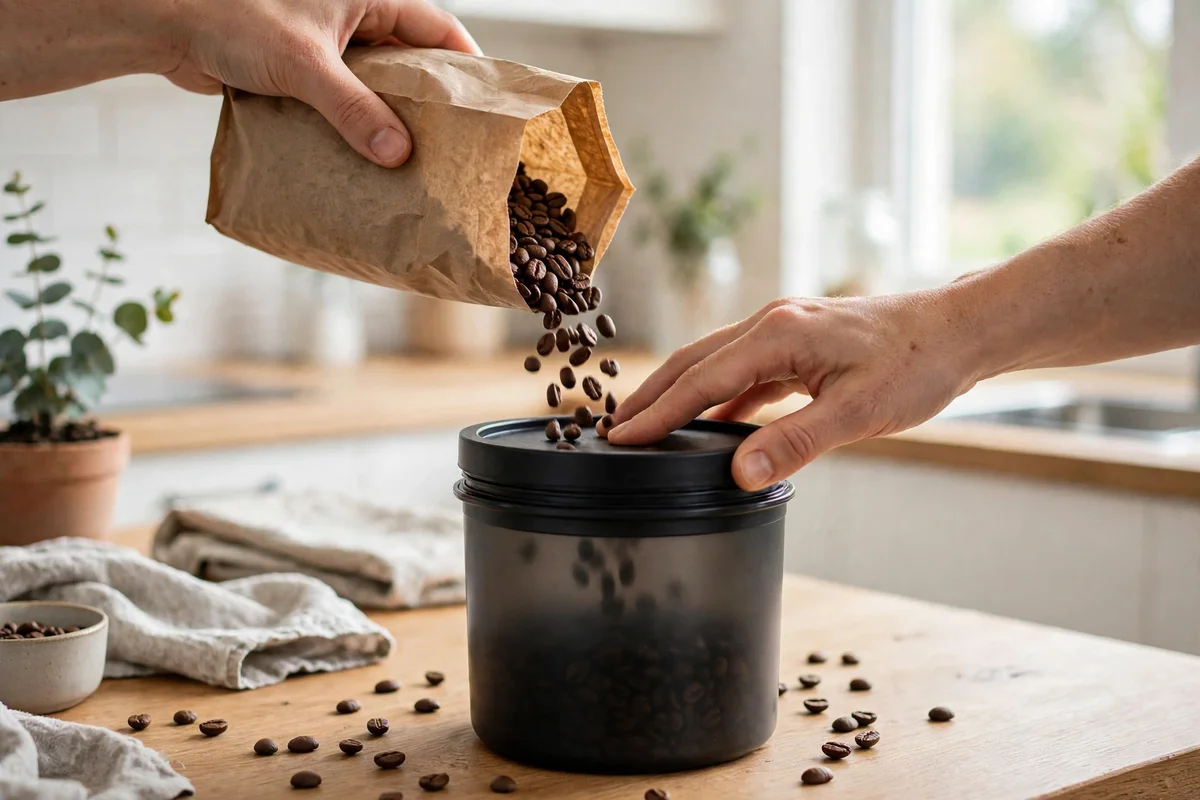
- Decant only when it actually helps, and freeze only for a large bag. Decanting into an airtight, opaque container helps when the original bag has no valve, will not reseal, or is torn, or when you buy a large bag that will last more than a month and you want to keep a small working amount handy while the rest stays sealed. In that case, move only a week's worth into the container, keep the rest sealed in the original bag, and wash and fully dry the container before refilling it, so old oils do not taint the new beans. Freezing is worth it only for a large bag you will not finish for a month or more, and only in small, sealed portions you thaw once and use fully, never refreezing — for a small two-to-three-week bag, freezing is pointless, because you will finish the bag before freezing would help, and repeated opening of a frozen bag causes condensation.
- Check for staleness before you brew, and use older beans well. Before brewing, smell the beans: fresh beans smell rich and fragrant, while stale beans smell flat, papery or faintly like old cooking oil, and the difference is usually obvious once you have smelled both. When you brew, watch the bloom — the bubbling and rising of the coffee bed when hot water first hits fresh grounds — because fresh beans bloom actively, while very stale beans barely bloom at all and produce a flat, dull cup. If the beans are stale but not spoiled, use them for a milky drink or a recipe where coffee is not the star, rather than throwing them away, but do not mix them with a fresh bag to stretch it, because the stale beans will dull the whole pot.
Common mistakes to avoid
- Topping up an old container with new beans. Adding fresh beans on top of old beans and oils means the old, stale layer mixes into every brew and taints the new beans. Fix: finish or empty a container completely, wash it, dry it fully, and only then refill it with fresh beans.
- Moving a small bag into a new container on day one. Every transfer exposes beans to air, and a new container often lets in more air than the original valved bag it replaced. Fix: for a bag finished in two to three weeks, stay in the original valved bag, rolled tight and clipped.
- Storing beans in the fridge for daily use. A bag moved in and out of the fridge collects condensation, and moisture dulls flavor. Fix: keep daily-use beans in a cool, dark cupboard, and only freeze large amounts in sealed portions you thaw once.
- Freezing a small bag you will finish soon. Freezing helps long storage, but opening and closing a frozen bag daily causes condensation and temperature swings that do more harm than good. Fix: freeze only a large bag you will not finish for a month or more, in small portions.
- Leaving the bag open, or in light and heat. An unclipped bag, a bag on a sunny counter, or a bag next to the oven lets air, light and heat fade the beans quickly. Fix: roll tight, clip shut after every brew, and store in a dark cupboard away from heat.
- Grinding the whole bag at once. Ground coffee goes stale in days, while whole beans last weeks, so grinding everything early wastes the freshness you paid for. Fix: grind only what you need for each brew, just before brewing.
What you need — and what to skip
You need the original bag with a valve if possible, a bag clip or rubber band to seal it, and a dark, cool cupboard away from heat. That is enough for a small bag. A grinder is useful if you buy whole beans, because grinding just before brewing keeps the rest of the bag fresh.
Skip a clear glass jar on the counter, because light fades beans even through a sealed lid, and skip a fridge container for daily use, because condensation is a bigger problem than the cold is a help. Skip vacuum-sealing equipment and special canisters for a small two-to-three-week bag: they are useful for large amounts stored for months, but they add cost and transfers without helping a bag you will finish soon. Skip buying a large bag to save money if you brew only one pot a day, because stale coffee is not a saving.
Decision table: bag size, finish time, storage choice
Use this table to settle the storage question in ten seconds, based on how much you bought and how fast you will finish it. Find your row, follow the storage choice in that row, and do not borrow a method from a different row, because the right answer changes with size and time.
| Bag size and finish time | Storage choice | Why |
|---|---|---|
| Small bag, finished in 2 to 3 weeks | Original valved bag, rolled tight and clipped, in a dark cupboard | Bag is finished before long-term staling matters; no transfer, no freezing needed |
| Small bag, no valve or torn bag | One airtight, opaque container, filled, sealed, in a dark cupboard | Sealed container replaces a bag that cannot seal, without light exposure |
| Large bag, finished in 1 to 2 months | One week's worth in a container, rest sealed in the original bag | Working amount stays handy; the bulk stays sealed and protected |
| Large bag, not finished for 2 months or more | Freeze in small sealed portions, thaw one portion fully and use it all | Freezing pauses staling for the bulk; portions avoid repeated thawing |
| Pre-ground coffee, any size | Smallest bag you will finish quickly, sealed and clipped, in a dark cupboard | Ground coffee fades in days, so finishing quickly matters more than the container |
When to stop — and when to throw beans out
Stop worrying about storage when the bag is sealed, clipped, in a dark cupboard, and being finished within a few weeks, because that is already the right system for a small bag, and adding more equipment will not make the coffee noticeably fresher. Throw beans out if they smell rancid, musty or like old oil, if they taste flat and papery even when freshly ground, or if they show any sign of moisture damage or mold, especially ground coffee stored damp — in that case, do not brew them, even in a milky drink. If the beans simply smell faint and bloom weakly, they are stale but not spoiled, so use them up in cooking or a milky drink and buy a fresh small bag next, rather than mixing them with fresh beans.
Related on Kitchenlify
- Coffee & Tea
- How to Clean a French Press Coffee Maker Properly
- How to Descale an Electric Kettle With Vinegar for Beginners
- All guides
Frequently asked questions
Should I keep coffee beans in the original bag or a container?
For a small bag finished in two to three weeks, keep them in the original valved bag, rolled tight and clipped, in a dark cupboard. Move them to an airtight, opaque container only if the bag has no valve, will not reseal, or is torn, or if you are storing a large amount for more than a month.
Should I freeze coffee beans to keep them fresh?
Freeze only a large bag you will not finish for a month or more, in small sealed portions that you thaw once and use fully. Freezing a small bag you will finish in two to three weeks is pointless, because repeated opening causes condensation and you will finish the bag before freezing helps.
Should I store coffee beans in the fridge?
No, not for daily use. A bag taken in and out of the fridge collects condensation, and moisture dulls flavor. Keep daily-use beans in a cool, dark cupboard, away from the oven and sunlight.
How do I know if coffee beans are stale?
Smell them: fresh beans smell rich and fragrant, stale beans smell flat, papery or faintly oily. When brewing, fresh grounds bloom actively when hot water first hits them, while very stale grounds barely bloom and make a flat, dull cup.
Is it bad to top up a container with new coffee beans?
Yes. Old beans and oils left in the container mix into the new beans and dull every brew. Finish or empty the container, wash it, dry it fully, and only then refill it with fresh beans.
What does the valve on a coffee bag do?
The small one-way valve lets gas from fresh beans escape without letting air back in, while the bag itself blocks light. That is why a small bag kept in its original valved bag, rolled tight and clipped, works well for two to three weeks. Do not move a small bag to a new container on the first day, because every transfer exposes the beans to air.
Should I buy a large bag or a small bag if I brew once a day?
Buy a small bag. A daily brewer usually finishes a small bag in two to three weeks, before staling becomes the main problem. A large bag bought to save money can go stale before you finish it, so a small bag you finish while fresh is the better choice for one pot a day.
Can I store ground coffee the same way as whole beans?
No, not for the same length of time. Ground coffee goes stale in days, not weeks, because grinding exposes a large surface area to air. Buy the smallest bag of ground coffee you will finish quickly, keep it sealed and clipped in a dark cupboard, and grind whole beans only when you buy them whole, just before brewing.
What should I do with stale coffee beans that are not spoiled?
Use them for a milky drink or a recipe where coffee is not the star, rather than throwing them away. Do not mix stale beans with a fresh bag to stretch it, because the stale beans will dull the whole pot. Throw beans out if they smell rancid, musty, or like old oil, or show any sign of moisture damage or mold.
How big is a small bag of coffee beans?
A small bag is usually 8 to 12 ounces (225 to 340 grams), which lasts a daily brewer about 2 to 3 weeks at one pot a day. Buy that size when you brew daily, and buy a larger bag only if you brew for several people every day, because a bag you cannot finish in 3 weeks goes stale before you use it.
How do I store coffee pods?
Keep pods in their box or in a sealed container in a cool, dark cupboard, away from heat and steam, and use them by the date on the box. Do not store pods above the coffee maker, because the steam and heat age them, and do not freeze pods, because condensation forms inside the pod when it thaws.
How do I store coffee beans in a humid climate?
Keep the bag sealed, in a cool, dark cupboard, and open it only to scoop out what you need, then clip it shut right away. Do not store beans in the fridge, because they absorb moisture and smells every time the bag opens, and do not leave the bag open on the counter, because humid air stales beans in days.