How to Thaw Chicken Safely in the Fridge
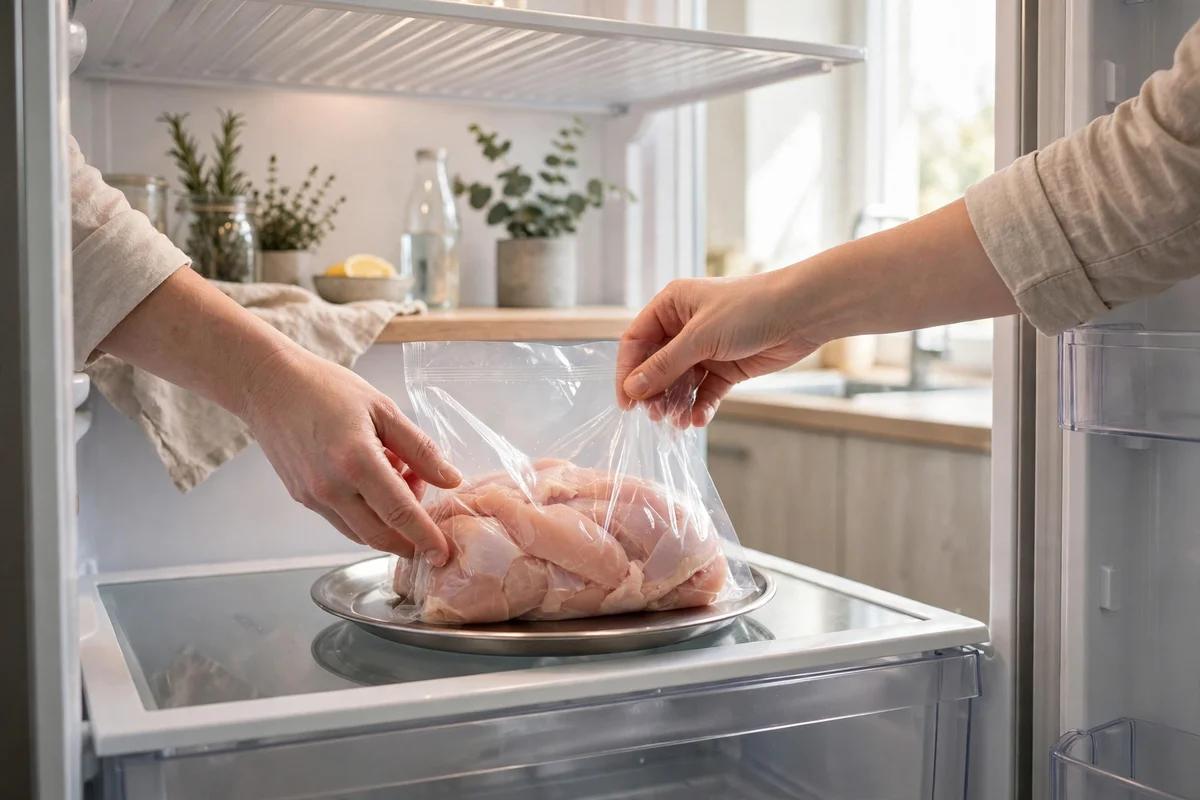
How to thaw chicken safely in the fridge starts on the bottom shelf: keep it sealed in its packaging or a leak-proof bag, place it on a rimmed tray on the bottom shelf, and leave it until it is soft all the way through with no icy center. Allow about 24 hours for every 5 pounds, which means boneless breasts often thaw in 12 to 24 hours, bone-in parts in about 24 hours, and a whole chicken in 1 to 3 days depending on size — then cook the chicken within 1 to 2 days after it has fully thawed. Never thaw chicken on the counter, because the outside warms into the temperature range where bacteria grow quickly while the inside is still frozen.

The short answer: how to thaw chicken safely in the fridge
Move the sealed chicken from the freezer to a rimmed tray on the bottom shelf of the fridge, and keep it there until fully thawed. Plan on 12 to 24 hours for boneless breasts, about 24 hours for bone-in parts, and 24 hours for every 5 pounds of a whole chicken. Keep the chicken sealed so juices cannot drip onto other food, keep the tray on the bottom shelf so any leak cannot fall onto ready-to-eat food below, and cook the chicken within 1 to 2 days after thawing. Do not refreeze chicken that has thawed in the fridge unless you cook it first.
Why this happens
Fridge thawing is the safest method because the chicken stays cold the whole time. Bacteria that can cause foodborne illness grow fastest between 40 degrees Fahrenheit and 140 degrees Fahrenheit, a range often called the danger zone. In the fridge, which should be at or below 40 degrees Fahrenheit, the chicken thaws slowly but never enters that range for long. On the counter, the opposite happens: the outer layers warm past 40 degrees within an hour or two while the center is still frozen solid, giving bacteria hours to grow on the surface before cooking. A rimmed tray matters because raw chicken juices can carry bacteria, and a single drip onto salad, fruit, or cooked leftovers below can contaminate food that will not be cooked again. The bottom shelf puts nothing underneath the chicken to catch a drip, which is why it is the rule even when the packaging looks sealed.
Step by step
- Plan the move the day before you need the chicken. Check the weight on the package and count backward from your cooking day. A package of boneless breasts needs a morning move for dinner the next day. A whole chicken needs 1 to 3 days, so move it 2 days before a weekend roast if you are unsure of its weight. Planning is the whole method, because fridge thawing cannot be rushed safely at the end.
- Keep the chicken sealed in leak-proof packaging. Leave the chicken in its original sealed packaging if it is intact. If the package is torn or leaking, place the chicken in a clean leak-proof bag and seal it, squeezing out extra air. Sealed packaging keeps juices inside, stops the chicken from drying out or picking up fridge smells, and makes the tray step work even if a small leak starts.
- Place it on a rimmed tray on the bottom shelf. Set a rimmed baking tray, plate with a rim, or shallow dish on the bottom shelf of the fridge, and place the sealed chicken on it in a single layer. The rim catches any juice if the packaging leaks. The bottom shelf ensures that even a leak cannot drip onto food below, because there is no food below it. Do not place raw chicken on a shelf above ready-to-eat food, even on a tray.
- Spread pieces in a single layer where possible. If you are thawing parts, spread them in one flat layer rather than stacking them in a pile. Pieces stacked on top of each other thaw unevenly, because the pieces in the middle stay frozen while the outer pieces thaw. If the package is a solid frozen block, leave it sealed and flat, and expect the center to take the longest.
- Leave it undisturbed until fully thawed. Do not open the package to poke or squeeze the chicken repeatedly, because each opening warms the surface and risks spreading juices. Leave it in the fridge and check it only when the planned time has passed. A whole chicken should feel soft all the way through, including inside the cavity, with no hard icy center when you press it gently through the packaging.
- Check that it is fully thawed before cooking. Press the thickest part through the packaging. It should feel soft and flexible, not hard or icy. For a whole bird, reach into the cavity, after washing your hands, and feel for ice. If any part still feels frozen, return it to the fridge for several more hours. Cooking partly frozen chicken leads to uneven cooking, with the outside done before the inside reaches a safe temperature.
- Cook within 1 to 2 days, and clean up safely. Once thawed, cook the chicken within 1 to 2 days. Keep it on the bottom shelf until cooking time. After handling raw chicken packaging, wash your hands with soap and water, wash the tray with hot soapy water, and wipe any fridge surface the package touched. Do not rinse raw chicken under running water, because splashing spreads bacteria around the sink without making the chicken safer.
Worked example: breasts for Tuesday, parts for Wednesday, a whole bird for Sunday
Suppose you have 3 frozen items: a 1.5-pound package of boneless breasts for Tuesday dinner, a 3-pound package of bone-in thighs for Wednesday dinner, and a 5-pound whole chicken for Sunday roast. The fridge method handles all three, but the move day is different for each, and moving them all on the same day would leave some thawed too early and one still frozen.
| Chicken | Weight | Move to fridge | Ready to cook | Cook by |
|---|---|---|---|---|
| Boneless breasts | 1.5 pounds | Monday morning | Tuesday morning | Wednesday |
| Bone-in parts | 3 pounds | Tuesday morning | Wednesday morning | Thursday |
| Whole chicken | 5 pounds | Friday morning | Saturday evening | Sunday |
The whole chicken shows why the 24-hours-per-5-pounds guide matters. A 5-pound bird needs about 24 hours, but a larger 7-pound bird needs closer to 36 hours, and a small 3-pound bird may be ready in about 15 hours. When in doubt, move the bird a day earlier rather than a day later, because thawed chicken kept cold on the bottom shelf is safe for 1 to 2 days, while a still-frozen bird on cooking day cannot be fixed safely by leaving it on the counter.
How long will your chicken take? Decide by cut and weight
Thawing time depends on thickness and weight more than on the type of chicken. A flat package thaws faster than a thick block of the same weight, and a whole bird thaws slowest because the cavity insulates the center. Use this table to plan, and always confirm by touch before cooking.
| Cut | Typical fridge time | Key check | If still frozen |
|---|---|---|---|
| Boneless breasts, 1 to 2 pounds | 12 to 24 hours | Soft and flexible throughout | Return to fridge for 6 to 12 hours |
| Bone-in parts, 2 to 4 pounds | About 24 hours | No hard center in thickest piece | Return to fridge for 12 hours |
| Whole chicken, 3 to 5 pounds | 24 to 36 hours | Cavity free of ice | Return to fridge for 12 to 24 hours |
| Whole chicken, over 5 pounds | 36 to 72 hours | Cavity and joints soft | Move it a day earlier next time |
Common mistakes to avoid
- Thawing chicken on the counter. Fix: always thaw in the fridge. Counter thawing warms the outside into the danger zone while the inside stays frozen, and that surface time cannot be undone by cooking.
- Placing chicken above ready-to-eat food. Fix: use the bottom shelf every time, on a rimmed tray. Even sealed packaging can leak, and a drip onto salad or leftovers contaminates food that will not be cooked.
- Stacking pieces in a pile. Fix: spread parts in a single flat layer. Stacked pieces thaw unevenly, so the middle stays frozen while the outside has already thawed.
- Cooking chicken that is still partly frozen. Fix: check the thickest part and the cavity by touch. If any ice remains, return the chicken to the fridge for several more hours rather than starting to cook.
- Keeping thawed chicken for many days. Fix: cook thawed chicken within 1 to 2 days. If plans change, cook it first and then refrigerate the cooked chicken, rather than letting raw thawed chicken sit.
- Rinsing raw chicken in the sink. Fix: do not rinse raw chicken. Rinsing splashes bacteria onto the sink, faucet, and nearby surfaces without making the chicken safer, because cooking is what makes it safe.
What you need — and what to skip
You need the sealed chicken, a rimmed tray or shallow dish large enough to hold it, space on the bottom shelf of the fridge, and soap and water for hand and tray washing. A food thermometer is useful at cooking time to confirm the chicken reaches 165 degrees Fahrenheit in the thickest part.
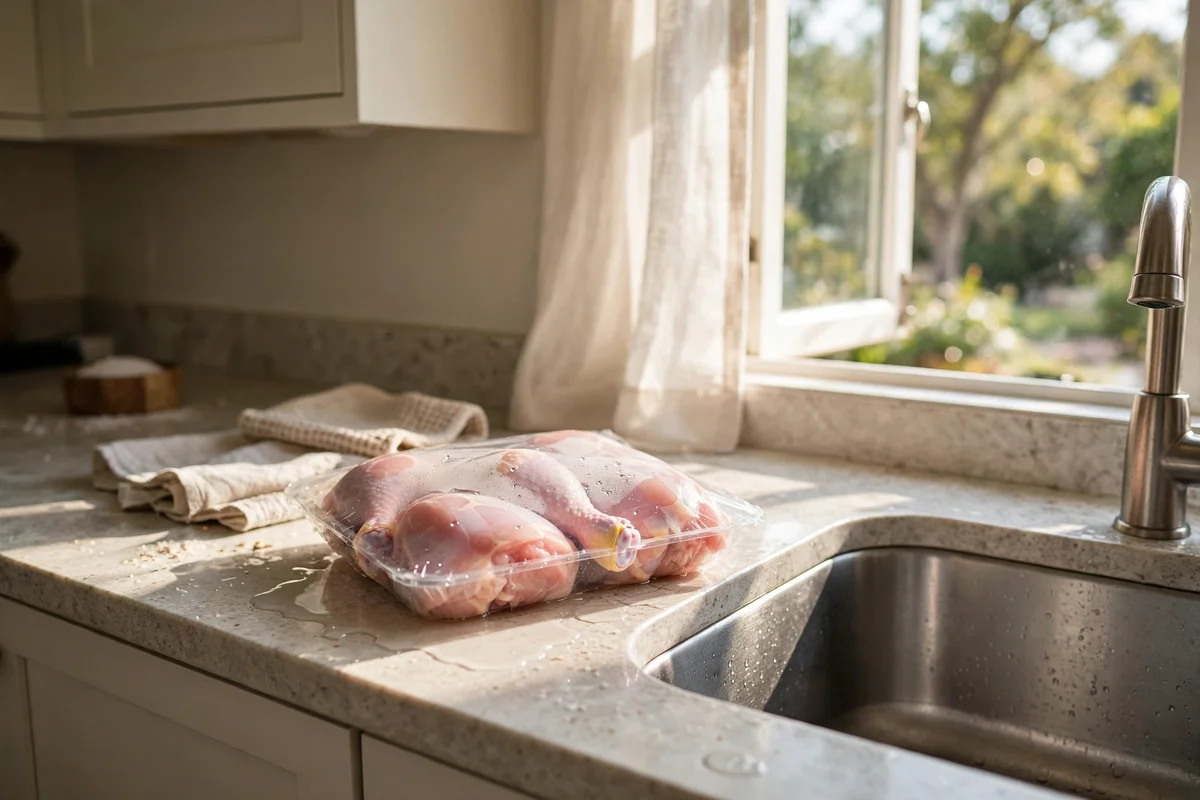
Skip counter thawing, skip hot water thawing, skip thawing in a bowl of standing water in the fridge, and skip refreezing raw chicken that has thawed in the fridge. Skip opening the package early to check, and skip placing the chicken on a flat plate with no rim, because a rimless plate cannot catch a leak.
When to stop — and safety notes
Stop and throw the chicken away if it smells strongly off after thawing, feels slimy, or has been left at room temperature for more than 2 hours, or more than 1 hour when the room is above 90 degrees Fahrenheit. Do not taste raw chicken to check it, and do not cook chicken that has sat out all day in the hope that cooking will fix it. Cook chicken until it reaches 165 degrees Fahrenheit in the thickest part, measured with a food thermometer, and keep raw chicken and its juices away from ready-to-eat food at every step. This guide gives general food-safety information for home cooking. It is not medical advice, and if you think you have eaten unsafe food and feel unwell, seek medical advice promptly.
Related on Kitchenlify
- All guides
- Food Storage
- Turkey Thaw Time Calculator
- How to Reheat Rice Safely
- How to Freeze Soup Without Freezer Burn
Frequently asked questions
How long does it take to thaw chicken in the fridge?
Allow about 24 hours for every 5 pounds. Boneless breasts often thaw in 12 to 24 hours, bone-in parts in about 24 hours, and a whole chicken in 1 to 3 days depending on size. Always confirm by touch that no icy center remains.
Can I thaw chicken on the counter if I cook it right away?
No. The outside of the chicken warms into the danger zone, between 40 and 140 degrees Fahrenheit, while the inside is still frozen. Fridge thawing keeps the whole bird cold until it is fully thawed.
Why does chicken go on the bottom shelf of the fridge?
Because raw chicken juices can drip, and the bottom shelf has no food underneath to contaminate. Even sealed packaging can leak, so the bottom shelf plus a rimmed tray is the safe combination.
How long can thawed chicken stay in the fridge before cooking?
Cook thawed chicken within 1 to 2 days. Keep it sealed on a rimmed tray on the bottom shelf during that time, and do not let raw thawed chicken sit for several days.
Can I refreeze chicken after thawing it in the fridge?
Do not refreeze raw chicken that has thawed in the fridge. If plans change, cook the chicken first, then refrigerate or freeze the cooked chicken, following normal leftovers guidance.
Should I rinse chicken before cooking it?
No. Rinsing raw chicken splashes bacteria around the sink and nearby surfaces without making the chicken safer. Cooking the chicken to 165 degrees Fahrenheit in the thickest part is what makes it safe.
How do I know the chicken is fully thawed?
Press the thickest part through the packaging. It should feel soft and flexible, with no hard or icy center. For a whole bird, check inside the cavity for ice as well, after washing your hands.
What if my chicken is still frozen on cooking day?
Return it to the fridge and wait, or change the meal plan. Do not move it to the counter to finish thawing, and do not start cooking a partly frozen bird, because the outside will cook before the inside reaches a safe temperature.
Does the packaging need to stay sealed while thawing?
Yes, keep it sealed if possible. Sealed packaging keeps juices inside and stops the chicken from drying out or picking up smells. If the package is torn, put the chicken in a clean leak-proof bag and seal it before placing it on the tray.
What temperature should my fridge be for thawing chicken?
At or below 40 degrees Fahrenheit. A fridge warmer than that lets the chicken spend time in the danger zone even while it thaws, so check your fridge setting if you are unsure.
Can I thaw chicken in cold water instead of the fridge?
Yes. Put the chicken in a sealed, leak-proof bag, submerge it in cold tap water, and change the water every 30 minutes. A pound of chicken thaws in about an hour this way. Cook it right after thawing, and do not use hot water, because hot water warms the outside into the danger zone while the inside is still frozen.
How long does ground chicken take to thaw in the fridge?
Ground chicken thaws faster than whole pieces: about 12 hours for a pound, or overnight in the fridge on a rimmed tray. Cook ground chicken the same day it finishes thawing, because ground meat spoils faster than whole cuts, and do not refreeze it after thawing.
Can I defrost chicken in the microwave?
Yes, but use the defrost setting and cook the chicken immediately after, because a microwave thaws unevenly and warms some parts into the danger zone. Stop the microwave halfway, turn the chicken over, and separate pieces as they loosen, so it thaws more evenly. Do not microwave-defrost chicken and then put it back in the fridge to cook later.