What Pans Work on Induction Cooktop
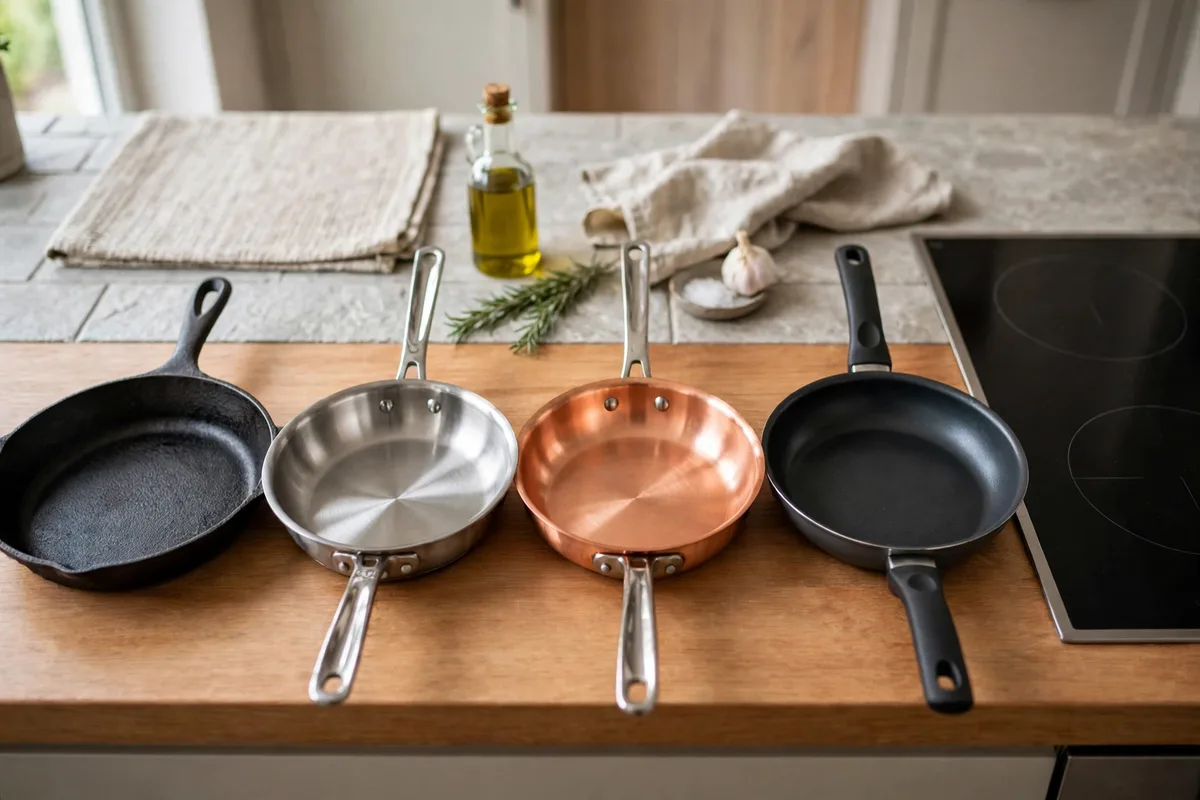
What pans work on induction cooktop: cast iron, carbon steel, enameled cast iron, and magnetic stainless steel — any pan a fridge magnet sticks firmly to. Induction heats the pan with a magnetic field, so a pan only works if its base contains enough iron. Bare aluminum, copper, glass, and ceramic do not work, unless the maker bonded a magnetic steel plate into the base. This guide shows the 30-second magnet test, the material-by-material list, and what to do with pans that fail.
what pans work on induction cooktop — what is the short answer?
Hold a fridge magnet to the bottom of the pan. If it sticks firmly, the pan works on induction; if it slides off or barely holds, it will not heat properly. That is the whole test behind what cookware works on induction cooktop: cast iron and carbon steel always pass, most clad stainless steel passes, and bare aluminum, copper, glass, and ceramic fail unless they have a magnetic base layer. Check every pan you own before you buy new ones — most kitchens already have more induction-ready pans than their owners think.
How do I do it step by step?

- Do the magnet test on every pan you own. Take a fridge magnet and hold it to the bottom of each pan. A firm grip means the pan works. A weak grip means the pan will heat slowly and noisily, if at all. No grip means the pan will not heat. Test the whole base, not just the center — a pan with a small magnetic disc heats only in the middle.
- Sort your pans into works, sometimes, and never. Put the firm-grip pans in the works pile: cast iron, carbon steel, enameled cast iron, and magnetic stainless steel. Put weak-grip pans in the sometimes pile — they heat, but slowly and unevenly. Put no-grip pans in the never pile: bare aluminum, copper, glass, and ceramic without a magnetic base.
- Check stainless steel carefully. Not all stainless steel is magnetic. All-18/10 stainless steel — the common kind in older or budget sets — is usually non-magnetic and fails the test. Stainless steel with a magnetic outer layer, often labeled 18/0 or induction-ready, passes. If the label says induction-ready and the magnet sticks, trust the magnet.
- Check the base size against the cooking zone. A pan works best when its base covers most of the cooking zone. A base much smaller than the zone may not be detected at all, and a base much larger than the zone heats unevenly. As a rule, the base should be about the same size as the marked circle.
- Check that the base is flat. Set the pan on a flat counter and press the edges — it should not rock. A warped base lifts off the glass and heats only in spots. Flat-bottom woks work on induction; round-bottom woks do not, because only a small patch touches the glass.
- Try one pan on the cooktop before you buy a set. Put your best magnetic pan on the cooktop, add a little water, and turn it on. If the water heats fast and evenly, your pans are fine and you do not need a new set. If the cooktop shows an error or the water barely warms, the pan failed — and that tells you more than any label.
- Decide what to do with pans that fail. Keep a favorite aluminum or copper pan for gas or electric cooking, or use it with an induction interface disc — a magnetic plate that sits between the cooktop and the pan. A disc works, but it heats slowly and wastes energy, so it is a stopgap, not a fix. For pans you use every day, replacing them with magnetic ones is the better answer.
What mistakes should I avoid?

- Trusting the label without the magnet test. Some pans say induction-ready but have a tiny magnetic disc that heats only in the middle. Fix: test with a magnet — firm grip across the base is what matters.
- Using a pan with a weak magnet grip. A weak grip means slow, noisy heating and hot spots. Fix: treat weak-grip pans as sometimes pans, not everyday pans.
- Using a pan smaller than the cooking zone. A tiny pan on a large zone may not be detected at all. Fix: match the base size to the marked circle.
- Using a warped or round-bottom pan. A warped base or a round-bottom wok touches the glass in one small spot and heats unevenly. Fix: use flat-bottom pans only.
- Sliding cast iron across the glass. Cast iron is heavy and rough, and sliding it scratches the cooktop. Fix: lift cast iron to move it, every time.
- Buying a whole new set on day one. Most kitchens already own several induction-ready pans. Fix: test what you have first, then buy only what is missing.
What do I need, and what should I skip?
You need a fridge magnet for the test; a flat counter to check pan bases; a little water to test one pan on the cooktop; the cooktop manual, for the error codes.
Skip buying a new set before testing the pans you own. Skip trusting the label alone without the magnet test. Skip small pans on large cooking zones. Skip round-bottom woks and warped pans.
Which pan materials pass the induction test
| Material | Works on induction? | Magnet test | Notes |
|---|---|---|---|
| Cast iron | Yes | Strong grip | Excellent; lift, do not slide |
| Carbon steel | Yes | Strong grip | Fast and responsive; flat bottom only |
| Enameled cast iron | Yes | Strong grip | Smooth base is gentle on glass |
| Clad stainless steel | Usually | Firm grip if magnetic layer | Check the outer layer, not the inside |
| All-18/10 stainless steel | No | Weak or no grip | Common in older sets; fails the test |
| Aluminum with steel base | Yes | Firm grip on the base | Look for the steel plate or induction symbol |
| Bare aluminum or copper | No | No grip | Needs a bonded magnetic base |
| Glass, ceramic, stoneware | No | No grip | Only with an interface disc |
What does the worked example look like?
Worked example: testing 10 pans from one kitchen. You pull 10 pans from your cabinets and test each one with a fridge magnet. The magnet sticks firmly to 7 of them — 2 cast iron skillets, 1 carbon steel pan, 3 stainless steel pans, and 1 enameled Dutch oven. It slides off the other 3 — 2 bare aluminum pans and 1 copper pan. That is 7 pans that work and 3 that do not, and 7 plus 3 is 10, so every pan is accounted for. You keep the 7, move the 3 to a shelf for gas cooking, and you do not need to buy a new set — that is the answer to do all pans work on induction cooktop in one kitchen: no, but most of yours probably do.
When should I stop?
Stop using a pan that the cooktop does not detect — it will not heat, and repeated error codes are the cooktop telling you the pan is wrong. Stop forcing a weak-grip pan for everyday cooking: it wastes energy and cooks unevenly. And stop buying pans without checking the magnet first — a quick test in the store saves a return trip.
What is the quick checklist?
- Magnet test every pan — firm grip means it works.
- Cast iron, carbon steel, enameled cast iron always pass.
- Check stainless steel — all-18/10 usually fails.
- Match the base size to the cooking zone.
- Flat base only — no warped or round-bottom pans.
- Test one pan on the cooktop before buying a set.
What else helps on Kitchenlify?
- Cooking Basics
- How to Use Induction Cooktop for Beginners
- Best Cookware Set for Induction Beginners Under $100
- Stainless Steel vs Nonstick vs Cast Iron for Beginners
- All guides
Frequently asked questions
Which pans work on induction cooktop and which do not?
Cast iron, carbon steel, enameled cast iron, and magnetic stainless steel work — any pan a fridge magnet sticks firmly to. Bare aluminum, copper, glass, and ceramic do not work, unless the maker bonded a magnetic steel plate into the base. That is the full answer to which pans work on induction cooktop and which do not: magnetic base, yes; no magnetic base, no.
What cookware works on induction cooktop if I already own a full set?
Test every pan with a fridge magnet first — that is how you find out what cookware works on induction cooktop in your own kitchen. Most kitchens already have several pans that pass: cast iron, carbon steel, and most clad stainless steel. Replace only the pans that fail, starting with the ones you use every day.
Do all pans work on induction cooktop?
No. That is the short answer to do all pans work on induction cooktop: only pans with a magnetic base heat on induction. Bare aluminum, copper, glass, and ceramic pans will not heat at all, and the cooktop will show an error or stay silent. Non-magnetic stainless steel, such as all-18/10, also fails.
Does stainless steel work on induction?
Some stainless steel does and some does not. Stainless steel with a magnetic outer layer — often labeled 18/0 or induction-ready — works well. All-18/10 stainless steel, the common kind in older sets, is usually non-magnetic and fails the magnet test. Test the pan, not the label.
Can I use aluminum pans on induction?
Only if the pan has a magnetic steel base bonded into it. Bare aluminum is not magnetic and will not heat on induction. Look for the induction symbol on the base, and confirm with a magnet — a firm grip means it works.
Can I use copper pans on induction?
Only copper pans with a magnetic steel base layer work. Pure copper is not magnetic and will not heat. Some modern copper pans are sold as induction-ready because they have that steel layer — test with a magnet before you cook.
Can I use a nonstick pan on induction?
Yes, if the nonstick pan has a magnetic base. The coating does not matter — only the base does. Many modern nonstick pans have a steel plate pressed into the aluminum body. If the magnet sticks firmly to the base, the pan works.
What is an induction interface disc?
An interface disc is a flat magnetic plate you put between the cooktop and a non-magnetic pan. It heats up and passes the heat to the pan, so you can keep using a favorite aluminum or copper pan. It works, but it is slow and wastes energy, so it is a stopgap for one favorite pan, not a fix for a whole set.
Do induction pans work on gas and electric stoves too?
Yes. A magnetic pan is still a normal pan — cast iron, carbon steel, and stainless steel all work on gas, electric, and glass-top stoves as well. That is why replacing a failed pan with a magnetic one is safe: the new pan works on every stove you might own later.