How Accurate Are Food Scales?

How accurate are food scales? A good digital scale lands within a gram or two of the true weight for the amounts you weigh most often — a bowl of flour, a chicken breast, a scoop of oats. That is close enough that your baking turns out the same way every time you make it. But the number on the display only tells you part of the story: how fine the scale reads, and how you use it, decide whether that gram or two stays a gram or two — or quietly grows.
Short answer: for everyday cooking, a 1 g scale is accurate enough. For baking small amounts and coffee, you want 0.1 g. Start with the Etekcity 11lb in our best food scale for beginners guide — it reads in 1 g steps and covers everyday cooking and most baking. If you weigh yeast, salt, or coffee beans, step up to the 0.1 g bowl scale in our best food scale for baking guide.
As an Amazon Associate, we earn from qualifying purchases. The two scales we name below link to Amazon so you can check the listing — we never show prices here.
How accurate are food scales in everyday cooking?
For the weights you cook with most, a good digital scale is accurate enough that you can stop worrying about it. Weigh 250 grams of flour and the true weight sits within a gram or two of what the display shows — less than half a percent of the amount, far smaller than the difference between two scoops from a measuring cup. Weigh a chicken breast for dinner and a gram either way changes nothing you can taste. That is the honest answer for most kitchens: the scale is not the weak link in your cooking. The weak link is usually the cup. Scoop flour straight from the bag and you pack more in; spoon it lightly and level it off and you get less — same cup, different weight, different dough. A scale wipes that variation out. You pour, you watch the number climb, you stop at the weight the recipe asks for, and the recipe turns out the same way next week as it did this week.
That holds true as long as the scale is healthy and you use it right. A scale with dying batteries, a scale sitting on a soft mat, or a scale you overloaded last month can drift further off — and that is where most "my scale is wrong" stories start. The rest of this guide shows you where the line sits: which step size you need, when a gram matters and when it does not, and how to check your own scale in five minutes with a coin.
Accuracy vs precision: two words that are not the same
Listings mix these two words up, and the mix-up costs people money. Accuracy means how close the reading sits to the true weight. Precision means how small a change the display can show. A scale can be precise without being accurate: it can show 10.0 grams in neat tenths while the bowl actually holds a little more or a little less. And a scale can be accurate without being finely precise: it can land within a gram of the true weight every time, but only show you whole grams.
Think of it this way. Precision is the size of the steps on the display — 1 gram steps or 0.1 gram steps. Accuracy is whether those steps land on the true weight. When you shop, the listing shouts about the steps because steps are easy to print in bold. Closeness to the true weight is harder to prove, so listings stay quiet about it. That is why you should never pick a scale on step size alone. A well-made 1 g scale that reads true every time beats a cheap 0.1 g scale that drifts, jumps, or reads differently depending on where you place the bowl. Repeatability is the clue you can actually check at home: weigh the same item five times in a row, taking it off completely between each weigh. If the number comes back the same every time, the scale repeats well. If it wanders, no step size on the box will save your baking.
0.1 g vs 1 g: the step size that changes what you can weigh
The step size decides the smallest amount you can weigh usefully. A 1 g scale shows you whole grams: 2, 3, 4. A 0.1 g scale shows you tenths: 2.0, 2.1, 2.2. That difference means nothing at 250 grams of flour and everything at 3 grams of yeast. Here are the two scales from our own guides that show the split clearly.
| Scale | Step size | Capacity | Rating | Best for |
|---|---|---|---|---|
| Etekcity Bowl 11lb | 0.1 g below 1000 g, 1 g above | 11 lb / 5 kg | 4.7 stars, 59,027 ratings | Baking small amounts, coffee, weighing in a bowl |
| Escali Primo 11lb | 1 g | 11 lb / 5 kg | 4.6 stars, 7,425 ratings | Everyday cooking, simple two-button use |
Run the yeast test in your head. You need 3 grams of yeast for a loaf. On the 1 g Escali Primo, the display jumps from 2 to 3 to 4 in whole grams, and each jump is a third of the amount you need — you cannot see whether you added 2.6 or 3.4 grams, because the display only shows whole numbers. On the 0.1 g Etekcity Bowl scale, you watch the number climb a tenth at a time and stop at 3.0. Same story with 4 grams of baking powder, where one whole gram is a quarter of the amount. Now flip it around: you need 250 grams of flour. One gram is less than half a percent of that, so the 1 g scale is plenty — you would never taste the difference, and you would never see it in the loaf.
Two details from the listings matter here. The Etekcity Bowl scale reads 0.1 g only below 1000 g, and switches to 1 g steps above that — which is fine, because everything above a kilogram is a bulk amount where tenths do not matter. It also reads from as little as 1 g, so it picks up the small amounts a 1 g scale can only guess at. The Escali Primo keeps it simpler: 1 g steps across the whole range, two buttons, and a lifetime warranty. If your cooking lives above 100 grams most days, that simplicity is the better buy. If your baking lives in the single grams, the finer steps earn their keep.
When precision matters: baking and coffee
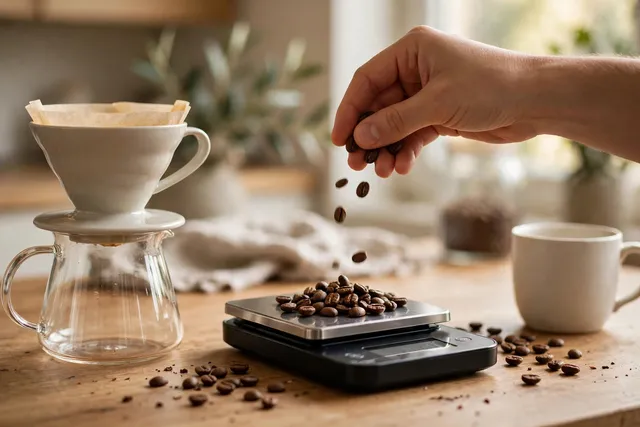
Baking is where small errors turn into real failures. Yeast, salt, and baking powder all work in single grams, and a gram too much or too little changes how dough rises and how a cake sets. Sourdough starter feeding is the same: you feed by weight every day, and a scale that hides small changes makes the starter drift from one feeding to the next. Splitting cake batter evenly between pans is another spot where the step size shows — a 1 g scale can leave one pan noticeably heavier than the other when you work in small batches. If you bake by weight, the 0.1 g scale pays for itself in loaves that rise the same way twice. Our best food scale for baking guide compares the scales that read fine enough for this work.
Coffee is the other place where tenths matter. A pour-over dose is often around 18 grams, so a 1 g step is a visible share of the dose, and it also hides the slow pour of water — you add water, the display sits still, then jumps a gram all at once. A 0.1 g scale with a timer lets you watch the dose and the water climb smoothly, so you can repeat a brew that tasted right instead of guessing at it. That is why coffee scales read to 0.1 g and carry a timer, while everyday kitchen scales do not need either. Our best food scale for coffee guide covers the 0.1 g scales built for this job.
When it does not matter: everyday cooking
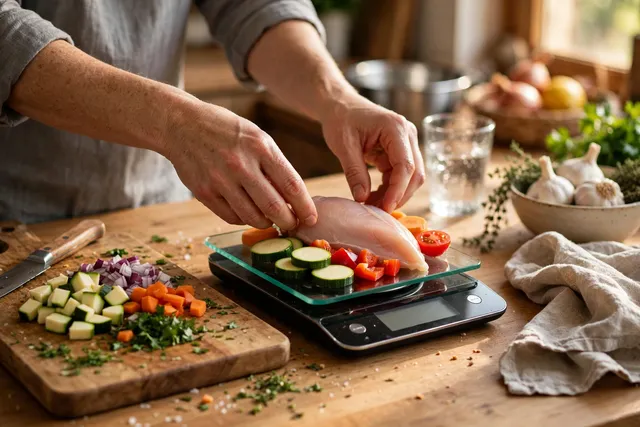
Most of your cooking does not need fine steps at all. A pot of soup, a tray of roasted vegetables, a week of meal prep — a gram or two either way disappears into the pot. Portioning chicken for dinner, weighing oats for breakfast, measuring rice for four people: the amounts run into the hundreds of grams, and the recipe forgives a gram. Chasing 0.1 g steps for this kind of cooking buys you nothing you can taste, and it usually buys you a smaller platform, a shorter battery life, or a scale that turns off while you are still chopping.
So match the scale to the job, not to the boldest number on the listing. If you cook dinner most nights and bake on weekends, a 1 g scale does the job and stays simple. If you bake bread every week or brew pour-over every morning, the 0.1 g scale earns its place on the counter. And if you do both, keep the 1 g scale for dinner and let the 0.1 g scale live next to the coffee maker — two tools, each doing the job it is good at.
What makes a scale read wrong
A healthy scale reads true. When it does not, one of these is usually the cause — and most of them are fixable in seconds.
- A soft or uneven surface. A scale on a dish towel, a silicone mat, or a warped board reads off because the feet do not sit flat. Move it to a hard, level counter and test again.
- Overloading. Every scale has a maximum load, and weighing past it can damage the sensors for good. Both scales above hold 11 lb / 5 kg including the bowl — a heavy bowl plus a big dough can get closer to that limit than you think.
- Low batteries. When the batteries run down, readings jump, stick, or drift. Fit fresh batteries before you blame the scale.
- Heat. A hot bowl or pan straight from the oven warms the sensors and skews the reading. Let hot containers cool a little, or weigh into a room-temperature bowl.
- Drafts and vibration. A scale next to an open window, a vent, or a running appliance can wobble by a gram. Move it somewhere still.
- Crumbs under the platform. Flour and sugar work their way under the platform and press on the sensors. Wipe the top and the edges clean with a dry cloth.
- Weighing below the minimum. The Etekcity Bowl scale reads from 1 g. Below that, no kitchen scale is the right tool — a pinch of spice or a dusting of saffron belongs on measuring spoons, not on a scale built for kilograms.
How to test your scale at home in 5 minutes
You do not need calibration weights to check a kitchen scale. A coin and an unopened bag from the pantry tell you what you need to know.
- Set it up right. Put the scale on a flat, hard counter, away from drafts and vibration. Switch it on, let it sit empty for a few seconds, and check that it reads zero.
- Test low with a nickel. A US nickel weighs 5 g. Place it gently in the centre of the platform and wait for the number to settle. It should read 5 g on a 1 g scale.
- Test repeatability. Take the nickel off, put it back on, and repeat five times. The readings should match every time. If they wander by more than a gram or two, the scale repeats poorly — and that matters more than any single reading.
- Test high with a sealed bag. Weigh an unopened bag of flour or sugar and compare the reading with the weight printed on the bag, remembering to tare out the bag itself or add its weight in your head. A gram or two either way is fine.
- Test the corners. Place the nickel in the centre, then move it to each corner. The reading should stay the same. If one corner reads differently, the platform or the sensors sit unevenly.
- Decide. If the readings stay within a gram or two at every weight, your scale is doing its job. If they sit further off, fit fresh batteries, move the scale to a flatter spot, and test again. If it still reads wrong, replace it — do not try to correct for the error in your head, because the error rarely stays the same at every weight.
One honest note: a coin is a rough check, not a lab calibration. It tells you whether your scale is close and steady, which is what your cooking needs. It does not certify the scale to a tenth of a gram, and no home test can. If you need that level of proof, a kitchen scale is the wrong tool for the job.
5 mistakes that make readings worse — and the fix
- Weighing on a soft mat, then trusting the number. Fix: lift the scale onto the bare counter before you weigh anything. A towel under the scale is the most common silent error in a home kitchen.
- Forgetting to tare, then doing mental subtraction for every ingredient. Fix: place the bowl on the scale, press tare to zero, add the ingredient, press tare again, and add the next one. One bowl, no subtraction, no extra washing.
- Pouring straight from a height into a bowl on the scale. Fix: pour slowly and let the number settle before you read it. Falling flour hits the sensors hard and the display can lock onto the spike.
- Reading the first number before it settles. Fix: wait two or three seconds after the last pinch lands. A scale that is still climbing has not finished measuring yet.
- Weighing tiny amounts on a big 1 g scale. Fix: use the right tool for the amount. A pinch of yeast on a scale that only shows whole grams is guesswork with extra steps — use a 0.1 g scale or measuring spoons instead.
When to stop — safety note
Stop trusting the scale the moment it stops repeating itself. If the same bowl reads a different weight every time you set it down, or the display flickers or blanks under a normal load, the numbers are no longer good enough for baking — and no amount of careful pouring fixes that. A scale that took a hard drop or a soaking needs the same treatment: put it aside, because water and shocks damage the sensors in ways you cannot see and cannot correct for. Never push past the maximum load — overloading can bend the sensors out of shape for good — and never set a very hot bowl or pan straight onto the platform, because heat skews the reading and can damage the surface. Between uses, keep the scale dry and somewhere nothing heavy sits on top of it. If you will not use it for a while, take the batteries out so they cannot leak inside it.
Related on Kitchenlify
- best food scale for beginners — our top 5 beginner scales, led by the 1 g Etekcity 11lb
- best food scale for baking — the 0.1 g scales that handle yeast, salt, and small baking amounts
- best food scale for coffee — 0.1 g scales with timers for pour-over and espresso
- How to Choose a Kitchen Scale for Beginners — the tare-first flour test and the starter spec
- Cups to Grams Converter — turn cup measures into grams before you weigh
- All guides
Frequently asked questions
How accurate are food scales?
A good digital scale lands within a gram or two of the true weight for the amounts you weigh most often, such as a bowl of flour or a chicken breast. That is close enough for everyday cooking and most baking. The step size matters more than the brand: a 1 g scale suits everyday cooking, while a 0.1 g scale suits small baking amounts and coffee.
Is a 0.1 g food scale more accurate than a 1 g scale?
Not always. The 0.1 g number is the step size, not a promise that every reading sits closer to the true weight. A 0.1 g scale shows smaller changes, which helps with tiny amounts such as yeast and coffee beans. A well-made 1 g scale can still read closer to the true weight than a cheap 0.1 g scale that drifts.
Do I need a 0.1 g scale for baking?
You need one when you weigh small amounts by weight, such as yeast, salt, and baking powder, or when you feed a sourdough starter. A 1 g step is a third of a 3 g yeast measure, so the display jumps past the amount you need. For flour, sugar, and dough in the hundreds of grams, a 1 g scale does the job well.
Do I need a 0.1 g scale for coffee?
Yes, if you brew by weight. A coffee dose is often around 18 g, so a 1 g step is a noticeable share of the dose, and it also hides the slow pour of water. A 0.1 g scale with a timer lets you watch the dose and the water climb a tenth of a gram at a time, which is how you repeat a brew that tasted right.
Why does my scale show a different weight each time I weigh the same thing?
The surface, the batteries, or the way you place the item usually cause it. Move the scale to a flat, hard counter, fit fresh batteries, place the item gently in the centre, and wait a few seconds for the number to settle. If the readings still jump around by more than a gram or two, the scale may be worn out or damaged.
How do I test if my food scale is accurate?
Weigh a US nickel, which weighs 5 g, then weigh the same item five times in a row and check that the readings match. Then test at a higher weight with an unopened bag of flour or sugar and compare the reading with the weight printed on the bag. If the readings stay within a gram or two, your scale is doing its job.
Can a food scale be wrong by a lot?
Yes, when something is wrong with it. Overload it, drop it, soak it, or leave dying batteries in it, and it can read several grams off, or give a different number every time. A healthy scale stays within a gram or two. If yours does not, change the batteries, move it to a flat surface, and test it again before you trust it.
Does a food scale stay accurate over time?
A good one holds its accuracy for years if you treat it well. Keep it on a flat surface, do not overload it, keep it dry, and change the batteries before they run flat. Test it with a nickel every few months. If the readings start to drift or jump, test it properly and replace it rather than guessing your way through recipes.
Is a 1 g scale good enough for everyday cooking?
Yes. For soups, stews, roasts, oats, rice, and portioning meat, a gram or two changes nothing you can taste. You only need finer steps when the amount itself is tiny, such as yeast, salt, baking powder, or a coffee dose. Buy the 1 g scale for everyday cooking and save the 0.1 g scale for baking and coffee.
What should I do if my scale reads wrong?
First change the batteries and move the scale to a flat, hard surface, then test it again with a nickel. Check that nothing touches the platform and that no crumbs sit under it. If it still reads more than a gram or two off, or the numbers keep jumping, stop using it for baking and replace it.