How to Choose a Colander Size for Beginners
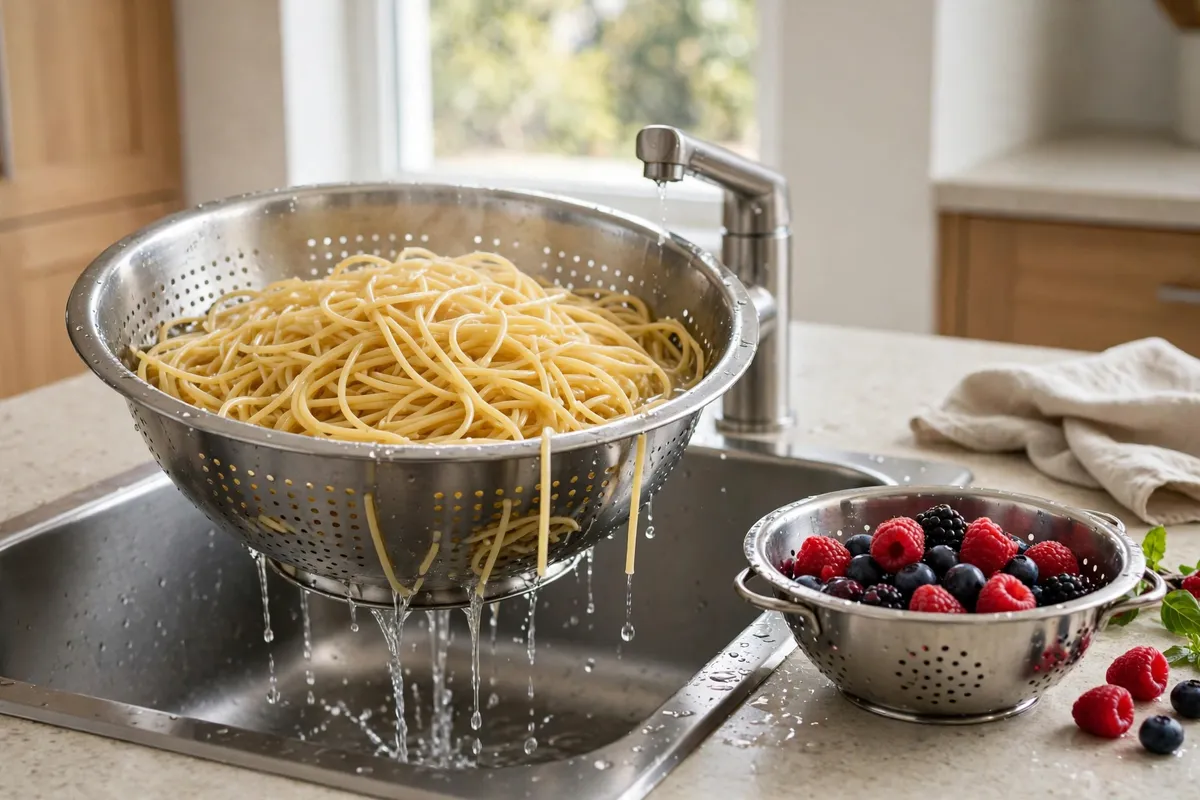
How to choose a colander size for beginners starts with the jobs you drain most. Start with a 4 to 5 quart colander, about 9 to 11 inches across, for pasta for two to four people. Add a small 1 to 2 quart colander for berries, herbs, and canned beans if you rinse small foods often. The colander must hold the full pot of food with room to spare, sit stable on its feet in the sink, and have holes small enough that the food you drain most cannot slip through. A colander that is too small spills pasta over the edge, while a colander that is far too large is hard to lift, hard to store, and awkward for small jobs.
How to choose a colander size for beginners — what do quarts, diameter, holes, and feet actually decide?
Quarts measure how much food the colander holds, and diameter measures how wide it is across the top, which affects how easily you can pour a pot into it without missing. A colander that holds 4 to 5 quarts can handle a pound of pasta plus water draining, while a 1 to 2 quart colander suits a pint of berries or a can of beans. Hole size decides what stays in and what falls through. Large holes drain pasta fast but let rice, quinoa, and small berries slip through. Fine holes hold small foods but drain more slowly and can clog with starchy pasta water. Feet and a stable base decide whether the colander sits still in the sink while you pour hot water into it, and handles decide whether you can lift it safely when it is full and hot. Material matters too: stainless steel is durable and handles hot water well, plastic is light but must be checked for hot-water safety, and silicone collapsible models save storage space but can be less stable when full.
Step by step: choose a colander size by the jobs you drain most
Use this worked example: you cook pasta for two twice a week, rinse berries for breakfast most mornings, and cook pasta for four friends once a month. Follow the steps with those three jobs in mind, and you will see why one colander cannot cover them all well, and which two sizes to buy.

- List the foods you drain most, and sort them by size and volume. Write down the foods you drain in a typical week: pasta for two, berries, canned beans, and pasta for four are the example jobs, but yours may include rice, vegetables, or salad greens. Sort each job by food size: pasta and vegetables are large and need larger holes, while berries, rice, and quinoa are small and need finer holes. Sort each job by volume as well: pasta for two is about 2 to 3 quarts of cooked pasta, pasta for four is about 4 to 5 quarts, and berries are about 1 quart. This list is your size chart: a colander that handles the largest job will be too big for the smallest job, and a colander that handles the smallest job will spill the largest job.
- Choose the main colander for your largest regular job, not your smallest. Pick a 4 to 5 quart colander, about 9 to 11 inches across, for pasta for two to four people, because it holds the full pot with room to spare and gives you a wide opening to pour into without missing. Test it against your largest pot: the colander should sit stable in the sink, with its rim below the sink edge if possible, so hot water does not splash over the sides. If your largest regular job is pasta for six or more, move up to a 5 to 6 quart colander, but do not buy a very large colander for a once-a-year job, because a colander that is too large is hard to lift when full of hot pasta and water, and it takes up cabinet space every day for a job you do rarely.
- Add a small colander for berries, herbs, and canned beans. Pick a small colander of 1 to 2 quarts, about 6 to 7 inches across, for berries, herbs, canned beans, and rinsing small vegetables, because a large colander lets small foods slip through large holes or get lost in a wide bowl. Test it with a pint of berries: the berries should sit in the bowl without falling through, and water should drain freely when you rinse them. A small colander is also easier to hold under a faucet with one hand, which matters when you are rinsing herbs or beans quickly. If you drain rice or quinoa often, choose a fine-mesh strainer for that job instead, because even a small colander's holes may be too large for grains.
- Check hole size against the smallest food you will drain in each colander. Hold each colander up to the light and compare the holes with the food you drain most in it: pasta needs holes large enough to drain fast, but not so large that short pasta slips through, while berries need holes small enough that a blueberry cannot pass through. For the main pasta colander, medium holes that drain quickly are right, and for the small berry colander, smaller holes are right. If one colander must do both jobs, choose smaller holes and accept slower draining for pasta, rather than larger holes that lose berries. Check the hole pattern as well: holes in the bottom drain fastest, while holes up the sides help when the colander is full and water needs to escape quickly.
- Check feet, stability, and handles with a full, hot load in mind. Set the colander in your sink and press down gently on the rim: it should sit flat on its feet without rocking, and it should not tip when you press on one side. Check the handles: they should be wide enough to grip with wet hands, and long enough to hold safely when the colander is full of hot pasta. A colander with a flat base and sturdy feet is safer than one with a rounded bottom that rolls in the sink, and a colander with a ring base can be stable if the ring is wide enough. Imagine pouring a pot of boiling water into it: if the colander slides, tips, or feels unsteady when empty, it will be worse when full and hot, and it is not the right colander for pasta.
- Check hot-water safety for the material, especially for plastic. For stainless steel, hot water is not a problem, and the colander can handle boiling pasta water directly. For plastic, check the label for a maximum temperature and for hot-water safety, because some plastics soften, warp, or release smells when boiling water is poured through them. If the label is unclear, do not use a plastic colander for boiling pasta water: use it for cold rinsing only, and use steel for hot draining. For silicone collapsible models, check that the colander locks open firmly and does not collapse under a full load of hot pasta, because a collapsing colander in a sink of hot water is a burn risk, not just an inconvenience.
- Test both sizes in one week, and keep the one that spills least. In one week, drain pasta for two in the main colander, rinse berries in the small colander, and drain pasta for four in the main colander, noting after each job whether food spilled, whether water drained fast enough, whether the colander stayed stable, and whether it was easy to lift and store. If pasta spills over the main colander's edge, move up one size. If berries slip through the small colander, move to finer holes. If the main colander is hard to lift when full, consider a lighter material or a slightly smaller size, and use a second batch for very large meals. One week of real draining tells you more than any size chart, because it tests volume, holes, stability, and lifting together.
Colander sizes by job
| Colander size | Diameter about | Best for | Watch out for |
|---|---|---|---|
| Small, 1 to 2 quarts | 6 to 7 inches | Berries, herbs, canned beans | Pasta spills over the edge |
| Medium, 3 to 4 quarts | 8 to 9 inches | Pasta for two, vegetables | Too small for pasta for four |
| Large, 4 to 5 quarts | 9 to 11 inches | Pasta for two to four | Heavy to lift when full of hot pasta |
| Extra-large, 6 quarts or more | 11 inches or more | Pasta for six or more | Hard to store, awkward for small jobs |
What you need — and what to skip
You need a main colander that fits your sink and your largest pot, a small colander for berries and beans, and a fine-mesh strainer if you drain rice or quinoa often. A sink that the colander sits stable in, and handles you can grip with wet hands, complete the setup. You do not need a colander in every size to start: a large and a small colander cover most beginner kitchens well.
Skip a colander that rocks in your sink, skip a plastic colander with unclear hot-water safety for boiling pasta, and skip a collapsible colander that does not lock open firmly under a full load. Skip buying the largest colander on the shelf for a once-a-year job, skip using a large-hole colander for rice or berries, and skip lifting a full colander of hot pasta with one hand or with wet, slippery handles.
6 mistakes beginners make — and how to fix them
- Buying a colander that is too small for your pasta pot. Fix: choose a colander that holds the full pot of cooked pasta with room to spare, usually 4 to 5 quarts for pasta for two to four. A small colander spills pasta and hot water over the edge.
- Using large holes for berries, rice, or quinoa. Fix: use a small colander with finer holes for berries, and a fine-mesh strainer for rice and quinoa. Large holes drain pasta fast, but they lose small foods.
- Ignoring feet and stability until the colander tips in the sink. Fix: test the colander in your sink before you buy, pressing on the rim to check for rocking. A stable base and sturdy feet matter more than a pretty shape when hot water is involved.
- Pouring boiling water through a plastic colander without checking the label. Fix: check the maximum temperature and hot-water safety on the label. If it is unclear, use steel for hot draining and plastic for cold rinsing only.
- Lifting a full colander of hot pasta with one hand. Fix: use both handles, with dry hands or a towel, and lift slowly over the sink. A full colander is heavy, and a one-handed lift is how spills and burns happen.
- Storing a wet colander in a closed cabinet. Fix: dry the colander fully, especially around feet and joints, before storing it. A wet colander stored in a closed space can smell musty and can rust if it has steel joints.
When to stop — safety note
Stop using a colander at once if it collapses under a load, if its feet are broken so it rocks in the sink, or if a plastic colander softens, warps, or smells when hot water is poured through it. Always pour hot water away from your body, keep your hands clear of steam rising from the sink, and lift a full colander with both handles, slowly, over the sink. Never place a colander on a hot burner to dry it, never use a damaged colander for hot pasta, and check the material label before the first hot use. If a colander tips, slides, or feels unsteady when empty, it will be worse when full and hot, and it should not be used for pasta until it is replaced or stabilized.

Related on Kitchenlify
- Kitchen Tools & Gadgets
- Pasta Per Person Calculator
- How to Choose Pot Size for Cooking for Two
- How to Choose Mixing Bowl Sizes for Beginners
- All guides
Frequently asked questions
What size colander should a beginner buy first?
A 4 to 5 quart colander, about 9 to 11 inches across, is the best first colander for most beginners, because it handles pasta for two to four people with room to spare. Add a small 1 to 2 quart colander later for berries, herbs, and canned beans, because a large colander is awkward for small jobs and may let small foods slip through.
How many quarts is a standard colander?
There is no single standard, but common sizes are small at 1 to 2 quarts, medium at 3 to 4 quarts, and large at 4 to 5 quarts, with extra-large models at 6 quarts or more. Check the label for quarts and diameter, and test the colander against your largest pot and your sink, because the name on the label varies between makers.
Can I drain pasta in a small colander?
Only for a very small amount, such as pasta for one person. For pasta for two or more, a small colander will spill pasta and hot water over the edge, because cooked pasta takes up much more space than dry pasta. Use a 4 to 5 quart colander for pasta for two to four, and drain in batches if you only have a small colander.
What hole size is best for a colander?
Medium holes suit pasta and vegetables, because they drain fast without letting short pasta slip through. Smaller, finer holes suit berries and small foods, and a fine-mesh strainer suits rice and quinoa, which slip through even small colander holes. If one colander must do both jobs, choose smaller holes and accept slower draining for pasta.
Are plastic colanders safe for boiling water?
Only if the maker says so on the label. Some plastics soften, warp, or smell when boiling water is poured through them, while others are rated for hot water. If the label is unclear, use a stainless steel colander for hot pasta water, and use plastic for cold rinsing only, such as berries and salad greens.
Should a colander have feet or a flat base?
Feet or a flat base both work, as long as the colander sits stable in your sink without rocking. Feet lift the colander above the sink bottom so water can drain underneath, while a flat base sits directly on the sink. Test the colander in your sink, pressing on the rim, and choose the one that stays put when you pour.
How do I stop pasta from sticking in a colander?
Drain pasta promptly, shake the colander gently to remove excess water, and return the pasta to the pot or toss it with sauce right away, rather than leaving it sitting in the colander. Pasta left sitting in a colander cools, dries, and sticks together, and no colander material prevents that if the pasta sits for several minutes.
Can I use a colander as a steamer?
Only if the maker says it is safe for that use, and only if it fits your pot with a lid on top. A metal colander can work as a makeshift steamer in some pots, but a plastic or silicone colander may not tolerate the heat, and a colander that does not fit the pot will let steam escape. Use a proper steamer basket if you steam food often.
How do I clean and store a colander?
Wash it promptly with hot soapy water, paying attention to holes and joints where food can trap, rinse well, and dry it fully before storing it. Store it where it will not be crushed by heavy pans, and do not store a wet colander in a closed cabinet, where it can smell musty. A colander that is dried and stored carefully lasts much longer.