How to Choose a Dinnerware Set Size for a Family of 4 for Beginners
How to choose a dinnerware set size for a family of 4 for beginners starts with a simple idea: the right set is not the biggest one, it is the one that gives four people a full place setting each, plus enough spares for a busy day, without filling every cabinet you own. Buying a first dinnerware set for a family of four sounds simple until you face the shelf, with sets of twelve, sixteen, twenty-four pieces and more, all claiming to be the right size. This guide explains piece counts in plain terms, what each piece is actually for, and how to pick a set size that fits your table, your dishwasher, and your cupboard.
The short answer: how to choose a dinnerware set size for a family of 4 for beginners
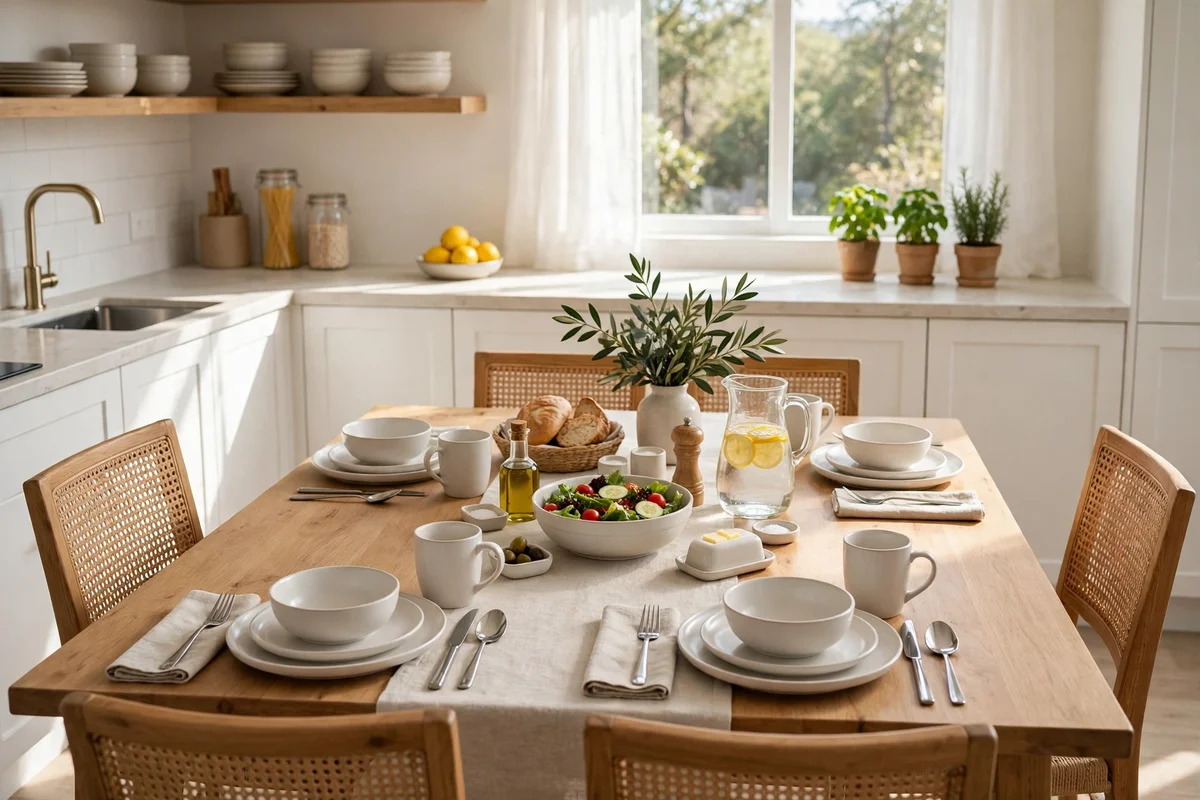
For a family of four, a sixteen-piece set is the usual starting point: four dinner plates, four salad or side plates, four bowls, and four mugs. That gives everyone one full setting at the table and leaves you a workable routine if one or two pieces are in the dishwasher. A twelve-piece set can work if you already own mugs or bowls, while a larger set makes sense only if you regularly host guests or want a full spare round for busy days.
Reconciling the conflicting rules: which count fits your routine
Beginners meet three different rules, and all three can be right for different households. Four settings is the minimum for a family of four. Household plus two guests gives six settings. Doubling the household gives eight settings. The table below shows which rule fits which routine, so you can pick the count that matches your washing, your guests, and your cabinets, instead of guessing between them.
| Your routine | Rule that fits | Settings to buy | Why it ends there |
|---|---|---|---|
| Dishwasher runs daily, guests are rare, cabinets are small | Four settings is enough | 4 settings | Clean pieces return daily, so no spare round is needed and a larger set would only fill the cabinets |
| Dishwasher runs every other day, guests are rare, cabinets are ample | Add a spare round for washing days | 6 settings | One round can sit dirty while the other round is in use, which the minimum count cannot cover |
| Dishwasher runs daily, guests come about once a month, cabinets are ample | Household plus two guests | 6 settings | Four settings serve the family and two spare settings serve guests, without doubling the whole set |
| Dishwasher runs every other day, guests come about once a month, cabinets are ample | Double the household | 8 settings | Dirty pieces, daily use, and guests all need cover at the same time, which only the largest count provides |
Bowl size deserves the same plain treatment. A soup or cereal bowl needs enough depth to hold a full serving with room to carry it to the table without spilling, while a pasta or salad bowl needs width so food can be tossed and eaten without piling up in the middle. If soup and cereal dominate your week, favor deeper bowls. If pasta and salads dominate, favor wider, shallower bowls. Capacity alone does not tell you this; depth and width do.
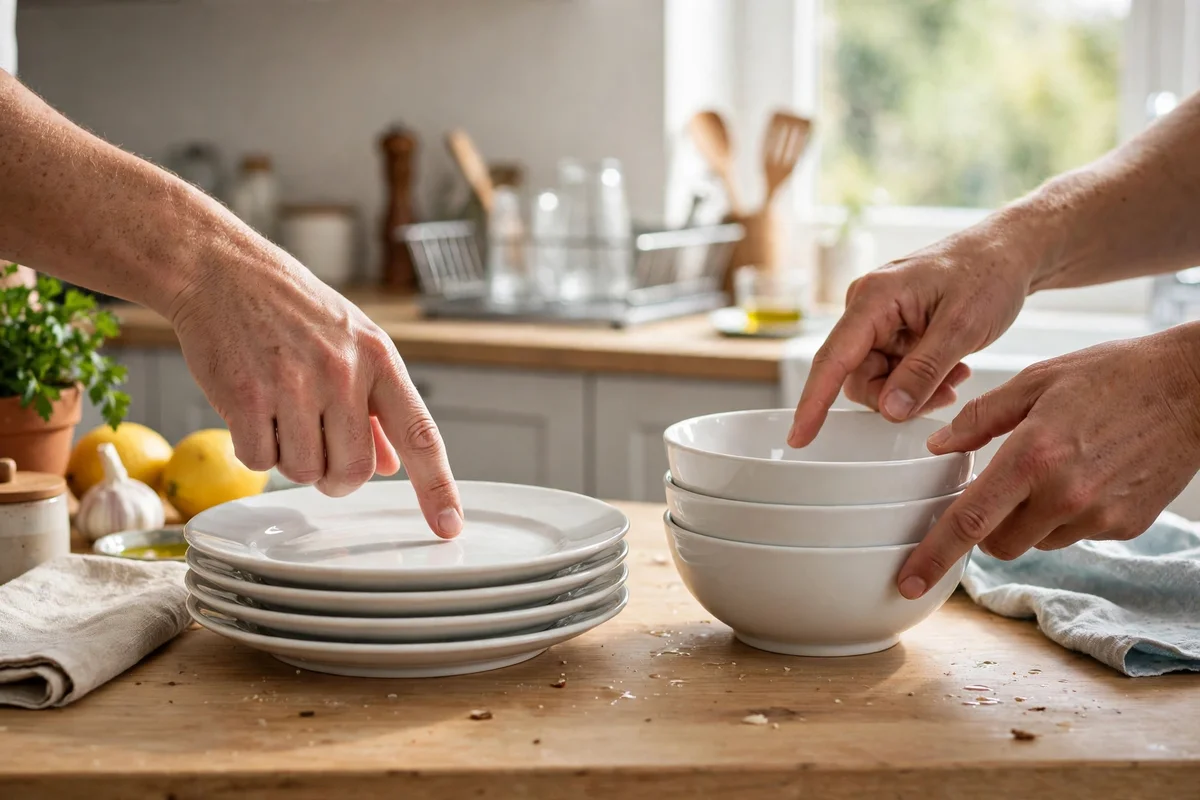
Plate diameter is a fit question, not just a looks question. Measure your dishwasher rack spacing and the depth of your cabinet shelf, then compare them with the plate diameter. A dinner plate wider than the rack spacing will not load flat, and a plate wider than the shelf depth will waste space or catch on the door. Finally, settle the mug-or-second-bowl choice by what your family actually eats and drinks. If hot drinks are part of most meals, the version with mugs is the useful one. If soup, cereal, and pasta are part of most meals, the version with a second bowl is the useful one. Count the pieces per setting first, so you know which version you are actually buying.
Step by step
- Count place settings, not just pieces. A set advertised as sixteen pieces is usually four place settings of four pieces each, while a twenty-four-piece set may be four settings of six pieces or six settings of four pieces. Always divide the total pieces by the pieces per setting to find how many people the set actually serves. For a family of four, you need four complete settings at minimum, and the pieces per setting tell you whether you are getting bowls, mugs, or only plates.
- Start with the sixteen-piece shape. Four dinner plates, four side plates, four bowls, and four mugs cover breakfast, lunch, and dinner for four people without daily juggling. Dinner plates hold the main meal, side plates handle salads, bread, and desserts, bowls cover cereal, soup, and pasta, and mugs cover hot drinks. If your family rarely drinks from mugs at meals, a set without mugs plus your existing cups can be just as good, but do not assume mugs are included unless the listing says so.
- Check dinner plate size against your table and dishwasher. Dinner plates commonly measure around ten to eleven inches across, and that inch matters. A larger plate looks generous but may not fit four place settings comfortably on a smaller table, and may not fit your dishwasher racks. Measure your dishwasher rack spacing and your table width, then compare them with the plate diameter. A plate that fits the dishwasher and leaves elbow room at the table is better than a grander plate that crowds both.
- Check bowl depth for the meals you actually eat. A shallow, wide bowl suits pasta and salads, while a deeper bowl suits cereal, soup, and noodles. Think about the meals your family eats most often in a normal week, not the meals you wish you cooked. If soup and cereal dominate, favor deeper bowls. If pasta and salads dominate, favor wider, shallower bowls. One bowl shape has to serve most meals, so pick the shape that matches your most frequent meal.
- Decide how many spares you honestly need. One full setting per person is the minimum, but real life includes a plate in the dishwasher, a bowl left in the sink, and a guest at the table. A set with four settings plus a few extra plates, or a second small set of the same plates, gives you that buffer. Buying a much larger set for spares you rarely use, however, just fills cabinets. A good rule is to add about half a round of spares, meaning two extra plates and two extra bowls, rather than doubling the whole set.
- Test the weight and grip before you commit. Dinnerware you lift every day should feel comfortable in your hands, not just look good on a shelf. Heavier pieces feel sturdy but tire small hands and can be hard for children to carry safely. Lighter pieces are easier to handle but can feel thin. If you can, hold one plate and one bowl before buying a full set, and check that the rim is easy to grip when the piece is warm or slightly damp.
- Check storage before you buy the box. Four settings of plates, side plates, bowls, and mugs take up real cabinet space, especially when stacked. Measure your cabinet height and depth, count how high you are willing to stack plates, and make sure mugs fit under the shelf above. A set that fits your table but not your cabinet will end up stacked on a countertop, which is not a storage plan. Plan the cabinet space first, then confirm the set fits it.
Common mistakes to avoid
- Buying the biggest set by default. A thirty-two-piece set sounds like value, but for a family of four it often means duplicate pieces you rarely use and cabinets you cannot close. Start with what four people need, then add spares deliberately.
- Counting pieces instead of settings. Sixteen pieces can mean four settings or eight partial settings, depending on what is included. Always work out how many complete place settings the set gives you before comparing sizes.
- Forgetting mug and bowl sizes. A set with plates you love but bowls too small for soup, or mugs too small for a normal drink, will frustrate you daily. Check every piece type, not just the dinner plate.
- Ignoring dishwasher fit. Plates that do not fit your dishwasher racks will be washed by hand forever, no matter how good they look. Measure rack spacing and plate diameter before buying.
- Choosing plate size for looks alone. Very large plates crowd small tables and make normal portions look lost. Choose a plate size that suits your table width and your usual portion size, not the largest size on offer.
- Stacking everything in one tall pile. Tall stacks of plates are heavy, hard to lift, and more likely to chip at the edges. Split plates into two shorter stacks, and keep everyday pieces within easy reach.
What you need — and what to skip
You need a tape measure, your table width, your dishwasher rack measurements, and an honest list of the meals your family eats most often. A quick count of your cabinet shelves and their heights completes the kit. No special tools are needed, and the measuring takes about ten minutes.

Skip serving platters, specialty plates, and matching extras in your first set unless you host often. Skip a second full set in a different style until you know which pieces your family actually uses every day, because those first weeks will tell you whether you need more bowls, more mugs, or simply more dinner plates.
Dinnerware set sizes compared for a family of 4
| Set size | What it usually includes | Who it suits | Drawback |
|---|---|---|---|
| 12 pieces | 4 dinner plates, 4 side plates, 4 bowls | Families who already own mugs | No mugs or spares included |
| 16 pieces | 4 dinner plates, 4 side plates, 4 bowls, 4 mugs | Most families of 4 starting out | Little spare capacity on busy days |
| 24 pieces | 4 settings of 6 pieces, or 6 settings of 4 | Families who host or want spares | Takes much more cabinet space |
| 32 pieces | 8 settings of 4 pieces | Large households or frequent hosts | Often too much for a family of 4 |
When to stop
Stop when four people can sit down to a normal meal with a matching plate, side plate, bowl, and mug each, the pieces fit your dishwasher and your cabinet, and you have a small buffer for a plate in the wash. If you are buying pieces you cannot store or settings nobody will use, you have gone past the right size for your household.
Related on Kitchenlify
- Dinnerware & Serveware
- How to Clean and Care for Stoneware Dinnerware
- How to Store Dinnerware in Small Cabinets Without Chipping
- All guides
Frequently asked questions
What size dinnerware set do I need for a family of 4?
A sixteen-piece set is the usual starting point for a family of four, giving four dinner plates, four side plates, four bowls, and four mugs. That is one full setting per person, and you can add a few spare plates and bowls if your dishwasher routine leaves pieces unavailable at mealtimes.
Is a 16-piece dinnerware set enough for 4 people?
Yes, for everyday meals, provided everyone uses one setting at a time. It feels tight on days when several pieces are in the dishwasher, so adding two spare plates and two spare bowls removes most of that pressure without buying a whole second set.
What size dinner plate is best for a family?
Dinner plates around ten to eleven inches across suit most families and tables. Larger plates look generous but can crowd a small table and may not fit dishwasher racks, so measure your table and dishwasher before choosing.
Do I need salad plates as well as dinner plates?
Side plates are useful for salads, bread, desserts, and snacks, and they protect the table when a meal has more than one course. If your family usually eats one-plate meals, you can manage with fewer side plates, but most sixteen-piece sets include them for good reason.
How many bowls should a family of 4 own?
Four bowls cover one each for cereal, soup, or pasta, and six bowls give you a comfortable buffer for busy mornings. If your family eats soup or cereal daily, favor deeper bowls in that count rather than adding shallow bowls you rarely use.
When does a family of 4 need more than 16 pieces?
Consider six or eight settings only if your routine needs them: six settings fit a dishwasher every other day or guests about once a month, and eight settings fit both at once with ample cabinets. Otherwise, a sixteen-piece set plus a few spares is enough.
Should I choose a set with mugs or a set with a second bowl?
Choose by what your family eats and drinks most. If hot drinks are part of most meals, the version with mugs is more useful. If soup, cereal, and pasta are part of most meals, the version with a second bowl is more useful.
How do I check a set will fit my cabinet?
Measure cabinet height and depth, count how high you are willing to stack plates, and make sure mugs fit under the shelf above. A set that fits your table but not your cabinet will end up stacked on a countertop.
How do I work out how many settings a set really gives?
Divide the total pieces by the pieces per setting. A sixteen-piece set is usually four settings of four pieces, while a twenty-four-piece set may be four settings of six pieces or six settings of four pieces, so always check the full piece list.
Should I buy open stock instead of a set?
Open stock — buying plates, bowls, and mugs singly — suits a household that breaks one piece often or needs more of one item, because you replace only what broke. A set is cheaper per piece when you need a full matching set at once. Many families buy a set first, then add open-stock spares for the pieces they break most.
How many spares should I keep with children in the house?
Keep 2 to 4 spare plates and bowls, stored where children can reach them without climbing. Spares let you keep a full table while a broken piece is replaced, and buying them with the set means the color and size match.