How to Cook Eggs in Stainless Steel Pan Without Sticking

How to cook eggs in stainless steel pan without sticking: preheat the dry pan on medium heat for 2 to 3 minutes, flick in a few drops of water until they bead up and glide across the surface, add enough fat to coat the bottom, then lower the heat and add the eggs. Eggs stick when the pan is too cold, too hot, or too dry — get those three right and the eggs slide. This guide shows the water-drop test, the fat, and the method for fried, scrambled, and omelet eggs.
how to cook eggs in stainless steel pan without sticking — what is the short answer?
A clean, dry pan, 2 to 3 minutes of preheating on medium heat, and the water-drop test: if the drops bead up and skate across the pan, it is ready; if they sizzle and vanish, it is not hot enough. Add 1 to 2 teaspoons of butter or oil per egg, swirl to coat, then turn the heat down to medium-low before the eggs go in. That is how to cook eggs in stainless steel pan without sticking for beginners in one paragraph: preheat, test, fat, lower the heat — and then leave the eggs alone until they release on their own.
How do I do it step by step?
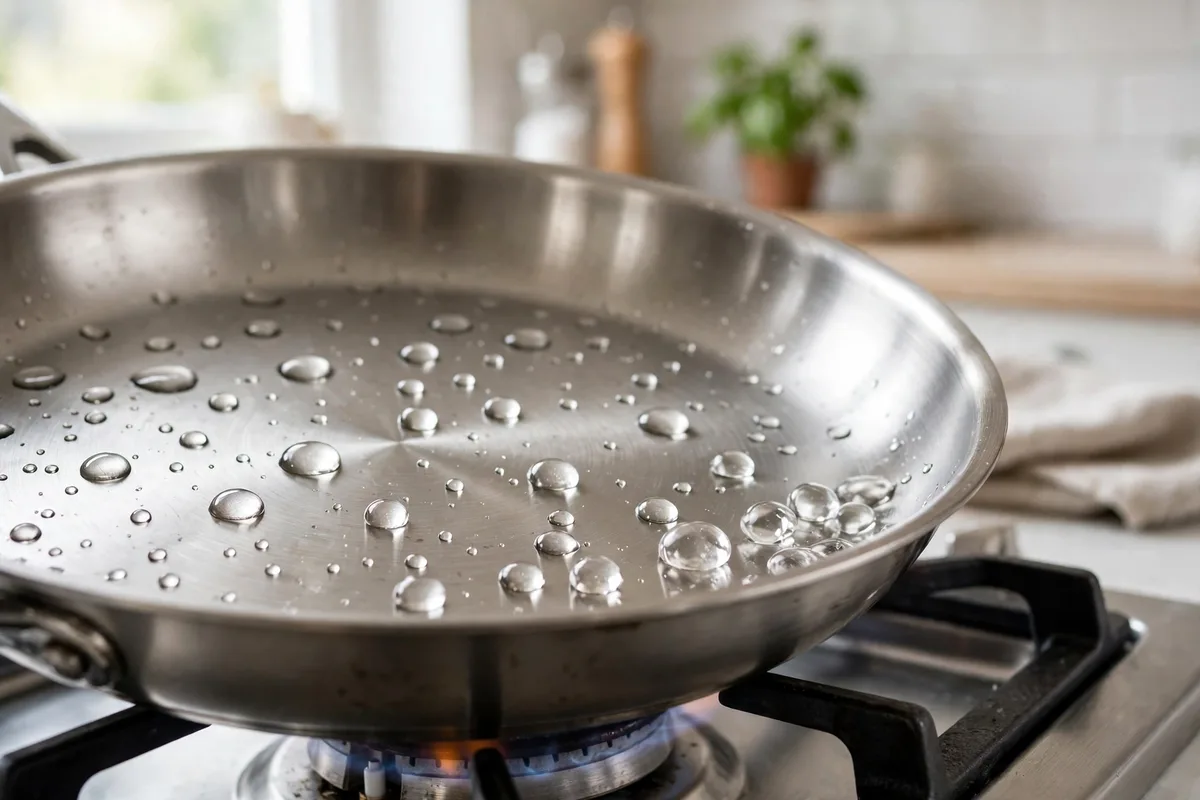
- Start with a clean, dry pan. Wash the pan and dry it fully — leftover residue or water spots give eggs something to grab. A small stainless steel frying pan is enough for the first few attempts. Put the pan on the burner empty; never add oil to a cold pan.
- Preheat on medium for 2 to 3 minutes. Set the burner to medium and give the pan 2 to 3 minutes to warm up evenly. Do not rush this with high heat: a pan that is too hot will scorch the butter and brown the eggs before they set. Patience here is the whole trick behind how to cook eggs in stainless steel pan without sticking.
- Do the water-drop test. Flick a few drops of water into the pan. If they sizzle and evaporate, the pan is not ready. If they bead up and glide around like drops of mercury, the pan has reached the right temperature — that is the Leidenfrost effect, a thin layer of steam lifting the water off the metal. If the water vanishes with an angry hiss, the pan is too hot: take it off the heat for a moment.
- Add fat and swirl to coat. Add 1 to 2 teaspoons of butter or oil per egg and swirl the pan so the fat coats the whole cooking area. Butter should melt and foam gently within a few seconds; oil should shimmer. If the butter browns or smokes right away, the pan is too hot — let it cool a little.
- Lower the heat, then add the eggs. Turn the heat down to medium-low right after the fat goes in, then crack the eggs into a small bowl first and slide them into the pan. Room-temperature eggs work best: cold eggs straight from the fridge drop the pan temperature fast and stick. You want a gentle sizzle, not violent spattering.
- Leave the eggs alone until they release. Do not touch the eggs for the first 30 to 60 seconds. The white is bonding and setting, and once it sets it releases from the pan on its own. Slide a thin spatula under the edge when the whites look set around the edges — if the egg resists, give it a few more seconds. This is where most sticking happens: moving the egg too early.
- Finish and serve right away. For fried eggs, cook 2 to 3 minutes for a runny yolk, or flip once for over-easy and cook 30 seconds more. For scrambled eggs, stir gently every 20 to 30 seconds and take the pan off the heat just before the eggs look done — they keep cooking on the hot steel. Serve at once, while the eggs are still soft.
What mistakes should I avoid?

- Adding oil to a cold pan. Cold oil soaks into the metal pores and the egg bonds to it. Fix: preheat the pan first, pass the water-drop test, then add the fat.
- Cooking on high heat. High heat scorches the butter, browns the eggs before they set, and makes sticking worse. Fix: medium heat to preheat, then medium-low once the eggs are in.
- Moving the eggs too early. An egg that has not set yet tears and spreads across bare metal. Fix: leave the eggs alone for 30 to 60 seconds until the whites set and release on their own.
- Using too little fat. A dry patch directly under the egg defeats the whole method. Fix: use 1 to 2 teaspoons of fat per egg and swirl it to coat the whole cooking area.
- Using fridge-cold eggs. Cold eggs drop the pan temperature fast and stick on contact. Fix: let the eggs sit on the counter for 10 to 15 minutes, or set them in a bowl of warm water for a few minutes.
- Pouring cold water into a hot pan. Cold water on hot steel can warp the pan and does not fix a stuck egg. Fix: if the eggs stick, add a teaspoon of water and cover the pan for 20 seconds — the steam releases them.
What do I need, and what should I skip?
You need a clean, dry stainless steel pan; butter or oil; a few drops of water for the test; room-temperature eggs; a thin spatula.
Skip adding oil to a cold pan. Skip cooking on high heat. Skip moving the eggs before they set. Skip using a dry pan with no fat. Skip pouring cold water into a hot pan to reset it.
How to cook eggs in stainless steel pan without sticking for beginners — fried, scrambled, and omelet
| Egg style | Heat after the fat | Time | Key move |
|---|---|---|---|
| Sunny-side up | Low | 2 to 3 minutes | Do not flip; cover to set the whites |
| Over-easy | Medium-low | 2 to 3 minutes, flip, 30 seconds | Flip once, gently |
| Scrambled | Medium-low | 90 seconds to 2 minutes | Stir gently every 20 to 30 seconds |
| Omelet | Medium-low | 2 to 3 minutes | Fold when the top is just set |
| Poached (in water) | Gentle simmer | 2 to 3 minutes | Swirl the water, drop the egg in |
What does the worked example look like?
Worked example: 2 eggs, 2 teaspoons of fat, 5 minutes. You cook 2 eggs for breakfast. You preheat the pan for 2 minutes, then add 1 teaspoon of fat per egg — that is 2 teaspoons of fat in total. You cook the eggs for 3 minutes on medium-low, so 2 minutes of preheating plus 3 minutes of cooking is 5 minutes from cold pan to plate. The eggs slide out cleanly because the pan passed the water-drop test and the fat coated the whole bottom. That is eggs sticking to stainless steel pan how to stop in one breakfast: 2 minutes of heat, 2 teaspoons of fat, and 5 minutes total.
When should I stop?
Stop cooking if the butter smokes or the oil shimmers darkly — the pan is too hot and the eggs will burn before they set. Stop scraping a stuck egg with a metal spatula: it scratches the steel and tears the egg. And stop blaming the pan if the eggs stick every time — check the three causes in order: was the pan preheated, did it pass the water-drop test, and was there enough fat?
What is the quick checklist?
- Clean, dry pan — no residue or water spots.
- Preheat 2 to 3 minutes on medium heat.
- Water-drop test: beads that glide mean ready.
- 1 to 2 teaspoons of fat per egg, swirled to coat.
- Lower the heat before the eggs go in.
- Leave the eggs alone until they release.
What else helps on Kitchenlify?
- Cooking Basics
- Stainless Steel vs Nonstick vs Cast Iron for Beginners
- How to Clean Cast Iron Skillet After Cooking
- All guides
If eggs keep sticking no matter the technique, the pan may be the problem — see the best nonstick cookware set for a small kitchen.
Frequently asked questions
How to cook eggs in stainless steel pan without sticking for beginners — what is the one trick?
The water-drop test: preheat the dry pan on medium heat for 2 to 3 minutes, then flick in a few drops of water. If they bead up and glide across the surface, the pan is ready for fat and eggs. That is how to cook eggs in stainless steel pan without sticking for beginners in one test — everything else is fat and patience.
How to cook eggs in stainless steel pan — how much fat do I need?
About 1 to 2 teaspoons of butter or oil per egg, swirled to coat the whole cooking area. That is the amount behind how to cook eggs in stainless steel pan without sticking: enough fat to cover the surface, not a pool. If the eggs still stick, add a little more fat next time before you change anything else.
Eggs sticking to stainless steel pan how to stop — what if they still stick?
Check the three causes in order: the pan was not preheated enough, it failed the water-drop test, or there was not enough fat. That is eggs sticking to stainless steel pan how to stop in practice: reheat the pan properly, pass the test, and coat the bottom fully. If the eggs are already stuck, add a teaspoon of water, cover for 20 seconds, and the steam will release them.
Why do eggs stick to stainless steel?
Egg proteins bond to the metal before they set, especially on a cold or under-heated pan. A properly preheated pan tightens the steel surface, and a layer of hot fat keeps the egg and the metal apart. That is why the preheat and the fat matter more than the pan itself.
What temperature should the pan be for eggs?
Medium heat for the preheat, then medium-low once the eggs go in. The water-drop test is the practical check: beads that glide mean the pan is ready. A pan above 450 degrees Fahrenheit will burn the oil and make the eggs stick worse, so medium heat is the safe zone.
Should I use butter or oil for eggs in stainless steel?
Either works. Butter gives better flavor but burns at a lower temperature, so keep the heat at medium-low. Oil has a higher smoke point and is more forgiving if the pan runs hot. Many cooks use a spoon of oil first, then a small knob of butter for flavor.
Are eggs cooked in stainless steel safe to eat?
Yes, if they are cooked through: the FDA advises cooking eggs until both the white and the yolk are firm, and scrambled eggs are not runny. For most people that means a fully set white and a yolk that is no longer liquid. A food thermometer should read 160 degrees Fahrenheit for egg dishes.
How do I clean a stainless steel pan after eggs stick?
Soak the pan in hot water for 10 minutes, then scrub with a baking soda paste — 3 parts baking soda to 1 part water — and a non-abrasive sponge. For stubborn residue, simmer 1 cup of water with 2 tablespoons of vinegar for 5 minutes, then scrub gently. Avoid steel wool, which scratches the surface.
Can I cook scrambled eggs in stainless steel?
Yes — scrambled eggs are the hardest test, and the same rules apply: preheat, pass the water-drop test, add enough fat, and lower the heat. Pour the beaten eggs in, let a little curd form, then stir gently every 20 to 30 seconds, folding the eggs from the edges to the center. Take the pan off the heat just before the eggs look done.