How to Organise Kitchen Without Pantry

How to organise kitchen without pantry means giving your cabinets the jobs a pantry would do: one cabinet for everyday food, one shelf for baking, a rolling cart for backup stock, and clear jars so you can see what you have. This guide shows you the zones, the cart, and the labeling that keeps a no-pantry kitchen working.
How to organise kitchen without pantry — what is the short answer?
Zone your cabinets by use: everyday food at eye level, baking supplies on one shelf, and backup and bulk food on a rolling cart. Decant food you use weekly into clear jars with labels, store heavy items low and light items high, and keep nothing above the stove, because heat and steam spoil food.
How do I do it step by step?
- Empty the food cabinets. Empty the food cabinets fully, and put everything on the counter or the table. You cannot zone a cabinet you cannot see into, and emptying it shows you what you own, what is expired, and what is duplicated.
- Group food into zones. Group the food into zones: everyday, baking, backup, snacks, and spices. Everyday is the food you cook with daily, baking is flour and sugar, backup is the extra rice and canned food, and snacks are what you grab between meals.
- Put everyday food at eye level. Put everyday food at eye level, on the easiest shelf to reach: rice, pasta, oil, salt, and coffee. The food you use daily should take the least effort to reach, and the food you use weekly should take a little more.
- Put baking supplies together on one shelf. Put baking supplies together on one shelf: flour, sugar, baking powder, and chocolate. Baking works as a group, so the supplies should live as a group, and you can see at a glance what you are out of.
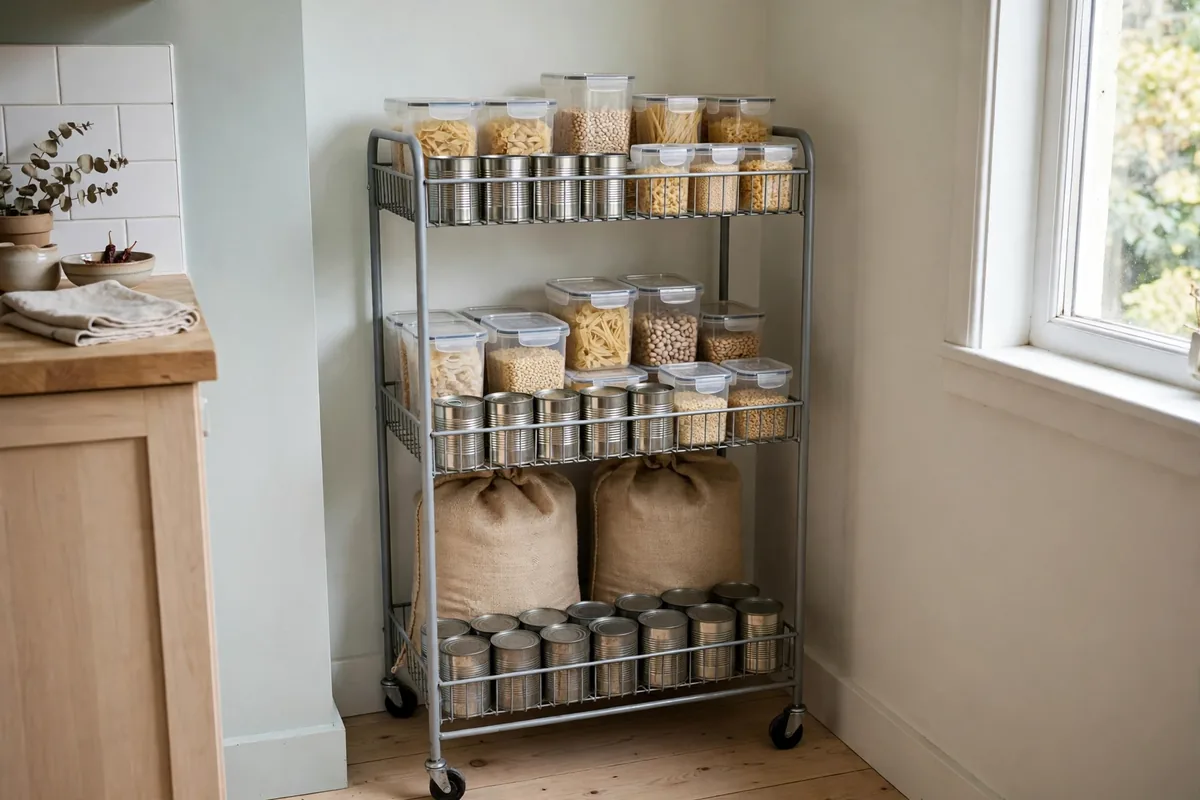
- Move backup and bulk food to a rolling cart. Move backup and bulk food to a rolling cart in a cool, dry corner: extra rice, canned food, and bulk buys. The cart holds the food you do not need this week, so the cabinets hold only what you use this week.
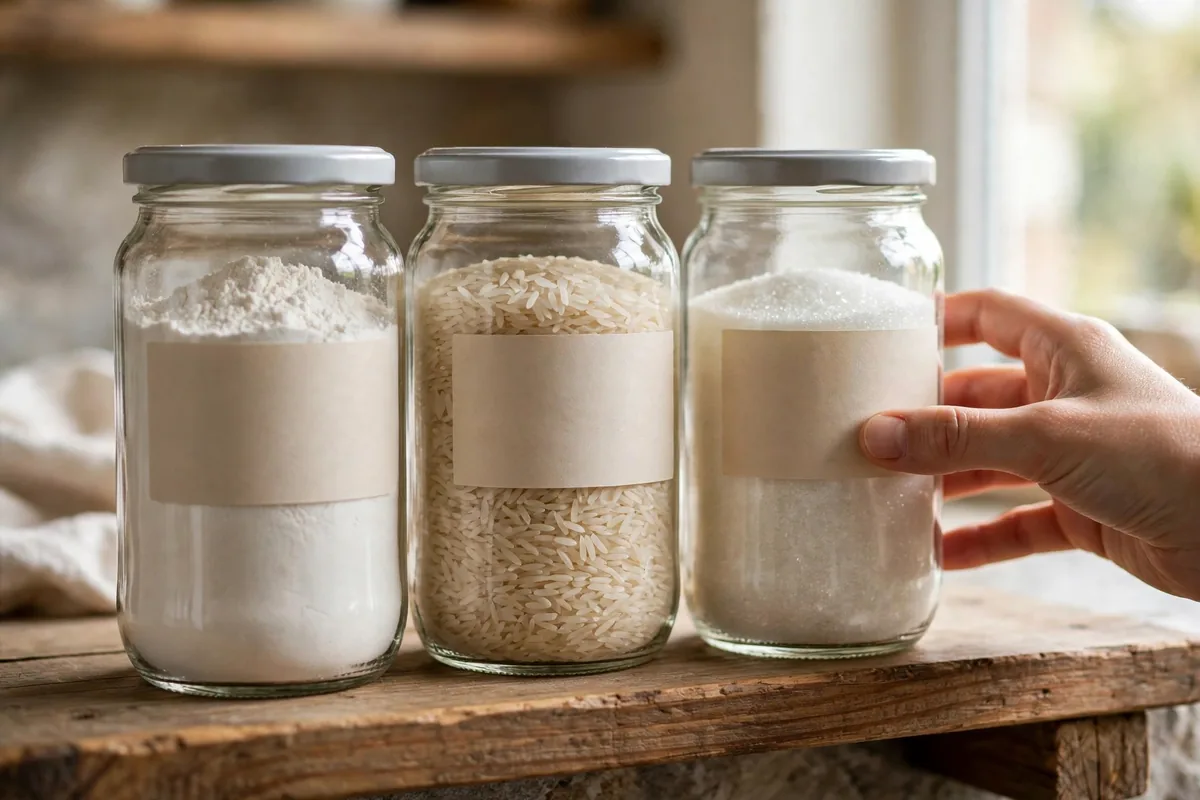
- Decant into clear jars with labels. Decant the food you use weekly into clear jars, and label each jar with the food and the date. Clear jars show you what is inside and how much is left, and a label tells you when it was opened, so nothing sits forgotten for a year.
- Put heavy items low and light items high. Put heavy items, such as large jars and bulk bags, on low shelves, and light items, such as cereal boxes and snacks, on high shelves. Heavy items on high shelves are hard to lift and dangerous when they fall, so keep them low.
What mistakes should I avoid?
- Mixing everyday and backup food on one shelf. Mixing everyday and backup food means you cannot see what you need this week and what is backup. Fix: keep everyday food in the cabinets and backup food on the cart.
- Storing food above the stove. Heat and steam from the stove spoil food and shorten its life. Fix: store food in a cool cabinet, and keep only oil and salt near the stove, in small amounts.
- Using opaque containers. Opaque containers hide what is inside, so you forget what you have and buy it twice. Fix: use clear jars, so you can see the food and how much is left.
- Buying bulk food with nowhere to put it. Bulk food with no home ends up on the counter, on the floor, or forgotten in a bag. Fix: buy bulk only when the cart has room for it.
- No labels on jars. Jars without labels all look the same, and flour looks like sugar until you taste it. Fix: label every jar with the food and the date.
- Keeping expired food. Expired food takes space and risks a bad meal. Fix: check dates when you empty the cabinets, and throw away anything expired before you put food back.
What do I need, and what should I skip?
You need clear jars, labels, and a rolling cart for backup food. A pen for the labels and a few baskets for snacks complete the setup, and the whole kit fits on one shelf of the cart.
Skip a pantry cabinet you cannot fit, because a kitchen without a pantry works with zones and a cart, not with a new cabinet. Skip deep bins you cannot see into, because a bin you cannot see into is a pantry by another name, and it hides food the same way.
Which method should I choose?
| Zone | Where | What goes there |
|---|---|---|
| Everyday | Eye-level shelf | Rice, pasta, oil, salt, coffee |
| Baking | One shelf | Flour, sugar, baking powder, chocolate |
| Backup and bulk | Rolling cart | Extra rice, canned food, bulk buys |
| Snacks | A basket or a shelf | Snacks, cereal, lunchbox food |
| Spices | A small rack or a drawer | Spices and herbs |
What does the worked example look like?
Worked example: a 3-shelf cart for backup food. The top shelf holds canned food, 10 cans in a row. The middle shelf holds extra rice and pasta, 4 bags. The bottom shelf holds bulk buys and paper goods. The cart holds the backup stock, so the cabinets hold only what you use this week, and the kitchen works without a pantry.
When should I stop?
Stop adding zones when every food group has one home. If a food has no zone, it does not belong in the kitchen yet, so find it a zone or leave it at the store, because a kitchen without a pantry only works when every food has a place.
What is the quick checklist?
- Zones in the cabinets: everyday, baking, backup.
- Clear jars with labels for weekly food.
- Rolling cart for backup and bulk food.
- Heavy items low, light items high.
- Nothing stored above the stove.
What else helps on Kitchenlify?
- How to Organize a Small Pantry Without Renovation
- How to Cook in a Small Kitchen Without Counter Space
- How to Organize a Pantry With Storage Containers (Small Pantry)
- How to Store Flour Long Term in a Pantry for Beginners
- How to Organize Deep Kitchen Cabinets for Beginners
- How to Organise Cleaning Supplies Under Sink Safely
- All guides
How to store food without a pantry
Zone your cabinets by use: everyday food at eye level, baking supplies on one shelf, and backup and bulk food on a rolling cart in a cool, dry corner. Decant food you use weekly into clear jars with labels, so you can see what you have and how much is left.
Store heavy items low and light items high, and keep nothing above the stove, because heat and steam spoil food. Buy bulk food only when the cart has room for it, and keep a short list on the fridge of what is running low.
Frequently asked questions
Where do I store food if I have no pantry?
In your cabinets, zoned by use, plus a rolling cart for backup and bulk food. Everyday food goes at eye level, baking supplies go on one shelf, and backup food goes on the cart, so the cabinets hold only what you use this week.
How do I organize food in a small kitchen cabinet?
Zone it: everyday food at eye level, baking on one shelf, and backup on a cart. Use clear jars so you can see what you have, and label each jar, so you know what is inside and when it was opened.
Should I decant food into jars?
Yes, for food you use weekly, such as flour, rice, and sugar, because jars keep it fresh and visible. Keep the rest in its original pack, because decanting food you use rarely wastes jars and time.
How do I store bulk food without a pantry?
On a rolling cart in a cool, dry corner, in sealed containers, with the oldest food at the front. The cart holds the backup stock, and the front-to-back order means you use the oldest food first.
What should I not store above the stove?
Food. Heat and steam from the stove spoil food and shorten its life, so store food in a cool cabinet instead, and keep only oil and salt near the stove, in small amounts you use up fast.
How do I keep track of what I have without a pantry?
Label every jar with the food and the date, and keep a short list on the fridge of what is running low. The labels tell you what is inside, and the list tells you what to buy, so you never run out and never buy twice.
How do I organize a kitchen without a pantry?
The short version of how to organize a kitchen without a pantry is: zone your cabinets by use, put everyday food at eye level, and move backup food to a rolling cart. Decant weekly food into clear labeled jars, and keep nothing above the stove.
What are kitchen pantry alternatives?
Kitchen pantry alternatives are: zoned cabinets, a rolling cart for backup food, clear jars for weekly food, and a basket for snacks. Together they do the job of a pantry, and the full zoning plan is in the steps above.