How to Re-Season Cast Iron Skillet

How to re-season cast iron skillet: scrub the pan back to sound metal, dry it fully, wipe on a whisper-thin coat of oil, and bake it upside down at 450 to 500°F for one hour. Re-seasoning is different from first-time seasoning: you are rebuilding a layer that wore out, flaked, or was stripped by rust — not starting from a new pan. This guide shows when to re-season, when to strip first, and how many coats a tired pan needs.
how to re-season cast iron skillet — what is the short answer?
Re-seasoning rebuilds the hard, slick layer of baked-on oil that makes cast iron nonstick and rust-proof. Scrub the pan clean, dry it on heat, wipe on a thin coat of neutral oil, and bake it upside down at 450 to 500°F for one hour, then let it cool in the oven. One coat revives a dull pan; 2 to 3 coats rebuild a pan that was stripped to bare iron. The oil coat must look almost dry before it goes in the oven — a thick coat turns sticky, not slick.
How do I do it step by step?
- Decide whether to strip or just re-season. If the seasoning is dull, patchy, or a little sticky, you can re-season over it — scrub it clean and add coats. If the pan has flaking black buildup, a rancid smell, or rust over most of the surface, strip it first: scrub to bare gray iron with steel wool, or use the oven-cleaner bag method for heavy crust. Stripping is only for pans that need it; most tired pans just need fresh coats.
- Scrub the pan back to sound metal. Rinse with hot water and a little dish soap, then scrub with a stiff brush or fine steel wool until the surface feels even and smooth. Remove loose flakes, sticky patches, and any rust. Rinse well. If you stripped the pan, wash it now with hot soapy water to remove all residue, then move fast — bare iron rusts within minutes.
- Dry the pan completely on heat. Towel-dry the pan, then set it on the stove over low heat for a few minutes, or in a 200°F oven for 10 minutes, until every trace of moisture is gone. Water left under fresh oil causes rust under the new seasoning, so do not skip this step.
- Wipe on a paper-thin coat of oil. Add a small amount of neutral oil — canola, grapeseed, or vegetable shortening — to a paper towel and rub it over every surface: inside, outside, and handle. Then wipe it all off again with a clean towel until the pan looks almost dry. This is the most important step: a thin coat bakes into a hard layer, and a thick coat bakes into a sticky mess.
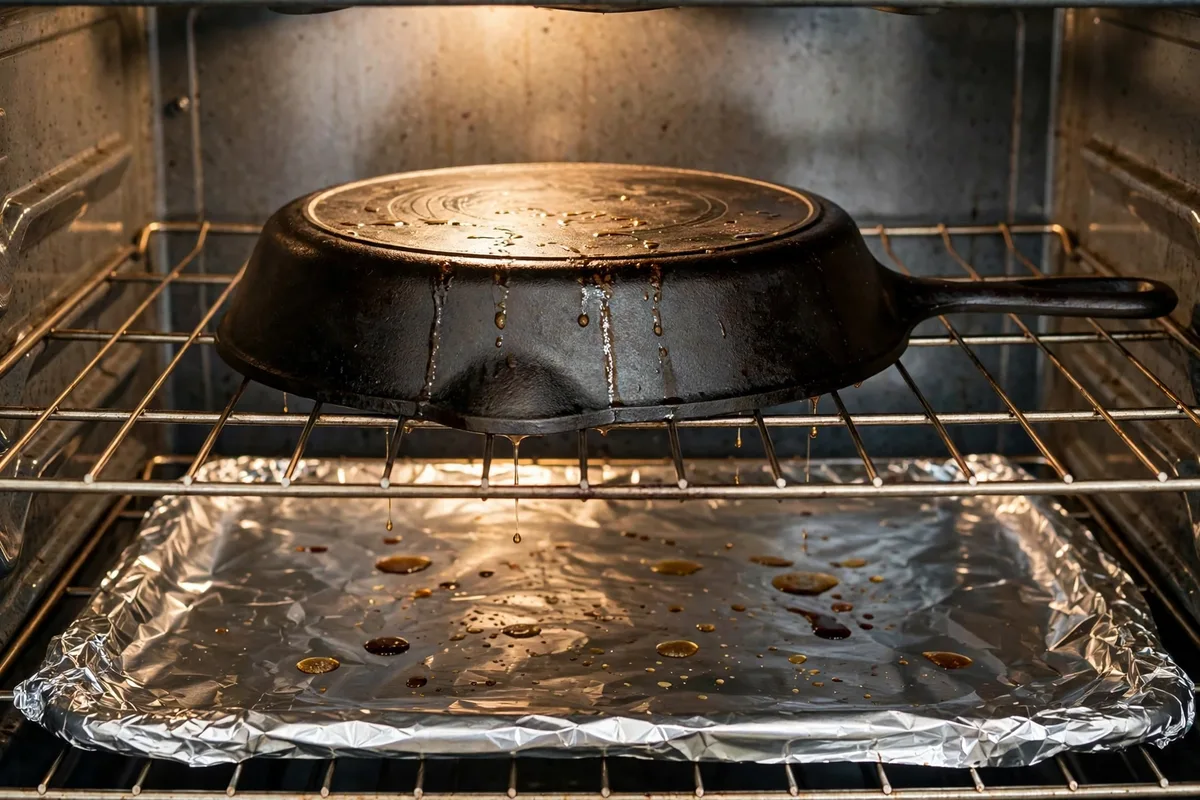
- Bake it upside down for one hour. Put foil on the lower oven rack to catch drips. Place the pan upside down on the middle rack and bake at 450 to 500°F for one hour. The upside-down position stops oil pooling in the center. That is how to re-season cast iron pan in oven: thin oil, upside down, one hot hour, then cool in the oven.
- Let it cool in the oven. Turn the oven off and leave the pan inside until it is fully cool. Cooling in the oven lets the fresh layer cure hard instead of staying soft. Do not pull a hot pan out and set it on a cold counter — the sudden temperature change can damage the new layer.
- Repeat for 2 to 3 coats. One coat revives a lightly worn pan. For a pan that was stripped to bare iron, repeat the oil-and-bake cycle 2 to 3 times until the surface looks evenly dark and satiny. Let the pan cool to warm between coats, then wipe on the next thin layer and bake again.
What mistakes should I avoid?
- Using too much oil. A thick oil coat bakes into a sticky, blotchy layer instead of a hard slick one. Fix: wipe the oil until the pan looks almost dry before it goes in the oven.
- Baking the pan right side up. Oil pools in the center and cures into a gummy puddle. Fix: always bake upside down, with foil below to catch drips.
- Skipping the dry step. Water trapped under fresh oil rusts the iron under the new seasoning. Fix: dry on heat until the pan is bone dry.
- Using olive oil for seasoning. Extra virgin olive oil has a low smoke point and does not cure into a hard layer. Fix: use canola, grapeseed, or vegetable shortening.
- Opening the oven to check the pan. Opening the oven drops the temperature and the layer cures soft. Fix: leave it alone for the full hour, then cool in the oven.
- Re-seasoning a pan that only needs a wash. A dull pan often just needs a good clean and a light oil wipe after cooking. Fix: re-season only when food sticks, the surface is patchy, or the pan was stripped.
What do I need, and what should I skip?
You need a stiff brush or fine steel wool; neutral oil with a high smoke point, such as canola or grapeseed oil; paper towels and foil for the oven rack; an oven that reaches 450 to 500°F.
Skip thick coats of oil, which turn sticky. Skip olive oil for the seasoning bake. Skip baking the pan right side up. Skip rushing the cool-down.
How to re-season a cast iron skillet after stripping it — how many coats does it need?
| Pan condition | What to do | Coats | Time |
|---|---|---|---|
| Dull or patchy seasoning | Scrub clean, then re-season over it | 1 to 2 | About 2 hours |
| Sticky or tacky surface | Scrub off the sticky layer first | 2 | About 3 hours |
| Light rust | Scrub rust off, then re-season | 2 to 3 | About 3 hours |
| Flaking buildup or heavy rust | Strip to bare iron, then re-season | 3 | Half a day |
What does the worked example look like?
Worked example: a skillet stripped after heavy rust. Your skillet was rusted all over, so you stripped it to bare gray iron with steel wool and a vinegar soak. Wash it, dry it on low heat for 3 minutes, and wipe on a thin coat of canola oil — then wipe it off until the pan looks almost dry. Bake it upside down at 475°F for one hour and let it cool in the oven. Repeat the oil-and-bake cycle 2 more times, for 3 coats in total, and the pan turns evenly dark and satiny. That is how to re-season a cast iron skillet after stripping it: 3 thin coats, 3 hot hours, and no shortcuts on the drying.
When should I stop?
Stop adding coats when the surface looks evenly dark and satiny — more coats will not make it slicker, and each extra hour in the oven is wasted. Stop if the pan comes out sticky or blotchy: scrub the sticky layer off and redo that coat thinner. And stop re-seasoning a pan that is cracked or warped — no amount of seasoning fixes structural damage.
What is the quick checklist?
- Decide: strip first, or re-season over the old layer.
- Scrub back to sound, even metal.
- Dry fully on heat.
- Oil thin — wipe until it looks almost dry.
- Bake upside down at 450 to 500°F for one hour.
- Cool in the oven, then repeat if the pan was stripped.
What else helps on Kitchenlify?
- Cleaning & Care
- How to Season Cast Iron First Time
- How to Clean Cast Iron Skillet After Cooking
- How to Remove Rust From Cast Iron Skillet
- All guides
Frequently asked questions
How to re-season cast iron skillet — how is it different from seasoning?
Seasoning is the first layer on a new pan; re-seasoning rebuilds a layer that wore out, flaked, or was stripped by rust. The method is the same — thin oil, baked upside down — but re-seasoning starts with scrubbing the old layer back to sound metal. That is the core of how to re-season cast iron skillet: clean, dry, oil thin, bake, repeat.
How to re-season cast iron pan in oven — what temperature?
Bake at 450 to 500°F for one hour, with the pan upside down and foil on the rack below. That range is hot enough to cure the oil into a hard layer. Below 400°F the oil stays soft and sticky, so do not bake cooler to save time. That is the temperature rule for how to re-season cast iron pan in oven.
What oil is best for re-seasoning?
Canola, grapeseed, or vegetable shortening — all have high smoke points and cure into a hard layer. Avoid extra virgin olive oil and coconut oil, which smoke at low temperatures and leave a soft, sticky finish. Flaxseed oil works but can flake if the coat is too thick.
How many coats does a stripped pan need?
Two to three coats for a pan stripped to bare iron. One coat protects the surface, but the color stays patchy and gray. Two or three coats build the even dark finish that releases food well. Let the pan cool to warm between coats.
Why is my seasoning sticky?
The oil coat was too thick, or the oven was too cool. Scrub the sticky layer off with hot water and a brush, dry the pan fully, and redo the coat thinner — wipe until the pan looks almost dry — then bake at 450 to 500°F for the full hour.
Can I re-season on the stovetop instead of the oven?
You can refresh a pan on the stovetop — heat it, wipe on a thin coat of oil, and heat until it just smokes — but that gives a light maintenance coat, not a full re-season. A real re-season needs the even, sustained heat of an oven bake.
Do I need to strip the old seasoning first?
Only if it is flaking, sticky, rancid, or covered in rust. If the old layer is just dull or patchy, scrub it clean and re-season over it. Stripping a pan that does not need it wastes hours and removes good seasoning.
How often should I re-season cast iron?
A pan used often rarely needs a full re-season — cooking with oil and wiping on a light coat after each wash keeps the layer alive. Re-season fully only after heavy scrubbing, a rust scare, or long storage in damp air, or a few times a year if the pan is used rarely.
Can I use the oven self-clean cycle to strip a pan?
It works, but it is the most aggressive strip: the cycle burns off everything at very high heat. Use it only for a pan that needs a full strip, and check the pan maker guidance first — some pans can warp or crack. Steel wool and a vinegar soak are safer for most pans.