How to Use a Food Scale
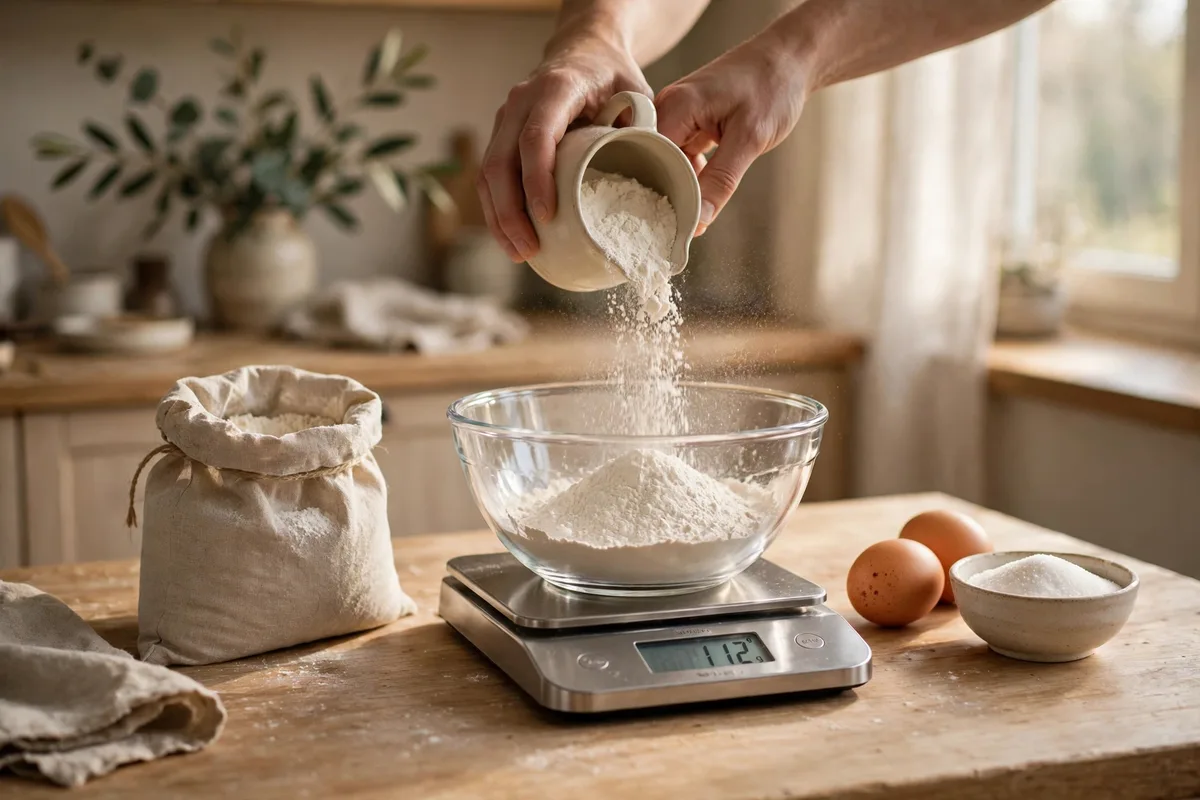
Learning how to use a food scale takes about five minutes, and it changes your baking from guesswork to repeatable results. You set the scale on a flat counter, press tare with your empty bowl on top, and add flour until the display shows the weight you need — then you press tare again and add the next ingredient to the same bowl. That one habit, tare between ingredients, is the whole skill. The rest of this guide walks you through the buttons, the units, weighing in bowls, and the mistakes that make readings jump around, so you can weigh flour, liquids, and dinner portions with confidence from your first try.
Short answer: put your empty bowl on the scale, press tare to zero, add your ingredient to the target weight, and press tare again before the next one. If you want a scale that makes this easy, start with the Etekcity 11lb in our best food scale for beginners guide — it reads in 1 gram steps, holds 11 lb (5 kg), and keeps the tare-first method simple.
As an Amazon Associate, we earn from qualifying purchases. The two scales we name in this guide link to Amazon — always check the live listing before you buy.
How to use a food scale, step by step
Follow this worked example: you want 200 grams of flour and 120 grams of sugar for a batch of cookies, weighed into one mixing bowl with nothing else to wash. Read the steps once, then do them with the bowl in front of you — the habit sticks faster when your hands learn it than when your eyes read it.
- Set the scale on a hard, flat counter. Put the scale on a solid worktop with nothing under it — no tea towel, no silicone mat, no chopping board. A soft layer under the feet absorbs some of the weight and makes the reading come out light, and a wobbly table makes the numbers jump. Slide the scale away from the wall and any cords, so nothing touches it while you weigh, and keep it out of the draft from a fan or an open window.
- Turn it on and wait for zero. Press the power button and let the display settle at 0 before you put anything on the platform. If the numbers flicker or drift instead of settling, change the batteries first — low power is the most common cause of jumping readings, and a fresh set fixes it more often than any other step.
- Pick your unit before you pour. Press the unit button until the display shows the unit your recipe uses — grams for most baking, ounces when the recipe lists ounces. Check the small letters next to the number before you add anything. Weighing 100 ounces when the recipe wants 100 grams ruins the batch, and the mistake is easy to make when the unit button sits next to the tare button.
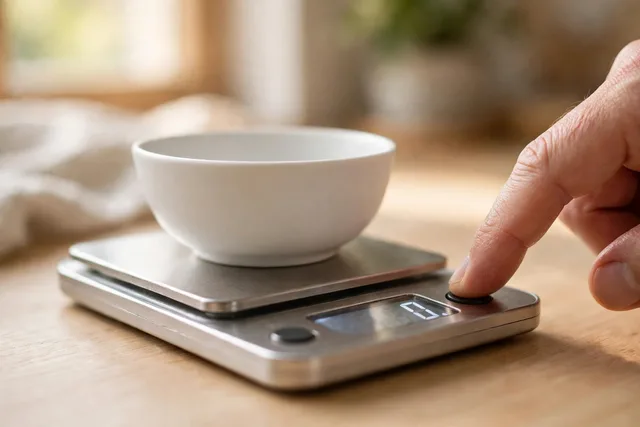
- Put the empty bowl on the scale and press tare. Set your mixing bowl on the platform and press the tare or zero button. The display resets to 0 with the bowl still sitting there, which tells the scale to ignore the bowl and weigh only what you add next. If the button sits under the bowl where your finger cannot reach it, slide the bowl slightly or use a smaller bowl — a tare button you cannot reach is a scale that will frustrate you every time you bake.
- Add the flour slowly until the display shows 200 grams. Pour in a steady stream, then slow down as you near the target and let the number settle before you add the last spoonful. Flour poured fast overshoots, and a display that is still climbing will read higher than the flour actually weighs. Stop at 200 grams and read the number at eye level, without lifting the bowl.
- Press tare again, then add the sugar to 120 grams. With the flour still in the bowl, press tare once more. The display returns to zero, and the sugar you add now counts on its own — 120 grams of sugar on top of the 200 grams of flour, in one bowl, with no subtraction and no second bowl to wash. Repeat the same move for every ingredient the recipe lists.
- Read the weight before you lift the bowl. Note the number, or write it down, while the bowl is still on the scale. Lifting the bowl to peek at a hidden display spills flour and breaks your flow, so if a wide bowl hides the numbers, you need a scale with a pull-out or angled display, or a smaller bowl for that recipe. When you finish, switch the scale off and wipe the top clean.
What the buttons do: tare, unit, mode, hold, and power
Most food scales have three to five buttons, and you only need to know what each one does once. Learn them by name now, and you will stop pressing the wrong one mid-recipe.
| Button | What it does | When you press it |
|---|---|---|
| Tare / Zero | Resets the display to zero with a bowl or container already on the scale | Every time you put an empty bowl on, and again before each new ingredient in the same bowl |
| Unit | Switches the reading between grams, ounces, lb:oz, and millilitres | Before you start, to match the unit your recipe uses |
| Mode | Switches between weighing modes on some scales, such as milk millilitres or piece counting | Only when you need that mode — leave it alone for everyday weighing |
| Hold | Freezes the reading on the display so you can read it after you lift a large bowl | When a big bowl hides the display and you need to check the number after lifting it |
| Power | Turns the scale on and off | At the start, and when you finish — most scales also switch off on their own after a minute or two |
On some scales the tare and power buttons share one key: a short press tares, a long press switches the scale off. Check your scale once, so a long press mid-recipe does not switch it off and lose your place.
How to use a food scale with a bowl
Almost everything you weigh goes in a bowl, so the bowl method is the method that matters. Put the empty bowl on the scale first, press tare, and add the ingredient — the scale weighs only what lands in the bowl. That order, bowl first and tare second, is the one to learn, because putting food in the bowl first and then taring forces you to guess the bowl's weight by hand.
A wide bowl causes the one real problem with this method: it can cover the display. Stand where you normally cook and look down at the numbers while the bowl sits on the platform. If you cannot read them, use a narrower bowl for that recipe, or choose a scale with a pull-out display that slides out from under the bowl — the kind that keeps the numbers visible no matter how wide the bowl is. Never lift a full bowl to peek at the display; you will spill flour and lose the reading.
Remember that the scale's capacity counts the bowl too. A scale that holds 11 lb (5 kg) holds the bowl plus the food together, so a heavy ceramic bowl plus a large dough can reach the limit sooner than you expect. A light mixing bowl gives you more room for the food itself. And if you weigh food straight on the platform, such as a piece of fruit or a chicken breast, wipe the platform first and centre the food on it — food sitting off-centre can read light.
One more bowl trick saves washing when you weigh sticky foods. Put the whole jar of peanut butter or honey on the scale, press tare, then spoon food out of the jar. The display counts down into negative numbers, and when it shows minus 20 grams, you have taken out exactly 20 grams — with no extra dish and no sticky spoon on the scale.
Grams, ounces, and millilitres: which unit to use
Your scale offers several units, but each one suits a different job. Pick the unit the recipe uses, and check the display letters before you pour.
| Unit | Best for | Watch out for |
|---|---|---|
| Grams (g) | Baking dry ingredients — flour, sugar, yeast, salt — and most recipes that list weights | Nothing — grams are the safest default for baking |
| Ounces (oz) | Butter, chocolate, cheese, and recipes that list ounces | Decimal ounces look like grams at a glance — check the letters |
| Pounds and ounces (lb:oz) | Meat, large vegetables, and bulk amounts over a pound | Easy to misread as a decimal — 1 lb 4 oz is not 1.4 lb |
| Millilitres (ml / fl oz) | Water and liquids that weigh the same as water | The scale assumes water density — oil, milk, and honey weigh differently, so use grams for those or follow the recipe's weight |
When a recipe gives you both cups and grams, trust the grams. Cups measure volume, which changes with how you scoop, while grams measure weight, which stays the same however you pour. If a recipe lists cups only, our cups to grams converter turns the volume into a weight you can weigh directly.
How to use a food scale for baking
Baking is where a food scale earns its place, because small weighing errors change the result. A cup of flour can weigh about 120 grams when you spoon it in lightly and up to 150 grams when you scoop and pack it, and that difference can turn light cookies dense or bread dough dry. Weigh the flour instead, and the same recipe gives you the same dough every time.
Weigh each dry ingredient into the same bowl with tare between them, and weigh butter straight from the wrapper onto the platform or a small plate — the wrapper's weight is small, but tare it out first if you want the exact number. For liquids, set a jug on the scale, tare it, and pour to the weight the recipe gives; for water, grams and millilitres match, so 250 grams of water is 250 millilitres. For yeast, salt, and baking powder, pour slowly and let the display settle, because a fast pour overshoots a small target. A scale that reads in 1 gram steps handles these amounts well, and a scale that reads to 0.1 grams gives you finer control when you weigh coffee or very small amounts. If you want to see why cups fall short, read our guide on how to measure flour correctly with cups and spoons for beginners — then weigh the same flour and compare the two numbers yourself.
How to use a food scale for portions and meal prep
For portions, the scale stops you guessing. A chicken breast, a scoop of rice, or a handful of oats all vary in size, and weighing them gives you the same portion every day instead of a different one each time you serve yourself.
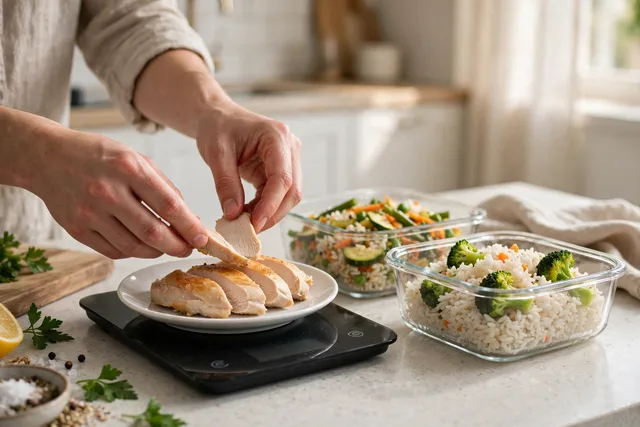
Weigh the empty container first, press tare, and add the food to the weight you want — then lid it and move on to the next container. For cooked food, weigh it after cooking, and keep the method the same every time, because cooked food weighs less than raw food and the two numbers are not interchangeable. For spreads and sauces, use the jar trick from the bowl section: jar on the scale, tare, spoon out, read the negative number. And if you track what you eat, log the weight straight after you weigh it — a number you remember an hour later is a number you will get wrong. If you cook without a scale sometimes, our guide on how to measure ingredients without a scale shows you the cup and spoon fallbacks — and why weighing beats them.
Two scales that make learning easy
You do not need a complicated scale to learn on. You need a big tare button you can find without looking, a display you can read under a bowl, and 1 gram steps. These two scales from our best food scale for beginners guide fit that description, and we checked their ratings and review counts on their Amazon listings.
- Etekcity 11lb — our top pick for beginners. It holds 11 lb (5 kg), reads in 1 gram steps, switches between five units including grams and ounces, and carries a 4.6-star rating from 178,415 ratings. The tare button is large and easy to find, and the backlit display stays readable while you pour. Check Price on Amazon →
- Amazon Basics 11lb — the best-rated simple scale. It also holds 11 lb, reads in grams, ounces, fluid ounces, and millilitres, and carries a 4.7-star rating from 120,428 ratings. The wide LCD screen and simple tare button make it a strong choice if you want the fewest buttons to learn. Check Price on Amazon →
If you want to compare more options before you buy, our how to choose a kitchen scale for beginners guide walks you through the tare-first flour test you can run on any scale.
7 mistakes that ruin your readings — and how to fix them
- Weighing on a towel or a soft mat. Fix: move the scale to a hard, flat counter. A soft layer under the feet absorbs weight and makes the reading come out light.
- Touching the scale or leaning on the counter while you weigh. Fix: keep your hands off the scale and the counter while the number settles. Even light pressure changes the reading.
- Weighing in a draft. Fix: move the scale away from fans, open windows, and oven heat. Moving air pushes on the platform and makes the numbers drift.
- Ignoring low batteries. Fix: change the batteries when the numbers jump, flicker, or drift. Low power is the most common cause of unstable readings, and fresh batteries fix it in minutes.
- Overloading the scale. Fix: remember that 11 lb (5 kg) counts the bowl plus the food. A heavy bowl plus a large dough can pass the limit, and overloading can damage the sensors for good.
- Switching units mid-recipe. Fix: check the unit before you start, and pick a scale where the unit button sits apart from tare. When the numbers look wrong out of nowhere, look at the unit letters first.
- Letting auto-off lose your place. Fix: work steadily, and tap a button gently to wake the scale if it sleeps — then re-tare before you carry on, because a scale that switched off may not remember where you stopped.
Cleaning, storage, and checking accuracy
After you finish, wipe the platform with a damp cloth and dry it before you put the scale away. Keep the scale out of the sink — running water and submersion damage the electronics unless the maker states the scale is waterproof. Brush flour and sugar away from the buttons and seams, and keep the scale flat in a spot where nothing heavy sits on top of it. During a long break from baking, take the batteries out so they cannot leak inside the case.
Test the accuracy now and then against a weight you already know. An unopened bag of sugar or flour prints its weight on the bag — weigh it and compare the two numbers. A nickel weighs 5 grams, so that works as a quick check too. When the reading misses by more than a gram or two, fit fresh batteries and try again on a flat, hard counter. A scale that still misses needs replacing, because it cannot weigh your flour reliably either.
When to stop — safety note
Put the scale aside straight away when it starts behaving oddly — readings that jump around for the same bowl, a display that flickers or blanks under a normal load, or any sign it has been dropped or soaked. A scale you cannot trust will spoil a bake, and one that has taken in water may not be safe to keep using. Stay inside the maximum capacity, because pushing past it can harm the sensors for good, and keep very hot bowls and pans off the platform — heat warps the surface and skews the numbers. Store it dry, where nothing heavy can press on it, and take the batteries out during a long break so they cannot leak.
How this guide was made
We read the top-ranking pages for this exact question before writing a word, and we built this guide to cover what they leave out: what every button does, how to weigh in a bowl without hiding the display, how to weigh sticky foods backwards from the jar, and how to weigh portions for meal prep. We checked each step against the features of the scales in our best food scale for beginners guide, and we wrote every step from the way you actually weigh in a real kitchen — bowl first, tare between ingredients, one bowl to wash. We have not hands-on tested every scale on the market; the ratings and review counts we quote come from the Amazon listings we link to.
Related on Kitchenlify
- best food scale for beginners
- best food scale with bowl
- best rechargeable food scale
- how to choose a kitchen scale for beginners
- how to measure ingredients without a scale
- how to measure flour correctly with cups and spoons for beginners
- cups to grams converter
- how to weigh ingredients with a food scale
- All guides
Frequently asked questions
How do I use a food scale for the first time?
Set the scale on a hard, flat counter and turn it on. Wait for the display to settle at zero, pick grams, put your empty bowl on the scale, and press tare. Add your ingredient slowly until the display shows the weight you need. Practise once with flour before a real recipe, so the tare habit feels natural when it counts.
What does the tare button do on a food scale?
Tare tells the scale to forget the bowl. With the empty bowl sitting on the platform, one press of tare sets the display back to zero, so every gram after that is food, not bowl. Add your first ingredient to the weight you need, press tare again, and the next ingredient counts from zero too — same bowl, no maths, nothing extra to wash.
Should I weigh food in grams or ounces?
Use grams for baking and for most recipes that list weights, because grams give you finer steps and match most baking recipes. Use ounces when the recipe lists ounces, and pick the unit before you start pouring. Check the small letters on the display before you add anything, because weighing 100 ounces when the recipe wants 100 grams will ruin the batch.
How do I weigh food without a bowl?
Weigh it on a small plate, or place it straight on the platform if it is dry and clean, such as a piece of fruit or a chicken breast. For sticky foods such as peanut butter or honey, weigh backwards: place the whole jar on the scale, press tare, spoon food out, and read the negative number, which tells you exactly how much you removed, with no extra dish to wash.
Do I weigh food raw or cooked?
Weigh food raw when the recipe or the nutrition label lists a raw weight, because cooking drives off water and changes the weight. A portion of chicken weighs less after cooking than it did raw, so a raw weight and a cooked weight are not the same number. Pick one way, raw or cooked, and use it the same way every time, so your portions stay comparable from day to day.
Can I weigh liquids on a food scale?
Yes. The millilitre mode on most scales assumes you are weighing water, because 1 millilitre of water weighs 1 gram, so grams work well for water and similar liquids. Oil, milk, and honey are denser or lighter than water, so their weight and volume do not match. Follow the recipe's weight when it gives one, and use a measuring jug for volume when the recipe lists millilitres.
Why does my food scale give different readings for the same food?
The scale usually sits on a soft or uneven surface, catches a draft from a fan or an open window, runs on low batteries, or gets nudged while you pour. Move it to a hard, flat counter away from drafts, change the batteries, keep your hands off the scale while it settles, and weigh the same item twice. If the two readings still disagree by more than a gram or two, the scale itself may be failing.
How do I check if my food scale is accurate?
Use a weight you already know. Weigh an unopened bag of flour or sugar and check the number against the weight printed on the bag, or weigh a nickel — it weighs 5 grams. Fresh batteries and a flat, hard surface come first when the number looks off. If it still misses by more than a gram or two, replace the scale.
Do I need a food scale for baking?
You do if you want the same result every time you bake. A cup of flour can weigh about 120 grams when you spoon it in lightly and up to 150 grams when you scoop and pack it, and that difference can turn light cookies dense or bread dough dry. A scale removes that variation, because 200 grams of flour is 200 grams however you pour it.
How do I weigh small amounts like yeast or salt?
Add them very slowly and let the display settle before you add more, because a fast pour overshoots a small target. A scale that reads in 1 gram steps handles most yeast, salt, and baking powder amounts well. If you weigh coffee or spices often, a scale that reads to 0.1 grams gives you finer control over amounts under 10 grams.