Mandoline Slicer vs Knife

Mandoline slicer vs knife is a fair question, because both tools cut vegetables — but they cut them in very different ways. A mandoline is a flat board with a fixed blade: you slide food across it and get thin, even slices at a fixed thickness. A knife is a free blade in your hand: slower for thin slices, but able to chop, dice, mince, and trim anything. This guide compares them on speed, slice evenness, safety, cost, and cleanup, so you can tell which one wins for the cooking you actually do.
The short answer: mandoline slicer vs knife
For thin, even slices, the mandoline wins: it is faster and far more consistent than a knife. For almost everything else — chopping, dicing, mincing, trimming, and cutting soft or odd-shaped food — the knife wins, because a mandoline can only slice. Most kitchens need both, but if you only cook for one or two people and rarely need paper-thin slices, a good knife alone is enough.
Speed: how much faster is a mandoline?
For a batch of thin slices, a mandoline is several times faster than a knife. Slicing a whole cucumber takes under a minute on a mandoline; the same job takes several minutes by knife, with constant attention to keep the slices even. The gap grows with quantity: five potatoes for a gratin take a few minutes on a mandoline and a long, careful stretch by knife. The speed advantage shrinks for small amounts, though — for one onion or two tomatoes, a knife is faster once you count getting the mandoline out, setting the thickness, and cleaning it afterwards. Speed also depends on safety: a mandoline used slowly and carefully is still faster than a knife, while a mandoline used in a rush is a cut waiting to happen.
Slice uniformity
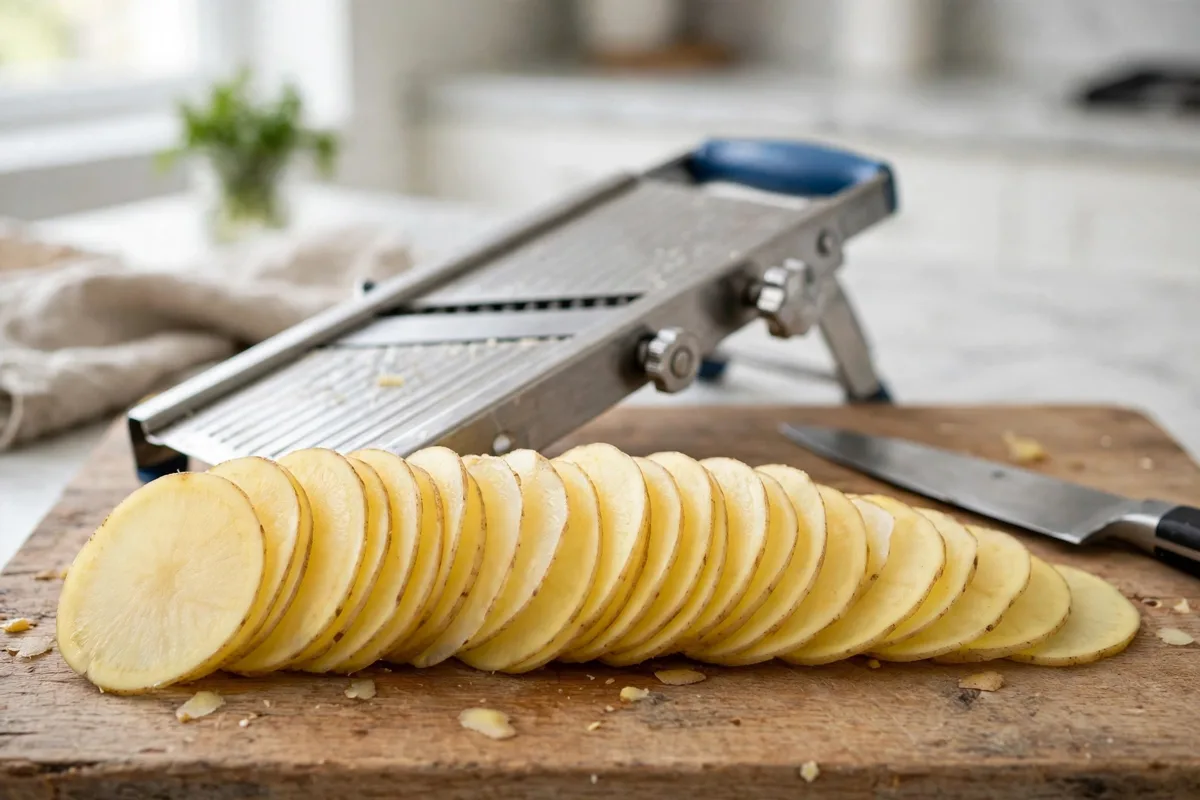
This is where the mandoline wins outright. Every slice comes off at the same fixed thickness, so a whole potato cooks at the same rate — no thin slices burning while thick ones stay raw. Even a skilled cook cannot match that consistency by hand. Uniformity matters most for gratins, where uneven slices cook unevenly; for chips, where thin slices crisp and thick ones stay soft; and for salads, where even slices look better and feel better to eat. A knife gives you control over shape, but not over thickness: your tenth slice is never quite the same as your first.
Safety: guard vs visible blade
A knife blade is visible, so you can see where it is at all times, and your fingers stay behind the knuckles of your guiding hand. A mandoline blade is hidden under the food, which is exactly why the hand guard matters: used with the guard, a mandoline is safe, because your fingers never come near the blade. Used with bare fingers, a mandoline is more dangerous than a knife, because the blade is fixed, very sharp, and your hand is moving straight toward it. The guard is the whole safety system — if you will not use it, do not use a mandoline. Our full safety routine is in the guide on how to use a mandoline slicer safely.
Cost
A basic mandoline and a basic chef's knife cost roughly the same, and both last for years with care. The difference is what else you need: a mandoline needs a working hand guard and, ideally, a cut-resistant glove while you learn; a knife needs a cutting board and a way to keep it sharp. Over time, a knife costs more in sharpening — a dull knife is a dangerous knife — while a mandoline costs more in replacement guards and blades. Neither tool is expensive, and cost should not decide this comparison: pick the tool that fits the cooking you do.
Cleanup
A knife wins on cleanup. Rinse it, wipe it, dry it, and put it away — thirty seconds. A mandoline takes about five minutes: rinse it under running water, brush from the back of the blade, wash the guard and the dial, and dry it fully before you put the cover on. Never wipe a mandoline blade with a cloth in your hand. The full routine is in our guide on how to clean a mandoline slicer. If you hate cleaning, that is a real reason to reach for the knife for small jobs.
| Mandoline slicer | Knife | |
|---|---|---|
| Speed for thin slices | Fast — a whole cucumber in under a minute | Slow — several minutes of careful cutting |
| Slice uniformity | Every slice the same thickness | Varies from slice to slice |
| Safety | Safe with the guard, dangerous without it | Blade visible, fingers behind the guiding hand |
| Versatility | Slices only | Chops, dices, minces, trims, peels |
| Cleanup | About five minutes, needs care | About thirty seconds |
| Storage | Large, needs a blade cover | Small, needs a sheath or block |
Which foods suit each tool
Reach for the mandoline for firm, even-shaped vegetables that need thin, even slices: cucumber, potato, onion, zucchini, carrot, radish, apple, and pear. Reach for the knife for soft fruit that would squash on a mandoline, for very small items that will not sit in the hand guard, for meat, for herbs, and for anything you need to chop, dice, or mince rather than slice. A mandoline is a vegetable slicer first — it is not a general-purpose cutter, and forcing the wrong food through it is how cuts happen.
When to use a mandoline, and when to reach for a knife
- Use the mandoline when you need a batch of thin, even slices — a gratin, a big salad, a pile of chips, a tray of roasted vegetables. The more slices you need, the more the mandoline earns its place.
- Use the knife for small amounts, for soft or odd-shaped food, for chopping and dicing, and whenever you are in a hurry or tired. A mandoline rewards steady attention; a knife is the safer choice on a rushed evening.
- Use both for a big cooking session: the mandoline for the even slices, the knife for everything else. Most good home cooks switch between the two without thinking about it.
Mandoline vs food processor
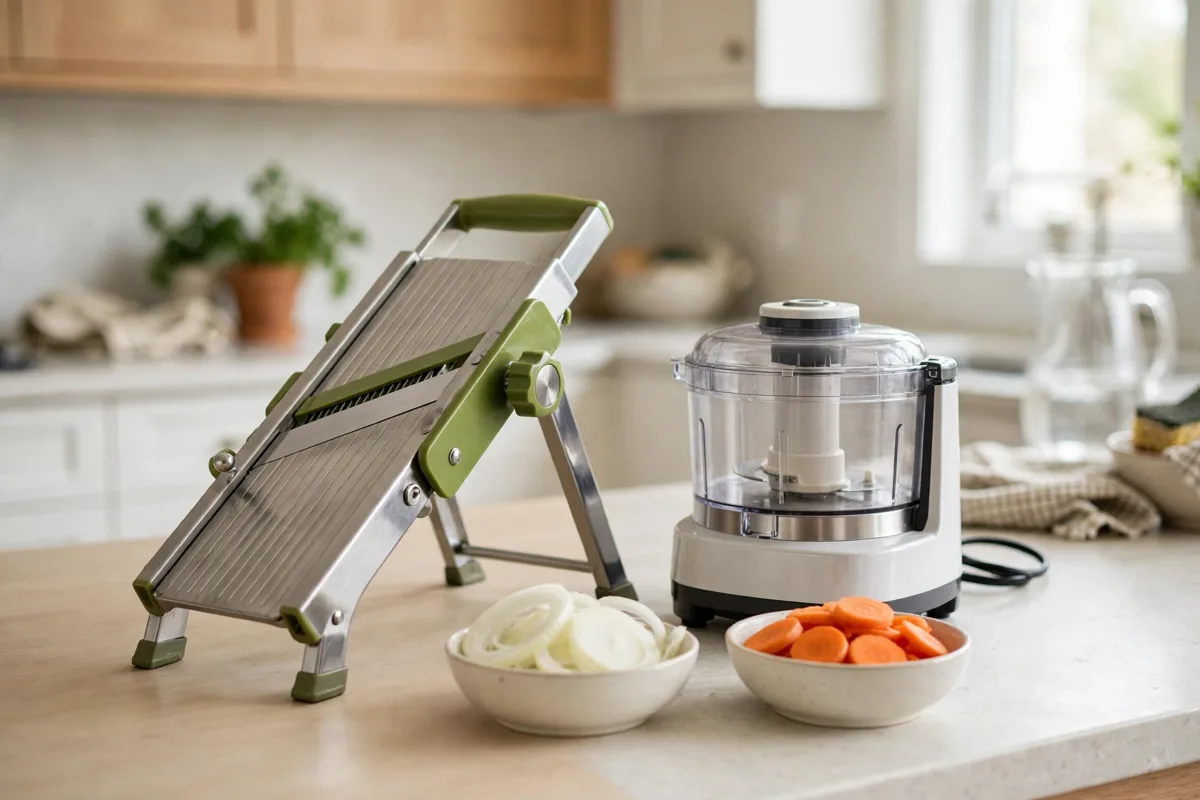
A food processor also slices, so it is worth a short comparison. A processor is faster for bulk work and it chops, grates, and mixes as well, which makes it the better choice if you cook for many people or prep in large batches. Its slices, though, are thicker and less even than a mandoline's, and it is far bigger to store and slower to clean. A mandoline gives thinner, more even slices from a smaller, cheaper tool. If your main job is thin, even slices, buy the mandoline first; if you chop and grate in bulk, buy the processor first. If you are choosing a first mandoline at all, start with our guide on how to choose a mandoline slicer for beginners.
Related on Kitchenlify
- How to Choose a Mandoline Slicer for Beginners
- How to Use a Mandoline Slicer Safely
- Best Mandoline Slicer for Beginners
- All guides
Frequently asked questions
Is a mandoline faster than a knife?
Yes, for thin, even slices of firm vegetables — a mandoline can slice a whole cucumber in under a minute, where a knife takes several minutes of careful cutting. The speed advantage disappears for small amounts, though: for one onion, a knife is faster once you count setup and cleaning.
Are mandoline slices really more even than knife slices?
Yes. A mandoline cuts every slice at the same fixed thickness, so a whole potato cooks at the same rate. Even a skilled cook cannot match that consistency by hand, and even slices matter most for gratins, chips, and anything fried or baked.
Is a mandoline safer than a knife?
It depends on how you use it. A knife blade is visible, so you can see where it is at all times. A mandoline blade is hidden under the food, which is why the hand guard matters — used with the guard, a mandoline is safe; used with bare fingers, it is more dangerous than a knife. The guard is the difference.
Can a mandoline replace a knife?
No. A mandoline only slices — it cannot chop, dice, mince, peel, or trim. A knife does all of those jobs and more. Most kitchens need both: the mandoline for fast, even slices, and a good knife for everything else.
What foods should I not cut on a mandoline?
Very soft, ripe fruit, very small hard items, and anything that will not sit firmly in the hand guard. Soft fruit squashes instead of slicing, small items leave your fingers too close to the blade, and meat is better cut with a knife — a mandoline is a vegetable slicer first.
Is a mandoline worth it for a small kitchen?
It is worth it if you slice vegetables thinly and evenly more than a couple of times a week — for salads, gratins, and chips. If you rarely need paper-thin slices, a good knife does the job and takes up less storage. Choose a compact model with a blade cover if space is tight.
Mandoline slicer vs food processor: which should I buy first?
Buy a mandoline first if your main job is thin, even slices. Buy a food processor first if you chop, grate, and mix in bulk, or if you cook for many people at once. A food processor slices too, but its slices are thicker and less even than a mandoline's — the two tools overlap, but they are not the same.
Do I need both a mandoline and a good knife?
Yes, for most home cooks. The mandoline wins on speed and evenness for thin slices; the knife wins on versatility, control, and safety for everything else. Together they cover nearly all vegetable prep, and neither one replaces the other.