How to Slice Bread Evenly Without Crushing It

How to slice bread evenly without crushing it? Let the loaf cool completely — 60 to 90 minutes for a standard boule — then use a long serrated bread knife 8 to 10 inches long and cut with long, smooth sawing strokes, letting the teeth do the work and never pressing down. Bread is mostly air, so downward pressure collapses the crumb into a dense, gummy layer, while a sawing motion cuts the crust cleanly and leaves every slice the same thickness.
how to slice bread evenly without crushing it — what is the short answer?
Start with patience, not the knife: a loaf sliced while it is still warm tears and squashes, because the crumb has not set yet — wait at least 60 to 90 minutes for a standard boule, and 2 to 4 hours for a large or heavy rye loaf. Then pick a serrated bread knife 8 to 10 inches long with deep scalloped teeth, hold it at a slight 45-degree angle to the crust, and saw with long strokes that use the full length of the blade. That is how to slice bread evenly serrated knife tips in one paragraph: cool loaf, long serrated blade, 45-degree angle, long strokes, no downward pressure — and a wooden bread guide or a ruler laid beside the loaf if you want every slice exactly the same width.
How do I do it step by step?
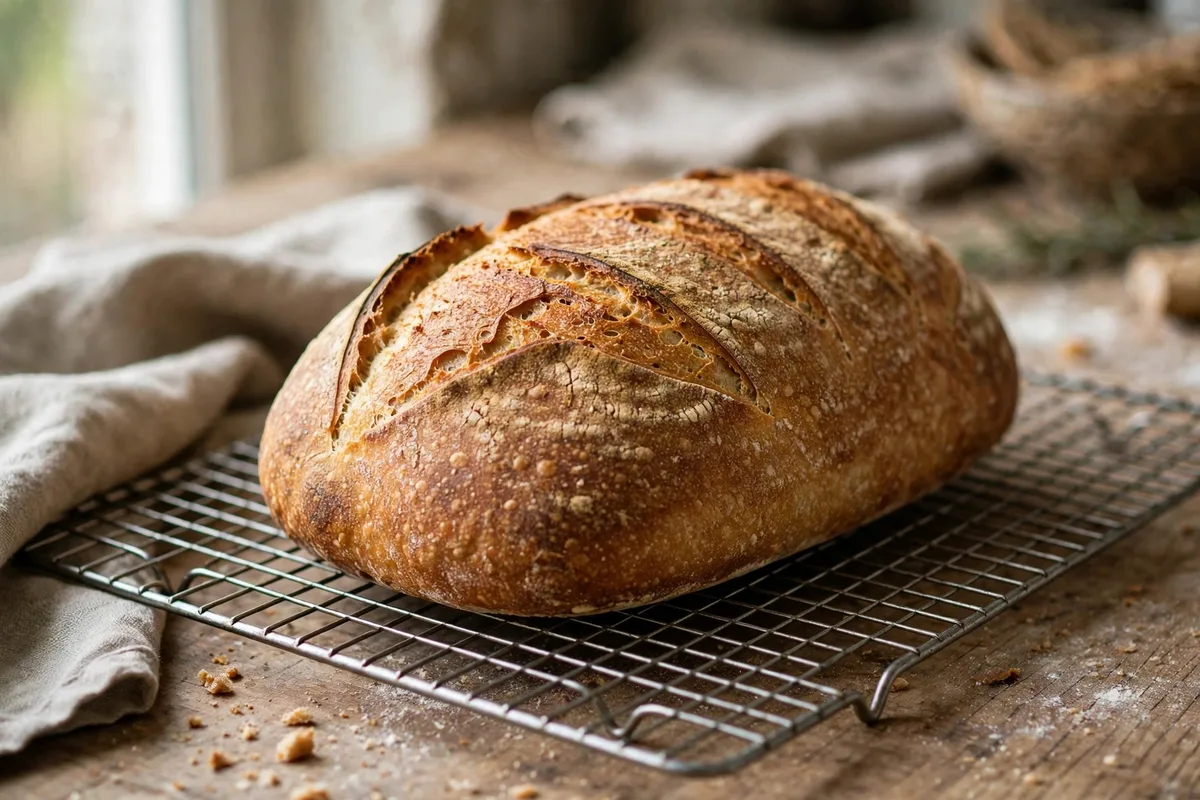
- Let the loaf cool completely. Wait at least 60 to 90 minutes for a standard boule to reach room temperature before you slice it, and 2 to 4 hours for larger loaves or heavy rye breads. Cutting into bread while it is still hot almost always leads to a gummy, compressed interior, because the steam inside the crumb has not settled yet. A fully cooled loaf slices cleanly; a warm loaf squashes under the knife.
- Pick a long serrated bread knife. Use a serrated bread knife 8 to 10 inches long, with deep scalloped teeth rather than tiny saw-like serrations — deeper teeth clear crumbs better as you cut. A straight-edged knife pushes down on the bread and compresses it, while a serrated edge saws through the crust without crushing the soft crumb underneath. A dull bread knife is also dangerous, because it forces you to press harder and the blade can slip.
- Steady the loaf on a flat base. Put the loaf on a cutting board with a damp towel underneath so the board cannot slide. If the loaf is round, slice a thin piece off the bottom first to make a flat base so it cannot roll — or flip a crusty round loaf on its side, so its longest side rests flat on the board and it cannot wobble while you cut.
- Hold the loaf with a claw grip. Hold the loaf steady with your non-cutting hand, fingertips curled in a claw position at least 2 inches from the blade. Do not press down on the loaf with that hand — pressing squeezes the crumb flat before the knife even touches it. Your guiding hand steadies, it does not squeeze.
- Make a guide cut with the knife tip. Place the heel of the knife on the far crust and pull back gently to score the surface where your slice will start. This small guide cut sets the thickness and keeps the blade from skidding across the crust. Hold the knife at a slight 45-degree angle to the crust so the teeth bite in instead of sliding.
- Saw with long, smooth strokes. Use long strokes that span the full length of the blade, back and forth, with the knife's own weight doing the work. Short, choppy hacks crush the crumb at one spot, while a long stroke spreads the cutting force along the whole slice. If you feel yourself pushing down, stop and reset your grip — the serrations do the cutting, not your arm.
- Keep the angle steady all the way down. Hold the same angle from the top crust to the bottom crust, and use a slightly firmer sawing motion as you reach the bottom crust so the slice exits cleanly instead of tearing. Check the thickness as you go — sandwich slices about 1/2 inch thick, rustic artisan slices about 1 inch — and use a bread slicing guide with slots at 0.25, 0.38, or 0.5 inches if you want every slice exactly the same.
What mistakes should I avoid?
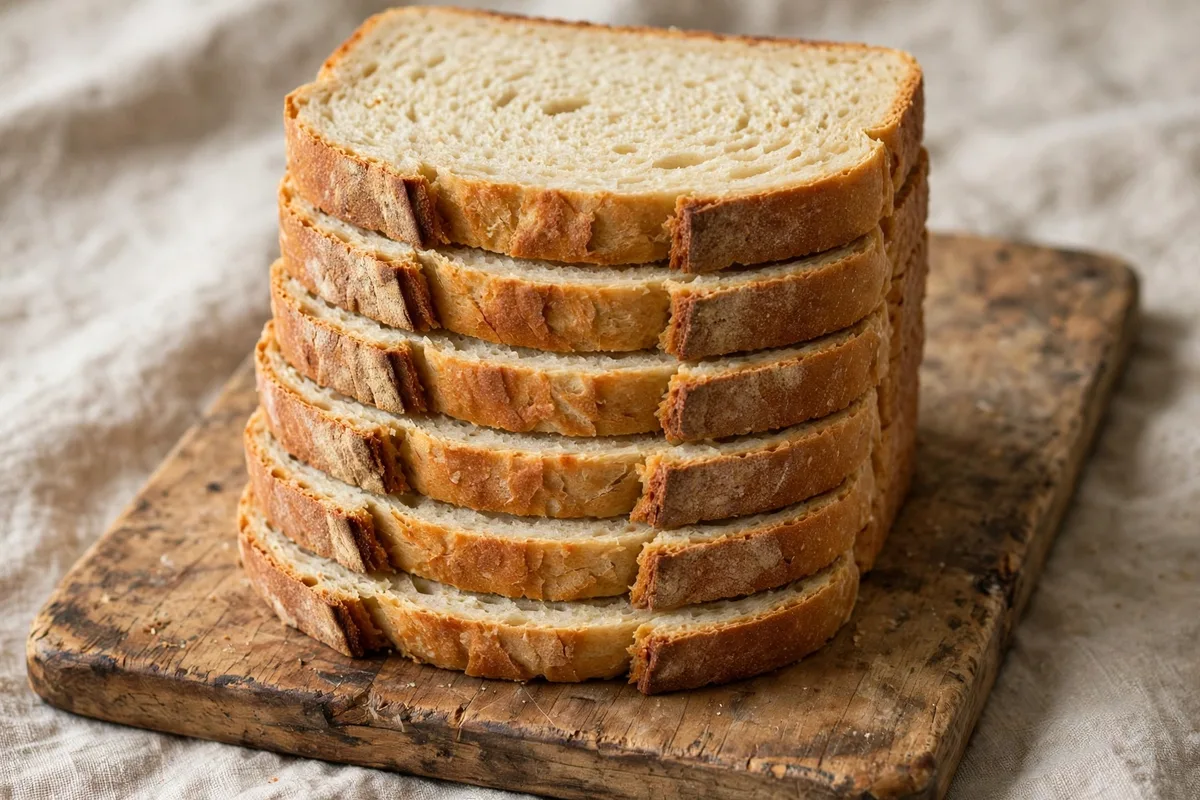
- Slicing a hot loaf. Hot bread has unset crumb and steam inside, so the knife tears it and the slices compress into a gummy layer. Fix: wait 60 to 90 minutes for a standard boule, and 2 to 4 hours for large or heavy rye loaves.
- Pressing down on the knife. Downward pressure collapses the airy crumb, which is the whole point of good bread. Fix: let the serrations saw with long strokes and the knife's own weight — if you are pushing, stop and reset.
- Using a dull knife. A dull bread knife cannot grip the crust, so you press harder, the blade skids, and the loaf crushes. Fix: keep the serrated edge clean and sharp, and brush crumbs off the blade as you work.
- Cutting with short choppy strokes. Short hacks concentrate the force on one spot and crush the crumb there, while the rest of the slice stays uneven. Fix: use long strokes that span the full length of the blade, heel to tip.
- Letting the loaf roll. A round loaf that rolls makes your hand squeeze it to hold it still, and squeezing squashes the crumb before the knife starts. Fix: slice a flat piece off the bottom first, or flip the loaf on its side so it rests flat on the board.
- Changing the angle halfway down. If the angle drifts as you cut, the slice starts thick at the top and thins out at the bottom. Fix: hold one steady angle from the top crust to the bottom, and use a ruler or a bread slicing guide until the motion feels natural.
What do I need, and what should I skip?
You need a serrated bread knife 8 to 10 inches long; a stable cutting board; a damp towel under the board; a fully cooled loaf; a ruler or bread slicing guide for even thickness (optional).
Skip slicing a hot loaf. Skip a dull knife. Skip pressing down on the loaf. Skip short choppy cuts. Skip holding the loaf with flat fingers near the blade. Skip a straight-edged knife on crusty bread.
How to slice bread evenly without crushing it for beginners — which tool wins?
| Tool | Best for | Watch out |
|---|---|---|
| Long serrated knife, 8–10 in | Crusty loaves, sourdough, everyday slicing | Needs deep scalloped teeth, not tiny ones |
| Electric carving knife | Very soft sandwich loaves, big batches | Overkill for one loaf |
| Bread slicing guide | Exactly even slices every time | Check it fits your loaf width and height |
| Straight chef's knife | Soft breads if truly sharp | Compresses crusty bread — wrong tool |
| Short serrated knife | Small rolls and baguettes | Too short for a wide boule |
What does the worked example look like?
Worked example: a 12-inch loaf, half-inch slices, and 24 even pieces. Say you have a loaf 12 inches long and you want sandwich slices 1/2 inch thick. Divide 12 by 0.5 and you get 24 slices — a 12-inch loaf at half-inch thickness gives two dozen even slices. Cut the same loaf in rustic 1-inch slices and you get 12 slices instead, because 12 divided by 1 is 12. A 10-inch loaf at 1/2 inch gives 20 slices, since 10 divided by 0.5 is 20. And the cooling time matters as much as the math: a standard boule needs 60 to 90 minutes to cool, so waiting 60 minutes is the minimum — slice at 30 minutes and the crumb is still setting, and the first slices will squash no matter how good your knife is. Bread slicing guide thickness homemade loaf guides agree on the same numbers: 1/2 inch for sandwiches, 1 inch for rustic slices.
When should I stop?
Stop slicing the moment the loaf starts to squash under the knife — it is either still warm inside or your blade is dull, and more force will only make it worse. Stop and let the loaf cool for another 30 minutes, or switch to a sharper serrated knife. And stop cutting if the slices are coming out wedge-shaped: your angle is drifting, so reset the loaf on its flat side, make a fresh guide cut, and start the slice again.
What is the quick checklist?
- Loaf cooled 60 to 90 minutes (2 to 4 hours for large rye).
- Serrated knife 8 to 10 inches, deep scalloped teeth.
- Board steadied with a damp towel.
- Loaf on a flat base — bottom sliced or flipped on its side.
- Claw grip on, fingers 2 inches from the blade.
- Long sawing strokes, no downward pressure.
What else helps on Kitchenlify?
- How to Store Bread for a Small Household Without a Bread Box
- How to Choose Baking Dish Size for Beginners
- How to Clean Toaster Oven
- How to Chop Vegetables Evenly for Beginners
- All guides
Frequently asked questions
How to slice bread evenly without crushing it for beginners?
Cool the loaf fully — 60 to 90 minutes for a standard boule — then use a long serrated knife 8 to 10 inches long and cut with long, smooth sawing strokes at a slight 45-degree angle, never pressing down. That is how to slice bread evenly without crushing it for beginners: cool loaf, long serrated blade, long strokes, no pressure.
How to slice bread evenly serrated knife tips?
Use a serrated knife 8 to 10 inches long with deep scalloped teeth, hold it at a 45-degree angle to the crust, and saw with long strokes that use the full length of the blade. How to slice bread evenly serrated knife tips also include this: brush crumbs off the blade as you work, and let the teeth do the cutting — if you are pushing down, the knife is dull or the loaf is still warm.
What is a bread slicing guide thickness homemade loaf?
A bread slicing guide is a frame with slots that holds the loaf and guides the knife, so every slice comes out the same thickness — common slot sizes are 0.25, 0.38, and 0.5 inches. A bread slicing guide thickness homemade loaf setup suits bakers who want exact slices: check the guide fits your loaf's width and height before you buy it, and remember it does not replace a sharp knife or a cooled loaf.
How long should bread cool before slicing?
At least 60 to 90 minutes for a standard boule, and 2 to 4 hours for larger loaves or heavy rye breads. Slicing sooner tears the crumb and squashes the slices, because the steam inside has not settled and the crumb has not set yet.
How thick should bread slices be?
About 1/2 inch thick for sandwiches, 1/2 to 3/4 inch for most uses, and about 1 inch for rustic artisan slices. Thin slices are 1/4 to 1/2 inch, thick slices are 1 to 2 inches — and a 12-inch loaf at half-inch thickness gives 24 slices.
Should I flip a round loaf on its side to slice it?
It helps with crusty round loaves: resting the loaf on its longest side stops it wobbling, so your hand does not squeeze it to hold it still. Slice a thin piece off the bottom first if you prefer to keep it upright — either way, the loaf needs a flat base so it cannot roll.
Can I slice bread with a regular chef's knife?
Only if it is truly sharp, and even then it suits soft breads better than crusty ones — a straight edge pushes down on the crust and compresses the crumb. A serrated bread knife is the right tool for crusty loaves, because its teeth saw through the crust without crushing what is underneath.
Why do my bread slices come out uneven?
Usually the angle drifts as you cut, so the slice starts thick at the top and thins out at the bottom, or short choppy strokes crush one spot. Fix: hold one steady angle from top crust to bottom crust, use long strokes that span the full blade, and use a ruler or a bread slicing guide until the motion feels natural.
What is the best knife for slicing homemade bread?
A long serrated bread knife, 8 to 10 inches, with deep scalloped teeth and a comfortable handle. Wide pointed serrations suit crusty artisan loaves, while tighter scallops suit soft sandwich loaves — and the blade should be long enough to span the full width of your loaf in one stroke.