How to Store Opened Canned Food in the Fridge Safely

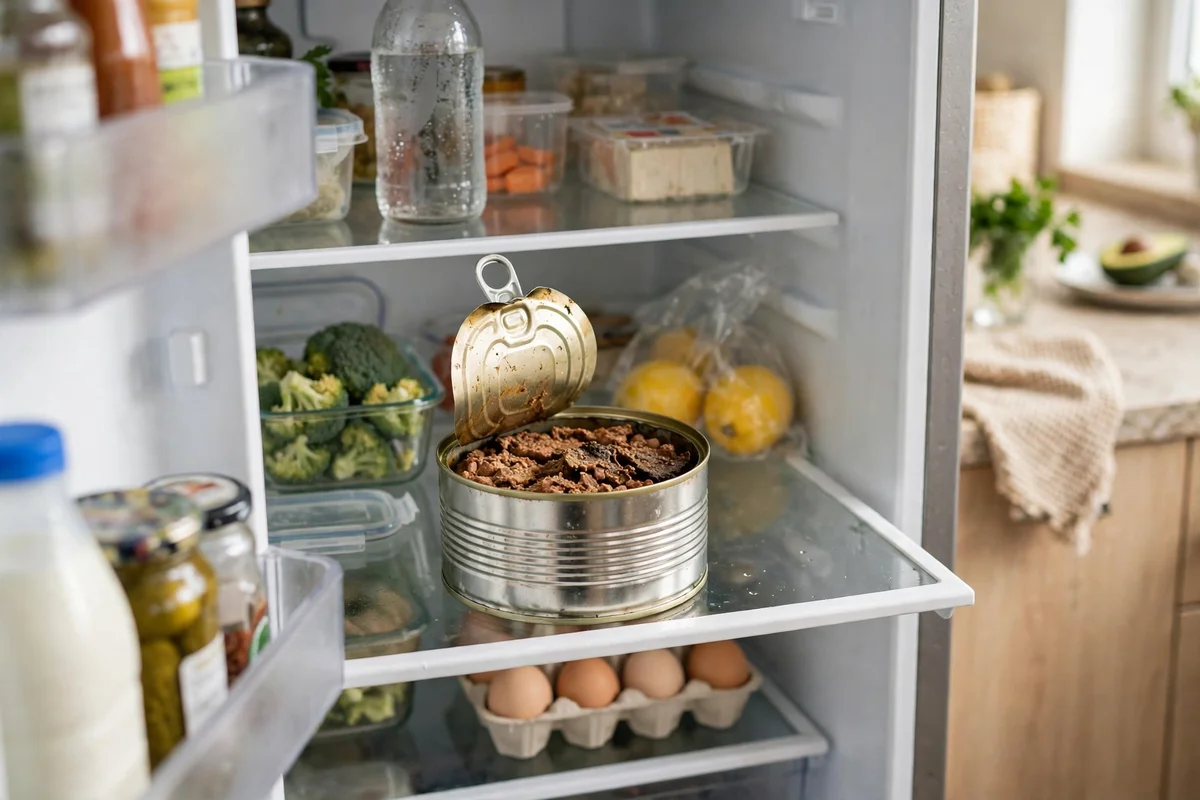
How to store opened canned food in the fridge safely starts with moving it out of the can right away: you open a can, use half, and then face the same question every time — can it stay in the can, how long will it last, and will it taste metallic tomorrow? Once a can is open, the food inside becomes perishable, just like fresh food, and a clean, covered glass or plastic container in the refrigerator protects it from spills, odors, and the metallic taste that open cans can give to acidic foods. With a date label and a by-type day count, you never have to guess.
How to store opened canned food in the fridge safely — what is the short answer?
Transfer opened canned food to a clean, covered glass or plastic container as soon as you open the can, label the container with the food name and the opening date, and refrigerate it promptly at or below 40 degrees Fahrenheit. Use most opened canned food within 3 to 4 days as a general guide, with shorter times for meat, seafood, and baby food, and longer times for pickles and olives. Do not leave opened canned food in the can in the refrigerator, do not leave it out for more than 2 hours, and throw it away if it smells off, looks moldy, or comes from a swollen, leaking, or badly damaged can.
Why should opened canned food leave the can?
An unopened can keeps food safe because it is sealed and sterile inside, but opening breaks that seal completely. Air, moisture, and microbes from the kitchen can now reach the food, and the refrigerator only slows their growth, it does not stop it. That is why opened canned food follows fresh-food rules, not pantry rules, even though it came from a can that lasted months on the shelf.
The can itself becomes part of the problem after opening. An open can has a sharp edge, spills easily, and cannot be sealed well, so food inside dries out, picks up fridge odors, and can be contaminated by drips from other foods. Acidic foods, such as tomatoes and pineapple, can also pick up a metallic taste from prolonged contact with an open can. A clean container with a tight lid solves all of those problems at once, without changing the food itself.
Time limits differ by food type because different foods spoil at different rates once opened. Meat, seafood, and poultry spoil fastest, vegetables last a little longer, and acidic tomato and fruit products and brined foods such as pickles and olives last longer still. A single number for every can would be misleading, which is why a by-type table, plus a date label, is the practical system for a real refrigerator.
What is a worked example you can follow?
Work through a real dinner example: you open a can of tomato sauce, a can of tuna, and a can of corn for one meal, and you use about half of each. Do not put three open cans back in the refrigerator. Instead, set out three clean containers before you start cooking: a small glass container for the tomato sauce, a small container for the tuna, and a container for the corn. As soon as each can is opened and the portion you need is taken out, spoon the rest into its container, press the lid on, and write the food name and today's date on tape or a label on each lid.
Now set the plan for each container. The tuna goes first, within 2 days, because fish spoils fastest. The corn follows within 3 days. The tomato sauce, being acidic, can last a few days longer, up to 5 to 7 days in a covered container, but in this example you plan to use it within 4 days for a pasta dish, well inside that window. Put the tuna at the front of the fridge shelf where you will see it first, and the tomato sauce behind it, so the order you see matches the order you should eat.
If a fourth can is opened the next day, repeat the same routine and do not mix new food into an old container to top it up. Mixing resets nothing: the older food still ages from its original opening date, and the new food takes on the older food age. Fresh container, fresh label, fresh date, every time, is what keeps the system honest and prevents a container that looks fine from quietly passing its safe window.
How do you do it, step by step?
- Check the can before you open it. Before opening, look for swelling, leaking, bad dents on seams, rust that breaks the surface, or a spurting liquid when opened. Do not taste food from a swollen, leaking, badly damaged, or visibly rusted can to decide whether it is safe. Throw such cans away, and wash your hands after handling them.
- Transfer the leftover food to a clean container right away. As soon as you have taken out what you need, spoon the rest into a clean glass or plastic container with a tight-fitting lid. Use a clean spoon, not the spoon you cooked with, and do not pour food back into the can or leave it sitting in the open can while you finish cooking. Transferring right away limits the time the food spends exposed to kitchen air.
- Label the container with the food name and opening date. Write the food name and the date you opened the can on the lid or on tape stuck to the container. Without a label, an unmarked container on day 4 looks exactly like an unmarked container on day 1, and guessing is how food gets kept too long. A label takes ten seconds and removes the guesswork for everyone in the household.
- Refrigerate promptly at or below 40 degrees Fahrenheit. Put the labeled container in the refrigerator promptly, and do not leave opened canned food out for more than 2 hours, or more than 1 hour if the room is above 90 degrees Fahrenheit. Keep the container on a main fridge shelf, not in the door where temperature varies, and keep it away from raw meat and poultry so juices cannot drip onto ready-to-eat food.
- Use the food within its by-type window, oldest first. Use each container within the by-type window in the table below, and always use the oldest opened container first. Plan meals around the shortest-window foods, such as tuna and meat, before the longer-window foods, such as tomato sauce and pickles. If you cannot use a container in time, freeze it promptly in a freezer container instead of letting it sit in the refrigerator past its window.
- Check before use and throw away anything doubtful. Before eating, check for off smell, mold, slimy texture, fizzing, or color change, and throw the food away if any sign appears, even if it is within its time window. Do not taste doubtful food to decide whether it is safe. When in doubt, throw it out, and wash the container before reuse.
- Do not mix new food into an old container. Never top up an older container with freshly opened food, because the older food still ages from its original date and the mixture takes on the older age. Use a fresh, clean container and a fresh label for every newly opened can, even if it is the same food type as a container already in the refrigerator.
What should you use, and what should you skip?
You need clean glass or plastic containers with tight-fitting lids in a few sizes, a clean spoon for transferring, and labels or tape plus a marker for dates. A refrigerator thermometer helps if your fridge does not show its temperature. Small containers are better than one large container, because they chill faster and let you use one portion without opening the whole supply.

Skip leaving opened food in the can, skip covering an open can loosely with foil as a long-term fix, and skip storing opened cans in the refrigerator door or on a warm shelf. Skip tasting doubtful food to decide if it is safe, skip mixing new food into old containers, and skip leaving opened canned food out on the counter while you finish a long cooking session. Skip reusing a container without washing it first.
How do the options compare?
Use this by-type table to set the use-by plan for each container, and follow package directions when they give a shorter time.
| Opened canned food type | Covered container in fridge | General guide | Notes |
|---|---|---|---|
| Baby food | Glass or plastic, lid on | 2 days | Use promptly, do not feed from the container and then store the rest |
| Meat, seafood, poultry, including tuna | Glass or plastic, lid on | 2 days for fish and meat, up to 3 days for some meats | Fish spoils fastest, plan it first |
| Vegetables, such as corn and beans | Glass or plastic, lid on | 3 days | Drain if the recipe allows, keep covered |
| Tomato sauce and fruits | Glass, lid on preferred | 5 to 7 days | Acidic foods pick up metallic taste in an open can |
| Soups and stews from a can | Glass or plastic, lid on | 3 to 4 days | Treat like cooked leftovers once opened |
| Pickles and olives in brine | Glass or plastic, lid on, kept in brine | 1 to 2 months | Keep submerged in brine, keep covered |
| Condensed milk or sweetened canned milk | Glass or plastic, lid on | A few days, follow package directions | Use promptly, do not leave in the can |
What are the 6 mistakes to avoid?
- Leaving opened food in the can in the refrigerator. An open can spills, dries food out, picks up odors, and can give acidic foods a metallic taste. Fix: transfer to a clean, covered container right away, every time.
- Forgetting to label the container. Without a date, you cannot tell day 1 from day 4, and food gets kept too long by guesswork. Fix: label every container with the food name and opening date before it goes in the refrigerator.
- Leaving opened food out for hours. Food left out for more than 2 hours, or 1 hour above 90 degrees Fahrenheit, ages fast, and refrigerating it later does not reset the clock. Fix: transfer and refrigerate promptly, and discard food left out too long.
- Mixing new food into an old container. Topping up makes the mixture as old as the oldest food in it, while looking fresh on top. Fix: use a fresh container and a fresh label for every newly opened can.
- Applying one day count to every can. Fish, meat, vegetables, and tomato products spoil at different rates, so one number misleads in both directions. Fix: use the by-type table and plan meals around the shortest-window foods first.
- Tasting doubtful food to decide if it is safe. Spoiled food can be unsafe even when a small taste seems fine, and tasting is not a safety test. Fix: check smell, appearance, and texture, and throw away anything doubtful without tasting it.
When should you stop, and when should you throw food away?
Stop adjusting when every opened can goes straight into a clean, labeled, covered container, refrigerated promptly on a main shelf, and used within its by-type window with the oldest container first. Throw away food from swollen, leaking, or badly damaged cans without tasting it, throw away any opened canned food that smells off, shows mold, fizzes, or feels slimy, and throw away any container that has passed its window, even if it looks fine.
Safety note: This is general food-storage guidance. Keep opened canned food refrigerated at or below 40 degrees Fahrenheit, use it within its by-type window, and throw away doubtful food without tasting it. For cooked leftovers made from canned ingredients, follow leftover rules as well; see the leftovers guide for dish-by-dish fridge times.
Related on Kitchenlify
- Food Storage
- How Long Do Leftovers Last in the Fridge by Food Type
- How to Choose Food Storage Container Size for Your Shelf
- All guides
Pickles and olives in brine keep longer than most opened cans — if you make your own, the Pickling Fermentation Brine Calculator works out the brine for your jar.
Frequently asked questions
How do you store opened canned food in the refrigerator safely?
Transfer it right away to a clean, covered glass or plastic container, label the container with the food name and opening date, and refrigerate it promptly at or below 40 degrees Fahrenheit. Use it within its by-type window, and do not leave it in the open can.
Can you leave opened canned food in the can in the refrigerator?
No, not as a routine. An open can spills easily, cannot be sealed well, dries food out, picks up fridge odors, and can give acidic foods a metallic taste. Transfer the food to a clean container with a tight lid instead.
How long does opened canned food last in the refrigerator?
It depends on type: meat, seafood, and baby food about 2 days, vegetables about 3 days, tomato sauce and fruits about 5 to 7 days, and pickles and olives in brine about 1 to 2 months, in a covered container. Most other opened canned foods fit a general 3 to 4 day guide.
How long can opened canned food sit out?
Do not leave opened canned food out for more than 2 hours, or more than 1 hour if the room is above 90 degrees Fahrenheit. Refrigerating it afterward does not reset the clock, so discard food that has sat out too long.
Should opened canned food go in glass or plastic?
Either clean glass or plastic with a tight-fitting lid works well. Glass is a good choice for acidic foods such as tomato sauce, since it does not pick up odors or tastes, while sturdy plastic is lighter and fine for most other canned foods.
Do you need to label opened canned food?
Yes. Label every container with the food name and opening date, because an unmarked container on day 4 looks the same as one on day 1. A label removes guesswork and helps everyone in the household use the oldest container first.
Can you freeze opened canned food?
Yes, if you cannot use it within its refrigerator window. Move it promptly to a freezer container, label it with the food name and date, and use it for cooking after thawing in the refrigerator. Do not freeze food in the can.
What should you do with a swollen or leaking can?
Throw it away without tasting the food inside. Do not try to save food from a swollen, leaking, badly dented, or rusted can, and wash your hands after handling it.
Can you mix new canned food into an old container?
No. Never top up an older container with freshly opened food, because the mixture is as old as the oldest food in it. Use a fresh, clean container and a fresh label for every newly opened can.
Can I freeze opened canned food?
Yes. Move the food to a freezer-safe container, leave about half an inch of headspace for expansion, label it with the food name and date, and use it within 2 to 3 months for best quality. Thaw it in the fridge overnight, and do not refreeze it after thawing.
What about dented cans?
A can with a small dent on the side is usually fine, but do not use a can with a deep dent on a seam, a bulging lid, a leak, or rust, and do not use a can that spurts or smells bad when opened. When in doubt, throw it away, because a damaged can can let bacteria in, and no saving is worth the risk.