Why Does My Pan Not Heat Evenly
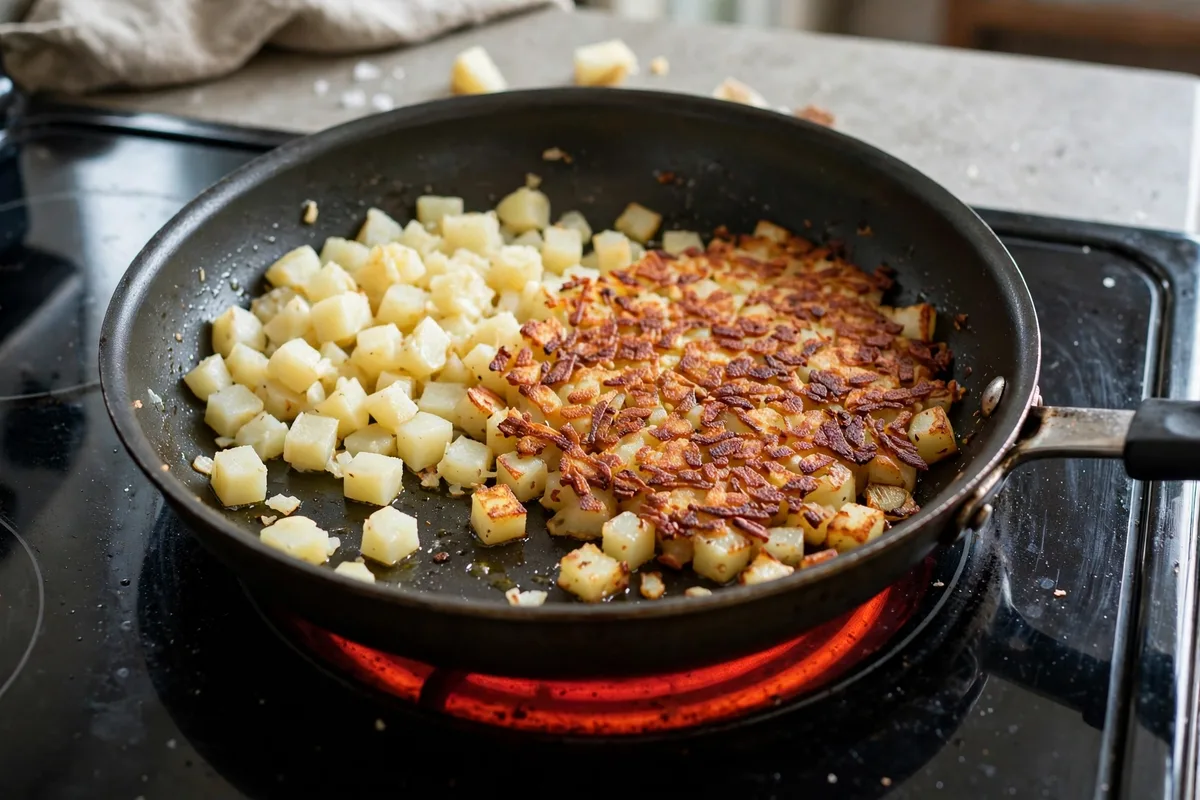
Why does my pan not heat evenly? In most kitchens the cause is one of three things: the pan base is warped and only touches the burner in spots, the pan is the wrong size for the burner, or the pan is too thin to spread the heat. A cast iron pan heated to 375°F in the center can sit at 250 to 275°F at the edges — a gap of 100 to 125 degrees — so the middle pancake browns while the edge pancake stays pale. The fix is a test, not a guess: check the base, match the burner, and give the pan time to warm up.
why does my pan not heat evenly — what is the short answer?
Start with the pan, not the stove. Lay a ruler across the base: if you can see daylight under the middle, the pan is warped and will always heat unevenly. Next, match the pan to the burner — the base should sit within about 1 inch of the burner size, so a 10-inch pan belongs on a large burner, not a small one. Then preheat slowly on medium heat for 2 to 3 minutes before food goes in, because thin pans and cast iron both need time to even out. If a known flat, heavy pan heats evenly on the same burner, the burner is fine and the old pan is the problem. That is why does my pan not heat evenly on electric stove in one line: on an electric stove the pan only gets heat where it touches, so contact is everything.
How do I do it step by step?

- Do the flour test first. Sprinkle a thin, even layer of flour over the dry pan, put it on medium heat, and watch. If the flour browns in the center first and stays pale at the edges, the heat is uneven — the pattern shows you exactly where the hot spots are. The flour test costs nothing and tells you more in 2 minutes than guessing ever will.
- Test the base with a ruler. Lay a metal ruler or the edge of a level across the pan bottom, front to back and side to side. If you can see daylight under the middle, the pan is warped and will always leave a cool center. A pan that rocks on a flat counter fails the same test — it will not sit flat on any burner.
- Match the pan to the burner. Coil burners are commonly 6-inch and 8-inch, and the pan base should be within about 1 inch of the coil size. A pan much wider than the burner leaves its edges cool, while a pan much smaller than the burner overheats at the rim. Small pan, small burner; big pan, big burner — that is the whole rule.
- Preheat slowly on medium. Put the empty pan on medium heat for 2 to 3 minutes before food goes in, so the metal has time to even out. Cast iron needs longer: 3 to 5 minutes on medium, and about 10 minutes for a full even warm-up. High heat does not speed this up — it makes the hot spots hotter and the cool spots stay cool.
- Swap the pan to test the burner. Put a known flat, heavy pan on the same burner and repeat the flour test. If it heats evenly, the burner is fine and your pan is the problem. If the good pan also heats unevenly, the burner is the problem — check the coil and the socket next.
- Check the coil and the socket. On a coil stove, watch the coil as it glows: if one section stays dark while the rest glows red, the coil is worn or bent. A coil that does not sit flat in its socket heats in patches. Coil elements wear out after 5 to 10 years, and a bent coil can sometimes be eased back into place — but a cracked or sparking coil needs replacing, not bending.
- Stir, move, or change the pan. While you decide, stir food often so every piece spends time in the hot spots, and use a heat diffuser between the burner and a thin pan to spread the heat. If the pan fails the ruler test, replace it: a heavy flat-bottomed pan with a thick base of 2.5 to 4 mm spreads heat far better than a thin pan under 2 mm, which heats unevenly and warps under high heat.
What mistakes should I avoid?

- Heating on high to force even heat. High heat makes hot spots worse, not better: the hot areas scorch while the cool areas stay cool. Fix: preheat on medium and give the pan time — slow heat spreads, fast heat concentrates.
- Using a pan much wider than the burner. A wide pan on a small burner heats only in the middle, and the edges never catch up. Fix: match the pan base to the burner within about 1 inch.
- Putting food in a cold pan. Cold food on a cold pan sticks and cooks unevenly, because the metal has not expanded evenly yet. Fix: preheat the pan for 2 to 3 minutes, then add oil, then add food.
- Cleaning a hot pan with cold water. Thermal shock warps the base: hot metal hit with cold water contracts unevenly and the pan ends up rocking. Fix: let the pan cool fully, then wash it with warm water.
- Assuming cast iron heats evenly. Cast iron holds heat well but spreads it slowly, so it is famous for hot spots until it warms up fully. Fix: preheat cast iron for 3 to 5 minutes on medium, and about 10 minutes for a full even warm-up.
- Ignoring a coil that glows unevenly. A coil with a dark section is worn or bent, and no pan will heat evenly on it. Fix: check the coil and the socket, and replace a coil that glows in patches or is cracked.
What do I need, and what should I skip?
You need a metal ruler or a level; a flat, heavy pan to compare with; a heat diffuser for thin pans; flour for the flour test.
Skip heating an empty pan on high to test it. Skip buying a new stove before testing the pan. Skip a thin pan under 2 mm thick as your main pan. Skip cleaning a hot pan with cold water.
Pan heats unevenly causes and fixes — what do I check first?
| Cause | Sign | Fix |
|---|---|---|
| Warped pan base | Food browns in the center only | Replace the pan; a flat base is the fix |
| Pan too big for the burner | Edges stay cool, center scorches | Use a smaller pan or a larger burner |
| Pan too small for the burner | Sides overheat, food burns at the rim | Move to a smaller burner |
| Thin metal | Hot spots over the coil rings | Preheat slowly; use a diffuser or thicker pan |
| Worn or bent coil | One part of the coil stays dark | Straighten gently or replace the coil |
What does the worked example look like?
Worked example: a cast iron pan, 375°F in the center, 250°F at the edge. In a measured test, a cast iron pan heated to 375°F in the center stayed at 250 to 275°F at the edges. That is a gap of 100 degrees at the warm edge and 125 degrees at the cool edge: 375 minus 275 is 100, and 375 minus 250 is 125. So the middle of your pan can be hot enough to sear while the edge is still too cool to brown — and no amount of turning the knob up fixes it, because the gap comes from the metal, not the heat setting. The fix is time: preheat the pan slowly on medium for 3 to 5 minutes, and about 10 minutes for a full even warm-up, so the heat has time to spread to the edges before food goes in.
When should I stop?
Stop using a pan that rocks on a flat counter — it will never heat evenly, and it can also damage a glass cooktop. Stop cooking on a coil that sparks, smells of burning plastic, or has a cracked element: switch it off and get it checked. And stop turning the heat up when food cooks unevenly — more heat only makes the hot spots hotter; the fix is a flat pan, the right burner, and a slow preheat.
What is the quick checklist?
- Ruler test: no daylight under the middle of the base.
- Pan base within about 1 inch of the burner size.
- Preheat slowly on medium for 2 to 3 minutes.
- Cast iron: 3 to 5 minutes, about 10 for full even heat.
- Swap in a flat heavy pan to test the burner.
- Replace a warped pan — it will not fix itself.
What else helps on Kitchenlify?
- Best Cookware Set for Electric Stove Beginners Under $75
- How to Stop Stainless Steel Pan From Warping
- How to Cook on Electric Coil Stove
- Carbon Steel vs Cast Iron Pan for Beginners
- All guides
Frequently asked questions
Why does my pan not heat evenly on electric stove?
Because an electric stove only heats where the pan touches it. If the pan base is warped, too thin, or the wrong size for the burner, some spots touch and some do not — and the spots that touch get hot while the rest stay cool. That is why does my pan not heat evenly on electric stove in one sentence: contact is everything, so test the base with a ruler, match the pan to the burner, and preheat slowly on medium.
Why does my pan not heat evenly on a gas stove?
Gas is more forgiving, because the flame wraps around a slightly warped base — but a pan much wider than the flame still leaves its edges cool, and a thin pan still makes hot spots over the flame ring. The same checks apply: test the base, match the pan to the burner, and preheat on medium.
Pan heats unevenly causes and fixes — what is the most common cause?
A warped pan base. It is the most common cause because it is also the most invisible: a pan can look flat and still rock on a counter. The ruler test finds it in seconds — lay a ruler across the bottom, and if you can see daylight under the middle, the pan is warped. That is pan heats unevenly causes and fixes by the numbers: warped base first, wrong burner size second, thin metal third.
How do I know if my pan is warped?
Lay a metal ruler across the bottom, front to back and side to side, and look for daylight under the middle. Or set the pan on a flat counter and press one edge — if it rocks, it is warped. A warped pan also pools oil to one side when you tilt it.
Does a thicker pan heat more evenly?
Yes. A thicker base acts like a heat buffer: it absorbs heat and spreads it across the whole bottom instead of passing hot spots straight through. A good heat-spreading base is 2.5 to 4 mm thick, while thin pans under 2 mm heat unevenly and warp under high heat.
Why does my cast iron pan have hot spots?
Cast iron is a poor conductor of heat, so it warms slowly and unevenly — the center over the burner gets hot first and the edges lag behind. It holds heat wonderfully once it is hot, which is why it seems even. The fix is a slow preheat: 3 to 5 minutes on medium, about 10 minutes for a full even warm-up.
Can a heat diffuser fix uneven heating?
It helps, especially for thin pans on a coil or gas burner. A diffuser is a metal plate that sits between the burner and the pan and spreads the heat out before it reaches the pan. It is a good temporary fix, but it does not fix a warped pan — a warped pan still needs replacing.
Why does food burn in the center and stay raw at the edges?
Because the center of the pan is much hotter than the edges — in one measured test, a cast iron pan at 375°F in the center was only 250 to 275°F at the edges. The center sears while the edge barely cooks. Preheat slowly, match the pan to the burner, and stir food so every piece moves through the hot spots.
When should I replace a pan that heats unevenly?
Replace it when it fails the ruler test and rocks on a flat counter, when the base is visibly bulged, or when food burns in the same spot every time even after a slow preheat. A warped pan does not heal, and it wastes food and heat on every meal.