How to Store Ceramic Baking Dishes

How to store ceramic baking dishes comes down to three habits: keep them clean and fully dry, put something soft between stacked dishes, and never pile heavy dishes on top. Lids go in a separate spot, and dishes you use often belong where you can reach them without lifting a stack. Stored this way, a glazed dish stays chip-free for years — most damage happens in the cupboard, not in the oven.
The short answer: how to store ceramic baking dishes
Wash and dry the dish fully, then stack it with a towel, paper towel, or plate protector between each dish. Store lids separately — never clamped on top of a stack. Keep the dishes you use most at waist height, and the big ones low, so you never lift a heavy dish over your head. Never store a dish wet, and never store a heavy pan on top of a ceramic dish.
Stacking and nesting without chipping
Most ceramic baking dish sets are made to nest: each dish sits inside the next, so a set of three or four takes up little more space than one dish. Stacking works, but only with a soft layer between dishes. Glaze on glaze is the problem — two hard glazed surfaces touching will chip each other when you lift one out. Put a folded tea towel, a paper towel, or a felt plate protector between each dish, and the stack stays safe.
Stack in size order, largest at the bottom, and do not build the stack higher than three or four dishes. A tall stack is heavy, hard to lift, and the bottom dish takes all the weight. If a dish has handles, turn each dish so the handles do not all line up on the same side — alternating them keeps the stack level.
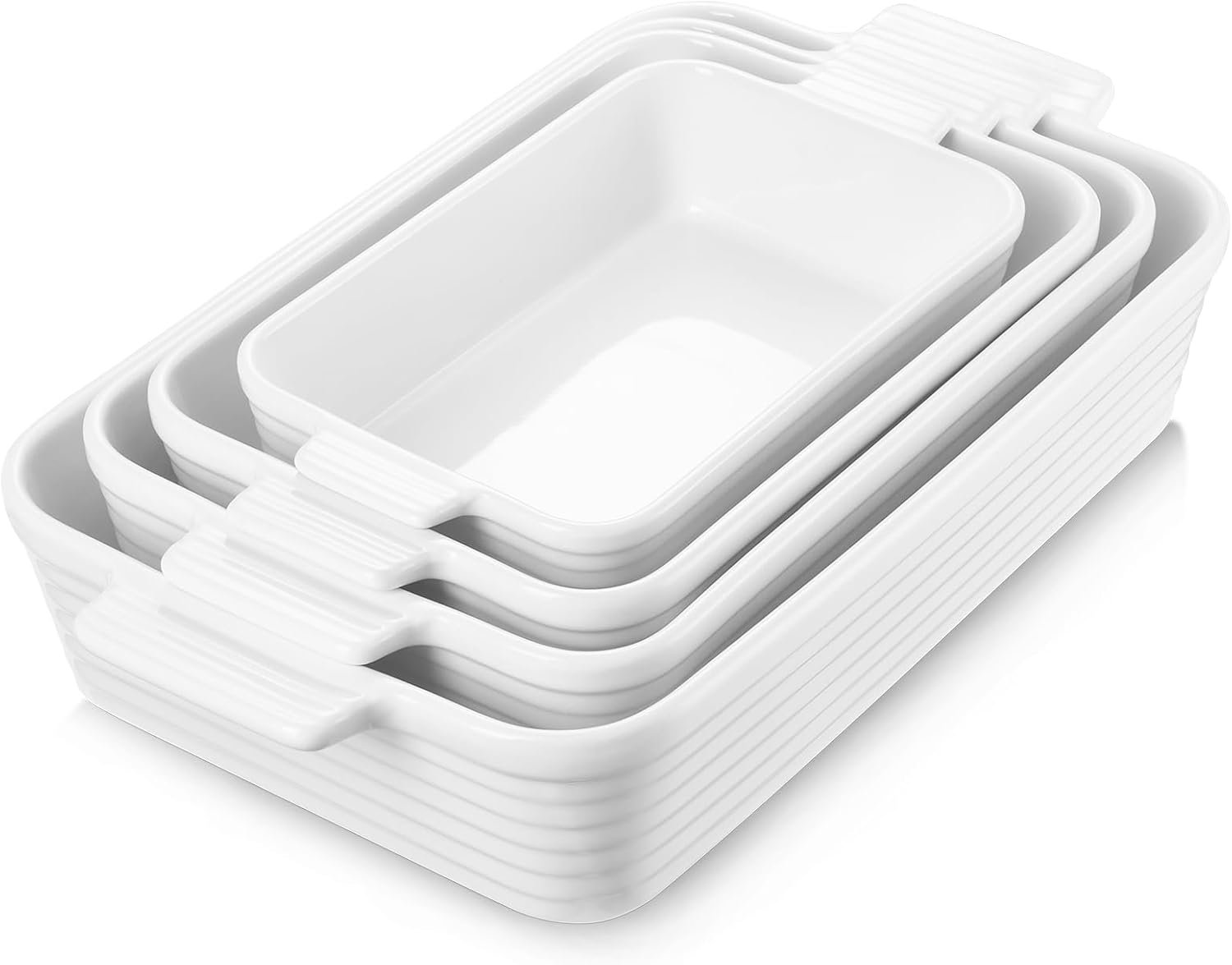
Check the set you buy for nesting before you rely on it: the LE TAUCI set, the DOWAN set of three, and the Jassceram set all nest, and their listings say so. If a set does not nest, store the dishes side by side instead of stacking them.
Storing lids separately
Lids need their own spot. PP lids, like the ones on the Artena sets, are light plastic — store them flat in a drawer or standing upright in a file organiser, never under a stack of dishes, or they will warp. Ceramic lids are heavy, so store them flat on a shelf with a soft layer underneath, or upside down on their dish with a towel between the lid and the dish rim. Never store a ceramic lid leaning against a wall: one knock and it slides off and chips.
Do not store a dish with its lid clamped on for months. A sealed dish traps moisture, and moisture leads to smells and marks. Leave the lid off for long-term storage, and put it on only when the dish holds food in the fridge.
Small-kitchen storage: vertical and out of the way
In a small kitchen, the best storage is vertical. Stand baking dishes upright on their sides in a deep drawer or a vertical divider, like books on a shelf — you can pull one out without lifting the rest. A plate rack or a baking-sheet organiser works the same way. If the dishes live in a cabinet, keep the ones you use weekly at the front and waist height, and the rarely used ones higher up.
Do not store baking dishes in the oven. It feels like free space, but the first time someone preheats the oven without checking, the dish inside heats empty — and an empty dish in a hot oven is a cracking risk. Keep the oven empty and the dishes in the cupboard. Our general guide on how to store pots and pans small kitchen stacking ideas covers the same ideas for pans, and our guide on how to store dinnerware in small cabinets without chipping covers dinnerware.
Storing with food inside: fridge storage
A ceramic dish is a good fridge container. Put the lid on — or cover the dish with foil or a plate if it has no lid — and the leftovers will keep in the fridge as they would in any container. How long they keep depends on the food, not the dish: cooked casseroles and lasagna are usually fine for three to four days in the fridge. Let the dish cool on a trivet before it goes in the fridge, and never put a hot dish straight into a cold fridge shelf.
Remember the fridge-to-oven rule when the leftovers come back out: let the dish come to room temperature before it goes back in the oven, or reheat the food in a different container. A cold dish in a hot oven is the fastest way to crack one. Our guide on how to prevent ceramic baking dish from cracking covers the temperature rules in full.
Storing rarely used and seasonal dishes
Dishes you use once or twice a year — the big roaster for holidays, the deep dish for Christmas baking — deserve a wrap before they go away. Wash and dry them fully, wrap each one in a tea towel or bubble wrap, and store them low in a cupboard or on a high shelf where they will not be knocked. Write the size on a strip of tape on the outside of the wrap, so you do not have to unwrap three dishes to find the one you want.
What not to do when storing ceramic baking dishes
- Do not stack heavy dishes on top. A cast iron pan or a heavy pot on top of a ceramic dish will chip the rim or crack it.
- Do not store dishes wet. A damp dish in a closed cupboard picks up smells and leaves marks on the shelf.
- Do not wedge dishes tightly. A dish forced into a gap that is too small will chip when you pull it out.
- Do not store metal utensils inside the dish. A metal spoon rattling around in a stored dish scratches the glaze.
- Do not store lids on top of a stack. A lid perched on a stack slides off the first time the cupboard door is bumped.
Storing ramekins and small dishes
Small dishes and ramekins are the easiest to store and the easiest to chip, because they get tossed in a drawer with everything else. Keep them in a single layer in a shallow drawer or a small box, nested if they nest, with a paper towel between them. Do not pile ramekins in a heap — the top ones slide and chip the rims of the ones below.

Clean before storing is the rule that ties it all together: a dish put away with food residue on it will stain and smell, and the residue can glue two dishes together in a stack. Our guide on how to clean a ceramic baking dish covers the wash routine. If you are buying a large set and storage is tight, our guide to the best large ceramic baking dish set notes which sets nest and which do not.
Related on Kitchenlify
- How to Clean a Ceramic Baking Dish
- How to Prevent Ceramic Baking Dish from Cracking
- How to Use a Ceramic Baking Dish for Beginners
- How to Store Dinnerware in Small Cabinets Without Chipping
- How to Store Pots and Pans Small Kitchen Stacking Ideas
- Best Large Ceramic Baking Dish Set
Frequently asked questions
Can I stack ceramic baking dishes?
Yes, if you put something soft between them — a folded tea towel, a paper towel, or a felt plate protector. Glaze on glaze chips when you lift a dish out. Stack largest at the bottom, no more than three or four high, and alternate the handles so the stack stays level.
What should I put between stacked ceramic dishes?
A folded tea towel, a paper towel, or a felt plate protector. Any soft layer stops the glazed surfaces touching and chipping each other. Do not use newspaper — the ink can transfer onto a light glaze.
Can I store food in a ceramic baking dish in the fridge?
Yes. Put the lid on, or cover the dish with foil or a plate, and the leftovers keep as they would in any container — cooked casseroles and lasagna are usually fine for three to four days. Let the dish cool before it goes in the fridge, and let it come to room temperature before it goes back in the oven.
How do I store ceramic baking dish lids?
Separately from the dishes. Store light PP lids flat in a drawer or upright in a file organiser so they do not warp. Store heavy ceramic lids flat on a shelf with a soft layer underneath. Do not leave a lid clamped on a dish for months — it traps moisture and smells.
How do I store baking dishes in a small kitchen?
Stand them upright on their sides in a deep drawer or a vertical divider, like books on a shelf. You can pull one out without lifting the rest. Keep the dishes you use weekly at waist height and the rarely used ones higher up.
Can I store a ceramic baking dish in the oven?
It is not a good idea. The first time someone preheats the oven without checking, the dish inside heats empty, and an empty dish in a hot oven is a cracking risk. Keep the oven empty and the dishes in the cupboard.
Should I store dishes with the lid on or off?
Off for long-term storage, so air can circulate and moisture does not build up. Put the lid on only when the dish holds food in the fridge.
How do I store a ceramic baking dish I rarely use?
Wash and dry it fully, wrap it in a tea towel or bubble wrap, and store it low in a cupboard or on a high shelf where it will not be knocked. Label the wrap with the size so you can find it without unwrapping everything.